
MANNA (Hebrew mân; Septuagint mâvva). — The food with which the Hebrew people were nourished for 40 years in the desert (Ex. 16:35). The Bible presents manna as something minute, grain-like, thin as frost, resembling white coriander seed and tasting like wafers with honey (Ex. 16:14-31). "The people went about and gathered it, and ground it in mills or beat it in mortars, and boiled it in pots, and made cakes of it" (Num. 11:8). It fell at night and was gathered every morning, except on the Sabbath, for which it was gathered the day before. Manna gathered beyond what was needed spoiled, became wormy, except for that kept in the ark as a testimony to the Lord’s goodness (Ex. 16:19-36).
In the Sinai Peninsula there exists a manna produced by certain insects, especially of the species Trabutina mannipara and Najacoccus serpentinus, which secrete it in a manner similar to bees. The plant on which they deposit the manna is classified as Tamarix mannifera and is called by the Arabs tarfa'. This manna roughly corresponds to the qualities described in the Bible, though with various differences: it is produced only at a certain time of year, from late May to July, in very limited quantities, does not spoil when stored, though it is carried off by certain ants. If, for these reasons, this Sinai manna is to be identified with the biblical manna, one must admit a special intervention by the Lord, particularly regarding the manner in which it was given to the Israelites. Advocates of this identification note that manna was not the sole food of the Hebrews and that there may have been a greater production in ancient times; moreover, the disappearance of the manna may be described in the Bible simply because it appeared to do so. This theory seems supported by ancient authorities such as Flavius Josephus (Antiquitates Judaicae, III, 1, 6), Origen (Selecta in Numeros: PG 12, 576), and St. Ambrose (Epistolae, 64: PL 16, 1271).
At present, the term "manna" refers to the juice obtained from incisions made in the bark of the *Fraxinus ornus*: it consists of about 50% mannitol (a hexahydric alcohol) and the rest of various sugars, water, and small quantities of other substances; it is used as a mild purgative and for extracting mannitol, which has the same application.
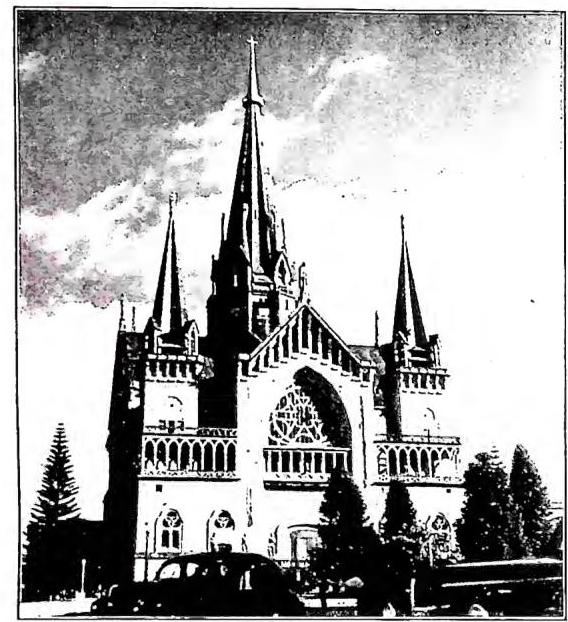
MANZALES, DIOCESE OF — Façade of the cathedral of Manizales.
MANZALES OF OCESI
1973
MANNA — MANNING HENRY EDWARD
pp. 45-89; B. Ubach, *L’Exode-El Levitico* (*La Biblia ilustrada*, 1, 11), Montserrat 1934, pp. 92-100. For the (replaced) identification cf. A. De Guglielmo, *What was the Manna?* in *Catholic Biblical Quarterly*, 2 (1940), pp. 112-29. Bellarmino Bagatti
ARCHAEOLOGY. — Only once in the catacomb frescoes (in S. Lorenzo on the Via Tiburtina) is the scene of the falling of manna in the desert represented.
Four Israelites, two men and two women, gather in the fold of their travelling cloak (penula) the manna descending from heaven (4th century, reproduced in Wilpert, *Pitture*, pl. 242, 2). The same episode was later painted in a basilica in Spain (Saragossa), illustrated by a distich of the poet Prudentius (*Dittocchaeon*, no. 11). G. B. De Rossi (*Altri monumenti di sacre vergini nell’Agro Verno*, in *Bullettino di archeologia cristiana*, 1863, pp. 76 and 80) and R. Garrucci (*Storia dell’arte cristiana*, II, Prato 1873-80, p. 64) held that manna was a symbol of the Eucharist; Wilpert preferred to interpret it in the sense expressed in a pseudo-Cyprianic prayer: “Protect, O Lord, the soul of the departed as you delivered the Israelites from death by hunger in the desert.”