
**MARK THE EVANGELIST, Saint.**
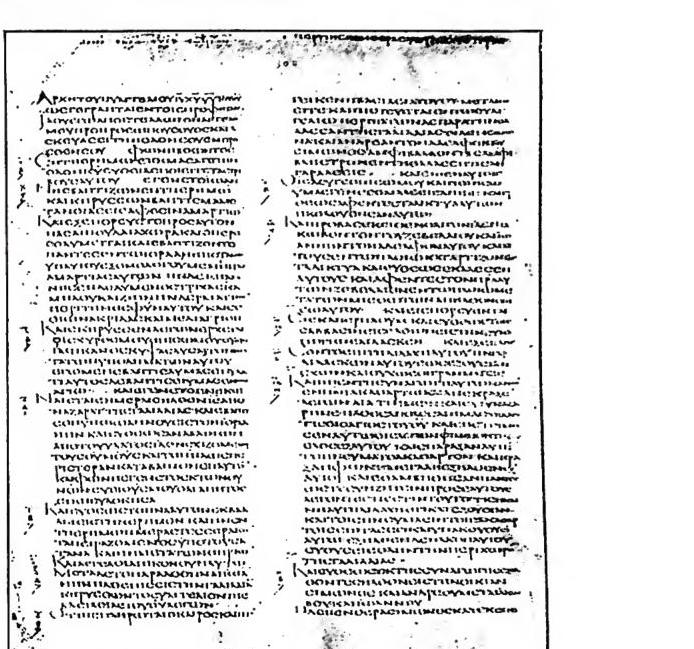
Inizio del Vangelo di s. M. (1, 1-30), cod. Alessandro (A., ca. sec. v.) - Londra, British Museum.
Some seek in this passage the Cenacle (v.). Many identify M. with the young man (vesuviosos) who, on the night of the Passion, followed Jesus and, to escape arrest, left his linen cloth in the hands of the guards. This episode, recorded only in the second Gospel (Mk. 14, 51 sq.), seems precisely a hallmark of the author. The opinion of Adamantius (PG 11, 1721) and Epiphanius (ibid. 41, 280.90), who see in M. one of the 72 disciples of Jesus, is unlikely. Papias, reporting the words of John, declares that M. was not a disciple of Jesus. The Muratorian Fragment, stating that "neither" did Luke see the Lord in the flesh ("Dominum tamen nec ipse vidit in carne"), seems to exclude that M. was a disciple of Jesus; it does admit, however, that he witnessed some facts or discourses of Jesus, beginning with the following words regarding M.: "[ali]quibus tamen interfuit et ita posuit." If M. is identified with the young man mentioned above (Mk. 14, 52 sq.), this seems plausible.
From St. Paul (Col. 4, 10) it is known that M. was a cousin of Barnabas (v.), who brought him to Antioch around 44 and associated him as an assistant (ὑπερέστει) in the journey undertaken with Paul to the island of Cyprus. Since M., Perge (v.), withdrew from the company to return to Jerusalem (Acts 13, 13), St. Paul did not wish to take him on the second missionary journey (49-50). For this reason, Barnabas separated from Paul and went to Cyprus with his cousin M. (ibid. 15, 39).
Probably M., like Barnabas, was of Levitical descent. The Monarchian Prologue even states that M. "acted as a priest in Israel, being a Levite according to the flesh" and that, after his conversion, he would have amputated his thumb to render himself unfit for the priesthood ("ut sacerdotio reprobus haberetur"). In this sense, the title of χολοβοδάκτυλος ("with a maimed thumb") attributed to him by the Philosophumena (7, 30, 1: PG 16, 3334) and by an ancient anti-Marcionite prologue preserved in some codices of the Vulgate should be explained; according to others, that epithet would simply mean that M. had short fingers, disproportionate to the rest of his body.
---
b) **First Part (1, 14-9, 50).** - M. selects episodes from Jesus' ministry in Galilee and its surroundings. The beginning unfolds in Capernaum and nearby (1, 14-3, 6); the ministry continues near the Sea of Galilee (3, 7-7, 23); then in the regions of Tyre and Sidon, at Bethsaida. Numerous miracles are narrated, especially exorcisms.
c) **Second Part (10-13).** - M. recounts episodes from the journey to Jerusalem and in that city: the journey, departing from Galilee, rich in teachings on marriage, virginity, wealth, etc. (10, 1-52); the triumphal entry into the city and the subsequent instructions (11-12, 44).
d) **Third Part (14-16, 8).** - M. describes the supper at Bethany, the Last Supper, with the institution of the Eucharist (14, 1-31); the prayer in the garden with the episode of the young man (M.?), who escapes the guards (14, 32-52); the trial, the Crucifixion, the Resurrection (14, 53-16, 1-8).
e) **Appendix (16, 9-20).** - Appearances to Mary Magdalene, to two disciples, to the Eleven. Jesus sends the Apostles into the whole world and is taken up into heaven (16, 9-20).
---
2. **Purpose.** - It seems explicitly indicated by the opening words: "The beginning of the good news (gospel) of Jesus Christ, the Son of God" (1, 1). The author wishes to recount the first phase of this good news, presenting Jesus Christ as "the Son of God." These last words are missing in some manuscripts (S 28) and in some versions (Armenian and Georgian), but they are found in the better ones. They should therefore be considered genuine.
Unlike Matthew, who, writing for the Jews, sought to prove his thesis especially by citing prophecies, the second Evangelist proves it simply by narrating the miracles that show Jesus' power over nature, diseases, death, and particularly over demons (the latter being a characteristic of M.).
3. **Literary Nature.** - Although it has an underlying apologetic intent, the second Gospel does not have the character of an apology like the first. It is a narrative of historical facts, with a lively and picturesque style. It reports the impressions of an eyewitness who is attentive to minute details. While narrating the prodigious deeds that highlight the divinity of the Master, it does not neglect the elements that reveal His humanity: Jesus is saddened, angry (3, 5; 10, 14), sleeps (4, 38), asks who touched Him (5, 30), experiences fear and weariness, and submits to the will of the Father (14, 34-36).
The Greek language shows both Semitic and Latin influences. If, as tradition affirms, this Gospel is the work of a Jew writing in Greek a book intended for Romans, these influences find a natural explanation. Among the Latinisms are noted: δημάχιον (6, 37); κήνος (12, 14); λεγώ (5, 9, 15); στενοχόλια (6, 27); φαγέλλος (7, 15); πραστόφιον (15, 16); κωδόπης (quodrans, 12, 42); etc.
4. **Origin.**
a) **External Evidence.** - Since the second Gospel is almost entirely contained in the other two Synoptics (v.), it is difficult to say whether a quotation, made in summary, is drawn from this or from some other Gospel.
The earliest witness explicitly attributing the second Gospel to M. is St. Papias (v.), bishop of Hierapolis. Here is what he wrote (around 125): "The presbyter (John) used to say this also: Mark, having become the interpreter of Peter, wrote down carefully, though not in order, all that he remembered of the things said and done by the Lord. For he had neither heard the Lord nor followed Him, but later, as I said, followed Peter, who would adapt his teachings to the needs of the moment, not with the intention of making a compilation (σύναξιν) of the Lord’s words. Thus Mark in no way sinned in writing some things just as he remembered them. His only concern was not to omit anything he had heard or to add anything false" (in Eusebius, *Hist. eccl.*, III, 39, 15).
From this testimony, which through Papias goes back to John, the disciple of the Lord, it is learned that he justified the lack of "compilation of the words" in the second Gospel by the fact that M. reported the discourses of Peter, made in this way, according to the needs. It seems that this referred to the logical arrangement of the discourses: such arrangement is noted in Matthew, lacking in M. The Muratorian Fragment has reached us mutilated at the beginning, precisely where it spoke of the first two Gospels. Since it states that the third Gospel is that of Luke and the fourth that of John, it is obvious that in the lost lines it also spoke of M.
St. Irenaeus, after saying that "Matthew, among the Hebrews in their own language, also published a writing of the Gospel, while Peter and Paul were evangelizing and founding the Church in Rome," continues: "After the departure (ἐξοδόν) of these, Mark, disciple and interpreter of Peter, also handed down to us in writing the things preached by Peter" (*Adv. haer.*, III, 1, 1: PG 7, 844). The bishop of Lyon certainly attributes the second Gospel to M., whom he mentions several times.
The ancient Latin prologue, which attributes to M. the epithet of colobodactilus, states that he, "having become the interpreter of Peter, after his departure wrote this (Gospel) in the regions of Italy" (cf. D. de Bruyne, in *Revue bénédictine*, 40 [1928], pp. 193-204).
Clement of Alexandria informs us that M. composed the Gospel in Rome, at the request of Peter’s listeners. The Apostle would have allowed it (in Eusebius, *Hist. eccl.*, VI, 14, 6); elsewhere he says that the request would have come from certain Caesarean knights to whom Peter was preaching in Rome (*Hypotyposes* on 1 Pt. 5, 13).
Other explicit testimonies are found in the works of
(not. Susunini)
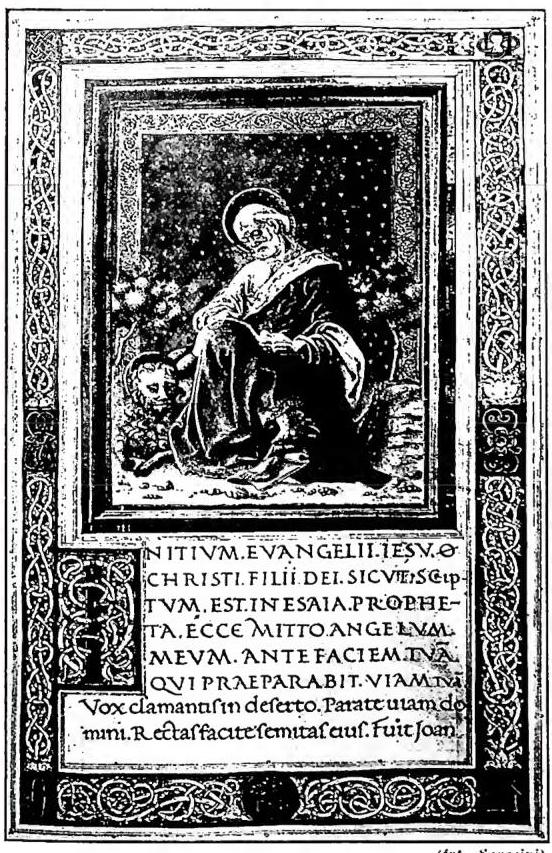
**MARK THE EVANGELIST, saint** – St. Mark in the act of writing the Gospel. Miniature from the Ferrarese school (15th century). Incipit of the Gospel of St. Mark – Vatican Library, cod. Urb. lat. 10.
Origene (*In Mt.* tom I: PG 13, 829), Tertullian (*Adv. Marc.*, 4, 2: PL 2, 363), Eusebius (*Hist. eccl.*, III, 24, 5-6), Jerome (*De viris ill.*, 8: PL 23, 643) substantially agree with the tradition represented by Irenaeus.
b) Internal arguments. – The Gospel itself contains several confirmations of the testimonies of tradition. This tradition states that Mark wrote down the preaching of Peter. Now, Peter’s preaching extended from the Baptism of John to the Ascension of Jesus (Acts 1:21; cf. 10:37-42) and emphasized the miracles performed by Christ (ibid., 2:22; 1:38). These are precisely the characteristics of the second Gospel.
Moreover, the Gospel of Mark is the most precious source for a biography of St. Peter (*P. De Ambroggi, S. Pietro Apostolo*, Rovigo 1931, cap. 1). The picturesque manner in which even minute details of events are described shows that the Evangelist had at his disposal a first-rate witness, attentive and impressionable, such as Peter was; and the language of Mark, imbued with Semitic and Latin colors, confirms what historical tradition attests regarding his origin.
5. Place, destination, date
Tradition is unanimous regarding the place of composition: Rome (Clement of Alexandria; Eusebius, *Hist. eccl.*, II, 15; Ephrem, *Diat.*, 286; Jerome, *De viris ill.*, 8).The destination is clearly indicated by Clement of Alexandria: for the Romans evangelized by Peter. That these were indeed the recipients is evident not only from the “Petrine” character of the second Gospel but also from the Latinisms scattered throughout II. For pagans, who knew nothing of the prophecies, it was unnecessary to insist on these; Peter and Mark preferred to emphasize the theme of miracles, especially those concerning demons, in which the defeat of idols could be seen.
The date of composition of Mark’s Gospel is not easily determined. It can be stated with certainty that tradition, morally unanimous (the majority of Greek manuscripts, St. Irenaeus, Origen, Epiphanius, Jerome), agrees in asserting that Mark is the “second” Evangelist in chronological order.
Internal evidence allows us to conclude that the Gospel was written before the destruction of Jerusalem (A.D. 70). There is no mention of this event as having occurred in the eschatological discourse (Mk 13); indeed, from the conclusion of this discourse (vv. 14-23), the opposite appears to be the case.
Tradition agrees in supposing that the second Gospel was composed before the death of St. Peter. Since a comparison of the Synoptic Gospels (v.) shows that Luke depends on Mark, it is obvious to conclude that Mark wrote before A.D. 63. In that year, Paul’s two-year imprisonment in Rome ended, and Luke abruptly concluded and published the Acts, which were composed after the third Gospel. The text of St. Irenaeus, cited above, remains to be explained, from which one might deduce that Mark published his Gospel after the death of Peter and Paul. In Greek, it reads as follows: *Μετὰ δὲ τὴν τούτων ἐξοδόν, Μάρκος ὁ μαθητὴς καὶ ἑρμηνευτὴς Πέτρου, καὶ αὐτὸς τὰ ὑπὸ Πέτρου κηρυσσόμενα ἐγγράφως ἡμῖν περὶ ἀδόκητον*. There is no need to insist on the fact that ἐξοδός properly means “departure” to conclude that Mark wrote, not after their death, but after the departure of the two Apostles from Palestine. Nor is the expedient of some who (with Kaulen) would like to read in Irenaeus *μετὰ δὲ τὴν τούτων ἐκδοσιν* (= after the “publication” of this, i.e., of the Gospel of Matthew) instead of *μετὰ δὲ τὴν τούτων ἐξοδόν* (= after their “departure”) of any avail. It should be noted, however, that Irenaeus does not say that Mark wrote the Gospel “after the death of Peter and Paul,” but that he “transmitted to us in writing” (ἐγγράφως ἡμῖν περὶ ἀδόκητον) the things preached by Peter: this expression seems to refer to the definitive publication, with the appendix (16:9-20), which appears to have been added later.
Irenaeus, moreover, was not greatly concerned with chronological existence; his testimony cannot therefore be decisive for a late date of the second Gospel.
Taking into account the various elements, the majority of Catholic scholars, and many non-Catholics such as J. Wellhausen and A. Harnack, hold that the Gospel of Mark was composed between the second apostolic mission of Paul (concluded in 53) and before the publication of the Gospel of Luke (62-63). Within this decade, after the Matthew (v.), the probable date of origin of the second Gospel may be sought.
6. Integrity
Some Catholics maintain that Mark did not write the entire book attributed to him but only a part (Protomark), which was later completed by subsequent redactors.It may be replied that the witnesses of tradition know of no other Gospel of Mark besides the one that has come down to us. All the papyri (including P45, from the first half of the 3rd century), all the codices, and all the versions attest that the Gospel of Mark has always been identical to that which has come down to the present day.
The only question that may be raised concerns the genuineness (not the canonicity) of the appendix (16:9-20), which is missing in Codex Vaticanus B (though it leaves an unusual blank space after 16:8), Codex Sinaiticus (S), the Syro-Sinaitic, Aethiopic, Old Georgian, and Old Armenian versions. It was also absent from several codices cited by Eusebius and St. Jerome. It was present, however, in Codices C, Δ, 33, W, O, A, etc., in the Old Latin (except the Bobbio codex k), the Vulgate, the other Syriac versions, the Bohairic, the Gothic, and in many citations of the Fathers (Irenaeus, Justin, Tatian, Epiphanius, Chrysostom, etc.). Some secondary manuscripts have a shorter ending (V [044] 099, 012); or an extended ending with the insertion of a logion after V. 13 (the Freer Logion of Codex W). The internal arguments against genuineness reduce to the disruption of the logical connection between V. 8 and V. 9, and to stylistic differences where Lucan reminiscences appear. There are, however, indications in favor of genuineness. Indeed, it is unlikely that the Evangelist would have wished to conclude the work with a γάρ without narrating anything of the appearances and the Ascension, especially since the theme of Peter’s preaching extended to this very point (Acts 1:21). It might be supposed that Mark, for a reason unknown to us, had left the Gospel suspended after V. 8. Some copyist copied and circulated it thus incomplete. Meanwhile, the Gospel of Luke was published, and Mark himself (or someone acting on his behalf) punctuated (or had punctuated) the last chapter of that Gospel to complete his own. Thus would be explained the stylistic differences and the absence of the appendix in some manuscripts, an absence which others supplied in different ways.
7. Directives of the Pontifical Biblical Commission
On June 26, 1912, the Pontifical Biblical Commission published nine responses concerning the author, the time of composition, and the historical truth of the Gospels according to Mark and Luke (*AAS*, 4 [1912], pp. 463-65; *Denz-U*, 2155-63). With regard to Mark, these responses indicate the arguments of tradition that compel us to affirm with certainty that Mark, disciple and interpreter of Peter, is the author of the Gospel attributed to him (ad I); it is declared that the reasons adduced against the genuineness of Mk 16:9-20 do not justify excluding its canonicity or inspiration or proving that Mark is not its author (ad II). Mark’s is the second Gospel in chronological order (ad V); its date cannot be postponed to after the destruction of Jerusalem; Mark wrote according to the preaching of Peter (ad VIII), and it merits historical credibility (ad IX).**
II. ICONOGRAPHY
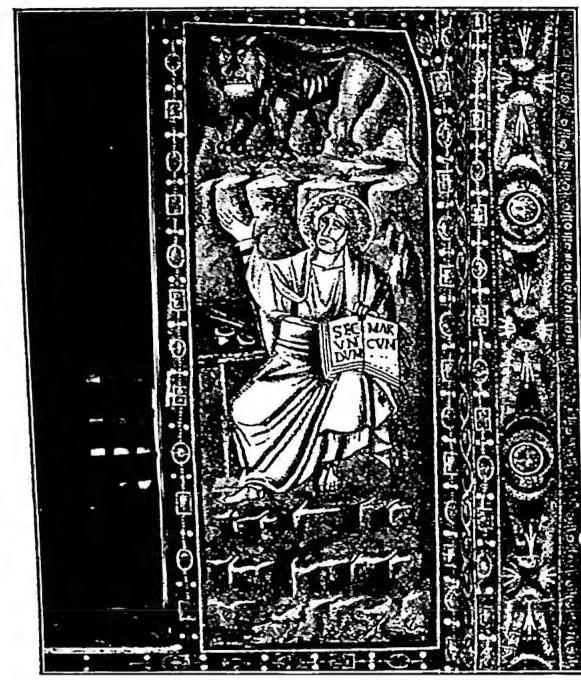
St. Mark the Evangelist is depicted as an old man, often bald, holding the book of his Gospel, with a lion, his evangelist’s symbol, beside him; sometimes he is shown seated on a throne, as is typically represented in a 15th-century sculpture on the main entrance door of the church dedicated to him in Rome, where there is also a canvas by Melozzo da Forlì depicting him in the act of writing his Gospel. Nevertheless, in the 10th-century Byzantine museum above the main portal of St. Mark’s Basilica in Venice, he appears to the left of Christ without his distinctive attributes, though an inscription indicates his name. In a slightly later museum in the chapel of St. Isidore in the same basilica, he already appears holding his Gospel.The iconography of St. Mark developed most richly in Venetian art; St. Mark’s Basilica in Venice contains numerous examples of different types of his depictions, up to a Renaissance museum executed in 1545 from a cartoon by Titian. The basilica also contains, in the chapel of St. Zeno, 13th-century museums with a cycle of scenes taken from the legend of the Evangelist.
There are countless depictions of St. Mark in Venetian Renaissance art. Notable for late 15th-century art is the triptych by Bartolomeo Vivarini in the Frari Church in Venice, where St. Mark is enthroned in the center,
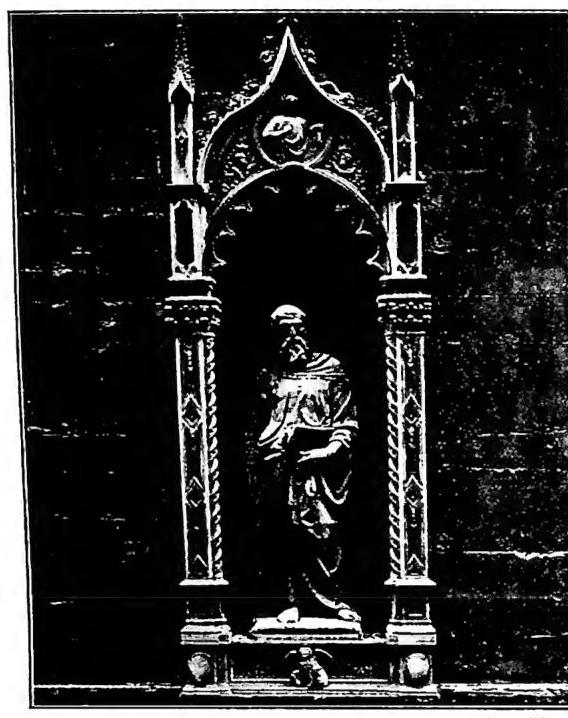
*St. Mark the Evangelist* — Statue of St. Mark, work by Donatello (1413) — Florence, Orsanmichele Church.
and for the early 16th century, Titian’s altarpiece in the Church of Santa Maria della Salute with St. Mark enthroned and four saints.
Great Venetian masters have also often illustrated both the legend of the Saint, his miracles, and the history of the translation of his body from Alexandria to Venice. Among these are: *The Preaching of the Saint in Alexandria*, painted by Gentile Bellini, now in the Brera Gallery in Milan, and the canvases by Tintoretto at the Accademia in Venice depicting the translation of the body of St. Mark and one of his miracles, as well as at the Brera Gallery, *The Discovery of the Body of St. Mark*.