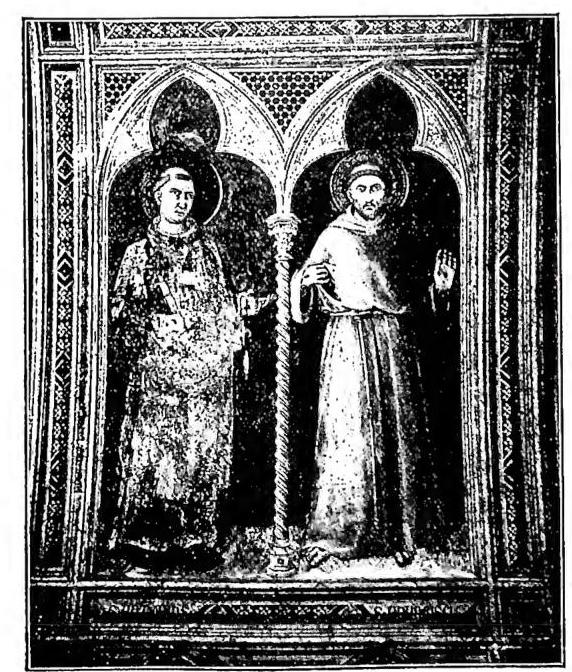
MARTINI, SIMONE (SIMONE di MARTINO). — Painter, born in Siena, according to Vasari in 1284, died in Avignon in 1344. Alongside Pietro and Ambrogio Lorenzetti, he is one of the leading exponents of the Sienese school, which, initiated at the end of the 13th century by Duccio di Boninsegna, developed—albeit with mutual influences—alongside the Florentine Giottesque school throughout the 14th century and much of the 15th. Martini completed the transition from Romanesque-Byzantine to Gothic art already begun by Duccio and created a pictorial current that, while flourishing in France through the work of Martini himself and his followers in Avignon, contributed significantly to the formation of a new phase of painting beyond the Alps (known as the "International Gothic") that matured in the early decades of the 15th century and soon spread to Italy as well.
Martini’s documented activity begins with the fresco of the *Maestà* (Siena, Palazzo Pubblico). Painted in 1315, when the artist was, according to Vasari’s likely chronology, already thirty years old, it reveals a fully formed artist capable of competing with the living Duccio di Boninsegna, author of the *Maestà* in the Siena Cathedral. Though nothing is known of Martini’s early works, those that remain clearly indicate that he was trained in Duccio’s circle, from whom he derived not only the compositional scheme and certain typological elements of the *Maestà*, but above all the value of certain plastic notations that Duccio had absorbed from his classical-Neohellenic education. Modern attributions inspired by this conviction refer to Martini’s early period: works that either imply, as in the Boston triptych (*Crucifixion between St. Nicholas and St. Gregory*, Museum of Fine Arts), collaboration with the master (to whom the central panel would belong), or clearly show his influence, such as the *Redeemer* in the Vatican, that in Naples (Pinacoteca), and the *Maestà* of Massa Marittima (Cathedral), generally attributed to Segna di Bonaventura, a direct follower of Duccio.
From Duccio, Simone Martini also drew the impulse to observe the modes of French Gothic painting, which had entered Italy through the works of miniaturists and glass painters, and he learned its elegant linearism, which helped him overcome the last Byzantine survivals still present in the master. Martini’s art oscillates, gently restless, between accents of more rigorous plasticity and more persuasive spatiality, and delicate inlays of surface colorism. The former are evident in the *Maestà*, more constructed and articulated than Duccio’s analogous composition; the latter appear in the altarpiece of *St. Louis Crowning Robert of Anjou* (*Stories of the Saint* in the predella, signed: Naples, Pinacoteca, formerly in S. Lorenzo Maggiore), datable to 1317 and probably executed in Naples, where the Angevin king granted the painter a pension that same year, and where Martini certainly had the opportunity to deepen his knowledge of French Gothic culture, widely diffused at that court. These traits reappear a few years later, in 1321, in the partial repainting that Simone executed of the central figures of the *Maestà* (the Madonna with the Child and the two nearest saints), which display a much more subdued pictorial consistency than the rest of the composition. In this central period of his activity, however, Simone tends more often to fuse the motifs of his vision into an elegant compromise between linear rhythm and delicate relief, as seen in the altarpiece of the Museum of Pisa (signed and documented to the year 1320; formerly in S. Caterina), that of Orvieto (Museo Civico, signed and marked by a barely legible date, formerly in S. Domenico), and finally that of Boston (Gardner Collection, formerly in Orvieto, Muzzocchi Collection): works for which the likelihood of intervention by his brother-in-law Lippo Memmi is debated.
A special mention must be made of the fresco of *Guidoriccio da Fogliano* (1328, Siena, Palazzo Pubblico): in it, the chromatic effect of the whites and blacks, standing out in the horse’s caparison and the knight’s garments, conveys an unbounded sense of space.
For more than a century, scholarship has unanimously recognized Simone as the author of the frescoes depicting the *Stories of St. Martin* in the chapel dedicated to this saint in the lower church of S. Francesco in Assisi. Referable to the period between the Pisa altarpiece and the *Guidoriccio* fresco, these frescoes vigorously reassert the plastic elements of the first version of the *Maestà*, accompanied by equally effective perspectival insights and a lively study of inhabited interiors and costumes, which in Sienese art must have heralded a broadly diffused current of taste, to which the two Lorenzetti were among the first to adhere. To the frescoes of the St. Martin Chapel must be added: two frescoes with figures of saints, functioning as altarpieces, also in the lower church; the stained-glass windows of the St. Louis Chapel, whose design most likely belongs to Simone himself, while those of the St. Martin Chapel are generally attributed to his workshop; the triptych of Altomonte (Calabria), recently published by Paccagnini, in which, however, only the central panel depicting *St. Ladislaus* can be plausibly attributed to Simone; and finally the *paliotto* of the Blessed Agostino Novello (Siena, S. Agostino), restored to its original appearance by a fortunate restoration, which, after a turbulent history of attribution, is now, at least in part (the figure of the Saint), unanimously recognized as Martini’s work. Another peak is reached with the *Annunciation* in the Uffizi (dated 1333 and bearing, in addition to Simone’s name, that of Lippo Memmi, to whom the lateral figures of St. Ansanus and Judith must be attributed; formerly in the Duomo), prefiguring with immediate clarity the works of the final period in the acute breaks of the edge of the mantle, which rhythmically accompany, accentuating it, the sensitive withdrawal of the Virgin at the angelic announcement.
In 1339, Simone left for Avignon, where he befriended Petrarch, for whom he painted a portrait of Laura, and where he likely remained until his death. The stylistic evolution, foreshadowed by the Uffizi altarpiece, now crystallizes into a search for dramatic movement and pathetic expression, for which the influence of Pietro Lorenzetti has often been invoked. Though the frescoes in the atrium of the Avignon cathedral have disappeared or are reduced to almost illegible fragments (the *St. George Delivering the Princess* is lost, though a description remains; the *Madonna and Angels* and the *Blessing Christ* are in ruins), such traits appear in the dramatic scenes of the *Stefaneschi Polyptych* (now dispersed among the museums of Antwerp, Berlin, and the Louvre, signed), in the lively little figures of the Virgilian *Allegory* in the Ambrosian Codex, in the brooding *Holy Family* of the Liverpool Museum (signed and dated 1342), and in works generally assigned to this period, such as the *Annunciata Stroganoff* (Leningrad, formerly in Rome) and the *St. John the Evangelist* by Bekoff (Paris): the dreamy enchantment has broken to give way to a lively and agitated reality, and at times brooding and convulsive.
In addition to those already cited, the following paintings are attributed to Simone:
Altenburg, Lindenau Museum: *St John the Baptist*;
Avignon, Calvet Museum: two fragments of a fresco that may have depicted an *Annunciation*;
Brussels, Stocklet Collection: *Blessed Christ*, *Annunciate Madonna*;
Cambridge, Fitzwilliam Museum: *St Michael between St Ambrose and St Augustine* (triptych);
Cambridge (USA), Fogg Museum: *Crucifixion*;
New York, Metropolitan Museum (formerly in Rome, Sterbini Collection): *St John the Evangelist*;
Orvieto, Museo dell’Opera del Duomo (formerly in S. Francesco): *Madonna and Child* (central panel of a polyptych, to which, according to Toesca, the Liechtenstein panel with *St Catherine* should be joined);
Rome, Palazzo Venezia Museum: *Madonna and Child* (mostly attributed to Lippo Memmi);
S. Casciano, church of the Misericordia: *Crucifixion*;
Florence, Settignano, Berenson Collection: *St Lucy*, *St Madonna* (panels of a polyptych);
Siena, Pinacoteca, no. 36: *Crucifixion*;
Siena, Palazzo Pubblico: painted *Crucifix*;
Venice, private collection: *Redeemer* (cusp of a polyptych);
Vienna, Liechtenstein Collection: *St Catherine*.
— See pl. XVII.