
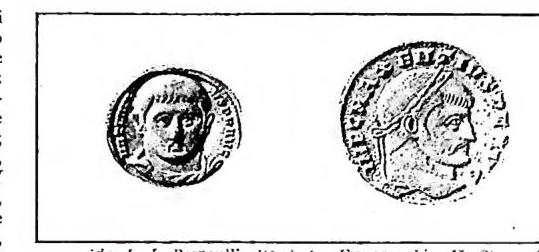
He himself marched against M., but with no better fortune than Severus, who before the well-prepared defences of Rome had to retreat.
But when Diocletian, at the Conference of Carnuntum in 308, forced Maximian to abdicate once more and had Galerius and Licinius acknowledged as Augusti and Maximinus Daia and Constantine as Caesars, M. was no more than a rebel, a usurper to be eliminated. Punishment seemed destined to come from the treacherous moods of the African troops, who acclaimed L. Domitius Alexander emperor, vicar of the praetorian prefect of Africa, and also from the enterprise of Constantine, who from Gaul brought his own troops into Spain. The loss of Africa and Spain meant famine for Rome, and M. had to decide to act. He sent his own prefect Ceionius Rufus Volusianus to Africa, who had no difficulty in defeating and killing Domitius Alexander. But foolish was the merciless ferocity with which Africa was punished. Meanwhile Galerius had died (311), and relations between M. and Constantine had grown ever worse. It is not very clear what the occasion was for the opening of hostilities; it would seem, however, that the initiative came from Constantine, who rapidly descended into Italy and easily defeated both the small detachments of Maxentian forces in Piedmont and a more powerful nucleus of troops at Verona. M., who had never shown any military qualities, had thought to shut himself up within Rome, then well-walled and abundantly supplied with provisions. But at the last moment he left the city and went to meet Constantine. The clash took place at Saxa Rubra on the Via Flaminia, a short distance from the Milvian Bridge, despite the strenuous defence of the Praetorians, who thus ended their stormy existence with honour. M. was defeated, and in his flight he drowned in the Tiber.
All pagan and Christian tradition is hostile to M. and depicts him as a wretched and despicable tyrant. This is what usually happens to the vanquished, but the standard which Constantine gave to his soldiers made the military action be considered a great Christian victory over M., certainly pagan to the end but not a persecutor.
It is not possible to recognise great qualities in M., yet the solemn sense of grandeur that he gave to his constructions in Rome, the most efficient care he took for the great roads of Italy and Africa, and the affection he showed for his own son Romulus, who died young, make him appear in some respects at least better than his reputation.