
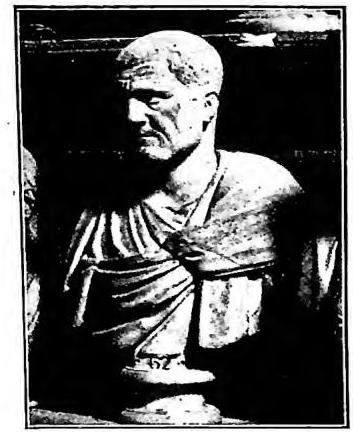
MAXIMINUS DAIA (Galerius Valerius Maximus Daia), Roman emperor. — Son of a sister of Galerius (q.v.), born in Illyricum, he was protected by his uncle in his military career and later adopted, taking the names Galerius Valerius M. The form of the surname appears, according to epigraphic evidence, to be preferable to the other Daza (q.v., e.g., CIL, VIII, 10784).
On the day of the abdication of Diocletian and Maximian (1 May 305), when Galerius and Constantius Chlorus were promoted to the rank of Augusti, M. D. was named Caesar together with Flavius Severus. He was assigned the two dioceses of the East and Egypt. From the very beginning, his inadequacy was so evident that at the conference of Carnuntum, held under the presidency of Diocletian (305), he was not, as he should have been, promoted from Caesar to Augustus, but instead a “new man,” Licinius, was preferred. This slight drew him fatally toward another rejected figure, Maxentius, though their friendship could not be translated into any effective action, each being absorbed by his own difficulties. When Galerius died (311), M. had himself acclaimed Augustus by his soldiers and rushed to occupy all of Asia Minor. His army and that of Licinius stood facing each other on the shores of the Bosphorus, but since neither felt confident of victory, no battle ensued. In 312, when threatened by Armenia, M. was unable to come to the aid of Maxentius against Constantine. However, after Constantine’s victory, when Licinius went to Milan and married the victor’s sister, M. decided he could cross the Bosphorus and seized Byzantium and Heraclea. This time, however, Licinius could not remain inactive; they fought at Campus Serenus near Heraclea, and M. was completely defeated. He fled across Asia Minor and tried to gather more forces, but stricken by illness, he died at Tarsus in Cilicia in the autumn of 313 (on 26 November of that year, his third consulship is recorded as annulled in Egyptian documents: Berliner Ägyptische Urkunden, I, 349). To the Christians he was always a zealous executor of Diocletian’s edict of persecution and reluctant to apply Galerius’ edict of toleration.
MAXIMINUS OF SALERNO. — Dominican, biographer of St. Catherine of Siena.
In 1417, while at S. Domenico in Siena, he wrote, at the behest of his prior, Tommaso Caffarini, a Legenda (life) of St. Catherine of Siena, “very abbreviated,” and thus called the Legenda minima, drawn from another that Caffarini himself had written by abridging the Legenda maior of Raymond of Capua. The abbreviation was done for the convenience of preachers “et aliis plurimis occupatis,” preserving the same order of chapters but grouping the miracles of the Saint into 80. This Legenda has so far been found in three manuscripts and published only in part (first 6 chapters and part of the 7th) by E. Franceschini, Leggenda minore di s. Caterina da Siena (Milan 1942, pp. 145–140).