
MATHEMATICS
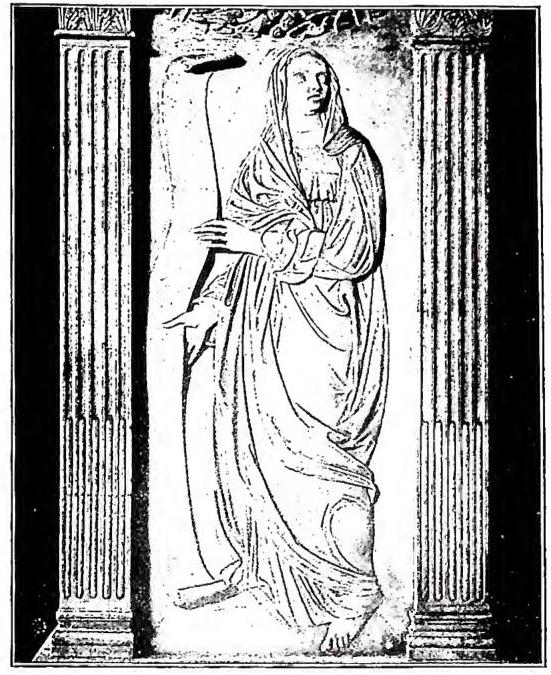
MATHEMATICS — The low-relief sculpture of Mathematics by Agostino di Duccio (ca. 1450). Rimini, Tempio Malatestiano.
was executed from the curvature of the meridian passing through Alexandria.
VI. PROJECTIVE GEOMETRY
Alongside non-Euclidean geometry, other branches have developed: projective geometry, differential geometry, and algebra.The first, which emerged at the beginning of the last century, took its starting point from the aforementioned theorems of Apollonius, and while connecting with descriptive geometry, it directed its attention to the transformations undergone by a plane figure when it is projected from a point onto another plane (section), proceeding thus through any number of successive operations of projection and section.
These transformations change points of one plane into points of another, lines into lines, collinear points on a line into collinear points on a line, concurrent lines into concurrent lines; they are called projective transformations, and they can also be extended to the transformation of one space into another. In these transformations, as has already been noted, the invariant entities appear, and indeed among these the fundamental invariants of projective transformations is the so-called cross-ratio of four points ABCD on a straight line, which is expressed by the quotient (AC/BC):(AD/BD), and does not change when, through repeated operations of projection and section, one passes from the points ABCD of one line to the corresponding points A'B'C'D' of another. If, through repeated operations of this kind, one returns to the original line, then there exist two points on that line which, despite the operations performed, come to coincide with their corresponding points (the so-called two fixed points). When, after repeated operations of projection and section, one returns to the same plane from which one started, there are three fixed points, and moreover there exists a conic which coincides with itself (invariant conic) without, however, any point coinciding with its corresponding point, but in such a way that each point of the conic, considered before performing the said operations, comes to lie upon another point of the conic itself.
Now, in 1872, Klein, making use of Cayley’s metric, showed that the three geometries mentioned in the preceding paragraph can be considered as a single geometry from the projective point of view, which depends exclusively on the projective transformation adopted to transform the plane into itself (i.e., motion of the plane upon itself, understood in a broader sense). The projective transformation that leaves two special imaginary points, called cyclic points, and the line determined by them (containing the inaccessible points) invariant, expresses, with an appropriate metric, the motions of the Euclidean plane (ordinary motions). In the non-Euclidean plane of Lobachevsky, the inaccessible entity is constituted by a real conic which the motions in that plane, i.e., the appropriate projective transformation, leave unchanged. In the plane of Riemann, the inaccessible does not exist, or, more precisely, it is formed by imaginary points. These imaginary points, although not drawable on the plane, can indirectly be represented, as, towards the middle of the last century, Staudt did, who, with synthetic methods of extraordinary elegance, showed the connection of those points with real points, in a manner analogous to how in projective geometry the inaccessible points (points at infinite distance) are handled through those which are instead accessible.
But the great advances in geometry came from its union with analysis, as will be seen in the following paragraphs.
VII. ANALYTIC GEOMETRY
At the foundation of analytic geometry lies the representation of a point by means of numbers. In the narrowest sense, these numbers, called coordinates, are the distances of the generic point under consideration in a plane from two fixed lines OX, OY in the plane itself, perpendicular to each other, called Cartesian axes. Or, if one is dealing with the study of figures in space, the coordinates, of which there are three, are the respective distances from three fixed planes, mutually perpendicular, like two adjacent walls and the floor of a rectangular room, whose edges OX, OY, OZ are the three Cartesian axes of space.Thus, given a point, one can determine its coordinates by constructing the aforementioned distances, and conversely, given three numbers, interpreted as distances, one can trace back to the point having those three numbers as coordinates.
Given then a line in the plane, the two coordinates a, b of a generic point on it cannot both be arbitrary, because if one is known, the other is deduced. For example, if the abscissa a is known, which is the distance of the point P from the y-axis, the point can be determined as the intersection of the given line with the parallel to the y-axis situated at a distance a from it; and then, once the position of P on the line is known, the other coordinate b will also be known. Hence a line entails a connection between the coordinates of its points, which will be expressed by an equation between the latter. Thus an equation of the first degree between the coordinates represents a straight line, one of the second degree a conic (ellipse or parabola or hyperbola), and so on, while from the coordinates of two points, by means of the Pythagorean theorem, one obtains the distance between them, and from the equations representing two lines one obtains the angle that they form. In this way graphic problems can sometimes advantageously be transformed into algebraic or, as is now more generally said, analytic problems.
In the end, even trigonometry, which can be traced back to Ptolemy, translates into numbers the problems concerning triangles and polygons in general, but from a less general point of view than analytic geometry. By means of trigonometry and the aid of algebra, many problems of elementary geometry are translated into the resolution of equations, often facilitating a search which, if approached through the purely synthetic method, is solved in a more elegant way, though sometimes it involves greater investigative effort. Naturally, in the choice of reference axes, to avoid complications, it is advisable to use elements intrinsically connected with those of the problem. It is this
was executed from the curvature of the meridian passing through Alexandria.
view that guided Ernesto Cesaro in his brilliant treatment of Intrinsic Geometry, published in 1896. However, the economy of logical labor achieved by employing the analytic method in the resolution of a geometric question is offset by the greater labor involved in the development of the calculations.
Analytic geometry, in its development, has gradually established important connections with projective geometry and has brought to light peculiar properties of lines and surfaces, but its grand progress came when it was joined to infinitesimal analysis to give rise to differential geometry.
VIII. INFINITESIMAL ANALYSIS
The concept of a magnitude that can be thought of as however small, or as is also said indefinitely small, is essential yet dynamic, inasmuch as, once a magnitude is fixed, it prompts the fixing of another smaller one, for example smaller than half of the preceding one, and so on in a continuous process. From this dynamic of the first element there emerges the concept of the infinitesimal (actual).It is found, albeit in a hidden way, already in elementary geometry (in the theorem on the equivalence of pyramids and in the theory of the rectification and quadrature of the circle), while it interpenetrates with the existence of the limit toward which a quantity tends, insofar as the difference between the quantity and its limit can become infinitesimal. With Newton, the comparison—and more precisely, the ratio between infinitesimals—comes into play when instantaneous velocity is conceived as the ratio between an infinitesimal space and the infinitesimal time taken to traverse II. Thus arise the concepts of function, of incremental ratio, and of derivative.
A function is nothing other than the relation of dependence between two variables, such as, for example, the relation between the space traversed by a moving body and the time taken, or the relation between the length of a rod and its temperature. The second of the two variables is called the independent variable, the first is said to be dependent on it and is also called a function of it; the relation of dependence may also be inverted.
The incremental ratio is the ratio between the increment of the dependent variable and the corresponding increment of the independent variable. Thus, if the space traversed from 8 a.m. to 11 a.m. has increased from 280 to 490 km, the increment of space will be 210 km, the increment of time will be 3 hours, and the incremental ratio (average velocity) will be expressed as 210 : 3 = 70. When these increments are infinitely small, one obtains the so-called derivative of the function. Thus, for example, the instantaneous velocity mentioned above is the derivative of space (as a function) with respect to time (the independent variable).
It is often convenient to give a geometric representation of a function by plotting on a plane the points whose coordinates are, one the value of the independent variable x, the other the corresponding value y of the function; this yields a curve known as the diagram of the function. The function y is denoted by f(x) to recall its dependence on the variable x; hence one writes y = f(x). The independent variable x may be considered not for all possible values, but only, for example, for those between two numbers a and b, and then one says that the function f(x) is defined only on the interval (a, b). In the same way, the motion of a train is considered only during the interval of time from departure to arrival. The derivative of f(x), calculated point by point for all points of the interval (a, b), constitutes in turn a new function, because to each value of x in that interval there corresponds a value of the derivative. This is denoted by f'(x) and also, when one wishes to emphasize its origin from the incremental ratio, by \(\frac{df}{dx}\) or \(\frac{dy}{dx}\) (the infinitesimal difference of y divided by dx, the corresponding infinitesimal difference of x).
But then one can generally perform the operation of differentiation again on f'(x), obtaining a new function: the second derivative, denoted by f''(x), and so on.
Linked to the operation of differentiation is the inverse operation: indefinite integration, which consists in finding the function F(x) that admits a given function f(x) as its derivative; this search is not always straightforward.
Consider now the area bounded by the diagram of a function f(x), by the segment (a, b) of the x-axis containing the points x for which the function is defined, and further bounded by the two perpendiculars drawn to the x-axis at the points a and b. To find this area, first divide the segment (a, b) into infinitesimal parts, which will be denoted generically by dx; then sum the areas of all the rectangles having as base an element dx and as height the segment HK, which has length f(x) if x is the measure of OH (one of the coordinates of the point K on the diagram). Each area will be given by the product f(x) dx, and thus the sum will be represented by the customary symbol:
\[\int_a^b f(x) dx\]
The calculation of this sum of infinitely many terms, each infinitesimal, is purely ideal if considered as the limit of a sum of a finite number of finite terms, however small. Yet it can often be carried out by means of the indefinite integration mentioned above. Indeed, if one succeeds in finding that function F(x) whose derivative is f(x), then the difference F(b) − F(a), that is, the value that F assumes at b minus that which it assumes at a, is precisely the value of that sum. This takes the name of definite integral; its concept was first rigorously established by Mengoli (1659).
In the last century and the early present one, the possibility of performing operations of differentiation and integration has given rise to a series of questions that have clarified and extraordinarily extended the concept of function. From these have arisen the theory of functions and the theories relating to all infinitesimal operations applied to them (differentiation, integration, differential equations, integral equations, integrodifferential equations). We shall merely mention a few among the numerous mathematicians who have worked in these fields: Cauchy, Jacobi, Riemann, Briot and Bouquet, Weierstrass, Betti, Brioschi, Casorati, Dini, Mittag-Leffler, Arzelà, Peano, Du Bois-Reymond, Pincherle; and, closer to our own time, Volterra, Vivanti, Borel, Lebesgue, Denjoy, Carathéodory, de La Vallée Poussin, Tonelli, Ricci.
Ordinary differential equations link the derivatives of one or more functions of a single variable (unknown functions) to other known functions. All problems in the dynamics of mechanical systems composed of a discrete number of material points depend on equations of this kind. Such equations are such that, if the position of a material point is known, together with its velocity at a given instant, and if the forces acting on the point are known, one can describe the motion that the point can undergo from that instant onward, and also know the motion it has undergone before that instant. This result, at the time when the mechanism of the universe was in vogue, gave rise to determinism. Since the universe is composed of moving material particles, if the positions and velocities of the individual material points at a given instant are known, one can reconstruct the history of the past and foretell the development of the future.
The assertion, which within certain restricted limits represents a fine achievement of science (so much so as to allow the prediction of many astronomical phenomena and to enable the design of mechanisms whose actual functioning adheres to predictions), becomes extremely arrogant and fallacious when assumed in too broad a sense. Even within the hypotheses of classical mechanics, it is shown that in some material systems there exist moments of indeterminacy (a kind of dead points such as are also found in trivial mechanisms) from which one can depart effortlessly and in various directions.
Partial differential equations concern relations between the derivatives of one (or more) unknown functions taken with respect to each of its two or more variables, and other known functions. Problems of motion with infinitely many variables, such as those pertaining to continuous media (fluids, elastic bodies, etc.), are connected with these equations. To them are linked most of the questions of mathematical physics.
In integral equations, the unknown functions are, together with known functions, constrained under the operation of integration; ordinarily the relations are very simple (linear), and then the solution of an integral equation can be approximated, for example, by reducing the equation to a system of first-degree algebraic equations (cf. n. III). To the theory of integral equations are linked the names of Abel, Volterra, Fredholm, Schmidt, Picard, Goursat, Hilbert, Fantappiè, and others.
In integrodifferential equations, first studied by Volterra, the unknown function appears not only under integration but also under differentiation. Such equations arise in physical problems of hysteresis, which occur when materials subjected to strong stresses—if elastic—or to strong magnetizations—if paramagnetic—retain a memory of the history of treatments they have undergone from the beginning.
paramagnetic, retain a memory of the history of treatments they have undergone from the beginning.
The search for solutions of ordinary differential equations was placed on a rigorous basis by Cauchy, who first established the existence of solutions and then their constructibility. Notable studies have followed throughout the past century and up to the present, particularly concerning the dependence of solutions on the so-called extremal conditions, i.e., the conditions that must be satisfied at the boundaries of the domain in which the unknown functions are sought. Extremal conditions cannot always be freely imposed, for they require a certain compatibility that can be ensured only when a parameter of the equation—i.e., a variable not appearing in the differentiation operations—assumes particular numerical values called eigenvalues, each of which generally corresponds to a solution of the equation. The particular solution is called an eigenfunction. The interest in eigenvalues and eigenfunctions is immense. In many problems of motion encountered in mathematical physics, the former give the vibration frequencies of the phenomenon, and it is well known how important knowledge of these frequencies is in the design of refined engineering to guard against the dangerous phenomenon of resonance.
IX. SERIES EXPANSIONS
It has already been noted that it is impossible to express a rational number by means of a finite number of digits and that it is impossible to express certain operations by means of a finite number of others. One often finds oneself, therefore, faced with processes without end; among these, one very important and frequent type is that of summation by series.If one adds to a number its half, then half of the half, and so on, one obtains one of the simplest examples of a convergent series (in this case, the sum tends toward twice the initial number). However, it is not always possible to reach the limiting result in a simple manner, and one must then be content with summing only the first terms of the series, generally committing an error that becomes smaller as the number of terms actually added increases. There are, however, series that converge more or less rapidly toward a limit, and there also exist divergent series, i.e., such that as the number of terms actually added increases, the resulting sum grows beyond any limit. There also exist indeterminate or oscillating series, so called because, as the number of terms added increases, the sum does not appear to tend toward a definite limit, as, for example, in the series:
\[-1 + 1 - 1 + \ldots\]
The concept of numerical series (sum of infinitely many numbers) extends to literal series and thus to series of functions. A series of functions synthesizes an infinity of numerical series, one for each point in the interval (a, b) where the functions are defined. Symbolically, one writes: \(f_1(x) + f_2(x) + f_3(x) + f_4(x) + \ldots\), where the subscript beneath the letter \(f\) indicates the diversity of the functions of \(x\) that are being added, and where for each value of \(x\) there corresponds, in the indicated sum, a numerical series.
With great generality, it can be said that every operation performed on a variable \(x\) can be expressed in the form of a series of functions. A polynomial of degree \(n\), such as \(a_0 + a_1x + a_2x^2 + a_3x^3 + a_4x^4 + \ldots + a_nx^n\), is the simplest operation that can be performed on the variable \(x\): \(a_0, a_1, a_2, \ldots\) are fixed numbers, while \(x\) varies (the \(a_i\) are the coefficients of the polynomial). If the number of terms of this series and hence its degree increases without bound, then one obtains the so-called power series, which was one of the first types of series of functions to be considered. Many so-called elementary functions, such as trigonometric functions (sine, cosine, tangent, and cotangent), the logarithm, the exponential \(e^x\), etc., are expressed by means of them. With polynomials or with elementary functions, other series are constructed, among which are important the series of Legendre polynomials, of Laguerre, of Hermite, trigonometric series, which are sums of sines and cosines of multiples of an angle \(x\), the series of Bessel, of Sturm, of Liouville, etc.
The properties of series have been studied by Frullani, Bonacci, Abel, Kummer, Riemann, Dirichlet, Dini, Peano, Cesàro, and in this century, among the most recent, by Borel, Tonelli, Picone. The questions addressed concern both the representability of functions by means of the various kinds of series and the nature of their convergence.
There exist series that cannot be summed directly because they are oscillating, but that can be utilized because they are summable in the mean. That is, the sum becomes performable by grouping the terms, summing each group, and finally adding these partial sums after applying to each an appropriate coefficient. This method is due to Cesàro; further developments and considerations are due to Féjer and to Teofilato, who, adopting a very general point of view, has shown how Cesàro’s method is connected with the interests of Poisson and Dirichlet. The study of trigonometric series and the representability of a generic function by means of them, or as one says, the expandability of the function in a Fourier series, was deepened by Dirichlet and subsequently extended and elaborated by Tonelli and by Picone.
From the generalization of expansions in trigonometric series came those in series of orthogonal functions, which generally are nothing other than the eigenfunctions discussed above and which are of such great importance in questions of mathematical physics. With regard to orthogonal functions, the names of Schmidt, Tamarkine, Picone, and Sansone are cited.
X. FUNCTIONAL ANALYSIS AND CALCULUS OF VARIATIONS
It arose around 1850–60 through the work of some young Italian mathematicians, who laid the foundations for a study of functions of a line, called functionals, such as, for example, the definite integral, which expresses the length of a curve, or the area of the graph of the intensity of a current passing through a given circuit considered as a function of time; each of these quantities depends simultaneously on all the values assumed by a function in a given interval.Thus there arose what are called functional operations, that is, those correspondences which pass from one functional to another, and with them there also arose a symbolic calculus, the first to concern themselves with which were Pinochet and Amaldi. The point of view of these two authors was particularly qualitative; alongside it there came another, due to Volterra, who made use of the conceptual transition from the discontinuous to the continuous, in order to transform the indices (that is, the ordinal number) by which the functions on which one operates are characterized, into a continuous variable (parameter). In this way, instead of speaking of the first function, second, third, etc., one will speak of an infinite continuous set of functions, distinguished by the value attributed to the parameter, which ends up intervening as an additional variable alongside those already possessed by the functions. The derivation with respect to the index, already adopted by Euler and Laplace, was thus extended by Volterra to partial derivation (cf. n. IX), to the differential of the functional, and to the Taylor series expansion, thereby obtaining algorithms very useful for the treatment of integral equations. From a different perspective, basing himself on the results of Dini regarding the theory of functions of a real variable, and on the theory of sets, Arzelà laid the foundations for the structure of general analysis, which was later constituted in these last years by Fréchet and others. Tonelli, for his part, dealing with the calculus of variations—that is, the calculus which studies the variation of a functional (such as the variation in the length of a curve undergoing an infinitesimal deformation)—introduced the concept of the semi-continuity of the functional, a fruitful concept which allowed him, among other things, to account for the success of some procedures previously used, and which led him to new developments and applications. In this direction there are notable works by Cinquini, Caccioppoli, and Cimmino.
Fantappiè followed a new path in the study of functionals, developing in the complex domain the results that Volterra had obtained in the real domain. In this way Fantappiè achieved a coordination of various theorems which was lacking in Volterra’s exposition, and found brilliant correlations between properties of functions of a complex variable and functionals; finally, he applied his theory to differential equations, integral equations, and matrices.
Finally, mention should be made of symbolic operational calculus, which, under suitable circumstances, allows one to substitute one of the operations of derivation or integration with a variable, thereby often facilitating the treatment of equations in electrical engineering. In this regard, the names of Heaviside, Giov. Giorgi, and Aldo Ghizzetti should be remembered.
MATEMATICS
Thus there arose the so-called functional operations, that is, those correspondences which pass from one functional to another, and with them there also arose a symbolic calculus, the first to concern themselves with which were Pinochet and Amaldi. The point of view of these two authors was particularly qualitative; alongside it there came another, due to Volterra, who made use of the conceptual transition from the discontinuous to the continuous, in order to transform the indices (that is, the ordinal number) by which the functions on which one operates are characterized, into a continuous variable (parameter). In this way, instead of speaking of the first function, second, third, etc., one will speak of an infinite continuous set of functions, distinguished by the value attributed to the parameter, which ends up intervening as an additional variable alongside those already possessed by the functions. The derivation with respect to the index, already adopted by Euler and Laplace, was thus extended by Volterra to partial derivation (cf. n. IX), to the differential of the functional, and to the Taylor series expansion, thereby obtaining algorithms very useful for the treatment of integral equations. From a different perspective, basing himself on the results of Dini regarding the theory of functions of a real variable, and on the theory of sets, Arzelà laid the foundations for the structure of general analysis, which was later constituted in these last years by Fréchet and others. Tonelli, for his part, dealing with the calculus of variations—that is, the calculus which studies the variation of a functional (such as the variation in the length of a curve undergoing an infinitesimal deformation)—introduced the concept of the semi-continuity of the functional, a fruitful concept which allowed him, among other things, to account for the success of some procedures previously used, and which led him to new developments and applications. In this direction there are notable works by Cinquini, Caccioppoli, and Cimmino.
Fantappiè followed a new path in the study of functionals, developing in the complex domain the results that Volterra had obtained in the real domain. In this way Fantappiè achieved a coordination of various theorems which was lacking in Volterra’s exposition, and found brilliant correlations between properties of functions of a complex variable and functionals; finally, he applied his theory to differential equations, integral equations, and matrices.
Finally, mention should be made of symbolic operational calculus, which, under suitable circumstances, allows one to substitute one of the operations of derivation or integration with a variable, thereby often facilitating the treatment of equations in electrical engineering. In this regard, the names of Heaviside, Giov. Giorgi, and Aldo Ghizzetti should be remembered.
In the Euclidean sense. Indeed, considering, at every position of the ship, the projection of AB onto the meridian and that onto the parallel, these will not vary as long as they refer to nearby positions, but will vary considerably for distant positions; it suffices to think of the ship’s movement along the parallel of Naples, while, kilometre by kilometre, it orients axis AB according to the local meridian, instead of remaining parallel to itself as it should in parallel transport. In other words, consider the cone tangent to the terrestrial sphere along the aforementioned parallel, like a pointed paper cone that contains, touching it, a ball representing the globe, and then unroll the cone’s surface onto a table. On the paper thus unrolled, draw, each time, the image of the ship’s axis during its parallel displacement. The initial position of this axis will be, on the table, parallel to the final one, but parallelism will cease when the paper is rolled up again onto the sphere, while the various images of axis AB will form with the respective generators of the cone a variable angle from generator to generator. In short, after a thousand kilometres, the angle between the initial and final positions will be just under ten degrees.
To establish the vector sum of two vectors, it is necessary to construct the diagonal of the parallelogram formed by the two vectors transported parallel to themselves until they share a common origin, just as is done for forces acting on a solid when one wishes to find their resultant. Similarly, one proceeds for the vector difference, which in ordinary space is achieved by parallel transport, as when, given the resultant of two forces acting on a solid and given one of the forces, one wishes to find the other. This operation, which in ordinary space has a meaning independent of the place occupied by each of the two vectors, instead, in curved space, is defined by performing parallel transport in the new sense piece by piece (one may think of the ship moving backwards). When the difference is infinitesimal, one has the differential (an infinitesimal increment of the vector), and when this difference is divided by the differential (infinitesimal increment) of the variable, one obtains the first covariant deviation mentioned above.
These are the fundamental entities of absolute calculus, which are then developed and extended, thus providing mechanics with a powerful investigative tool in the physical domain.
Other very recent studies link back to these theories, due to Bortolotti (Enea), Bompiani, Cartan. But the essentially metric study of differential geometry had to find, from the outset, a point of contact with projective geometry. The connection first established by Klein in 1872, as already mentioned in No. VII, reduced, as it were, the three geometries—Euclidean, Lobachevskian, and Riemannian—to a single one from the projective standpoint. These, in turn, could be synthesised with other geometries by considering projective transformations as included among the Cremona transformations.
A further step was taken, between 1918 and 1924, by Weyl and Cartan, by considering spaces with affine, or conformal, or projective connection. Thus a space is constructed, step by step, so that every infinitesimal space element can be referred to its neighbour while respecting affinity, or conformity, or projectivity.
In another direction, and precisely in the deepening and extension of analysis situs, glimpsed by Clifford in the last century, topology has developed, which, wedded to differential geometry, has been the object of notable studies by Severi and Blaschke. The interweaving of the various branches mentioned in No. I is more than ever verified in the interference of differential geometry with other disciplines of mechanics.
XIII. CALCULUS OF PROBABILITIES
Born between 1600 and 1700 with Buffon, Pascal, and elaborated shortly after by Bernoulli, Euler, D’Alembert, Condorcet, it was perfected by Laplace in the first half of the nineteenth century, and by Gauss and Poisson; notable contributions and refinements were later made by Bertrand, Chebyshev, and Kolmogorov.
The calculus of probabilities aims to determine the laws of chance. At first glance, this intention seems paradoxical, since what is truly fortuitous, once it lends itself to prediction, loses that essence of uncertainty with which it is invested. But what is truly fortuitous? In reality, numerous imponderable or unconsidered physical causes are present, which cause the event to oscillate around an average, interfering with one another, now summing and now cancelling out; among these causes, however, as already noted in connection with mechanistic determinism, one must also include moral causes, which are of unquestionable value and capable of directing the event in the most unexpected, or, as one says in probabilistic language, least probable, direction.
Chance refers to physical causes and is governed by two laws that render it less fortuitous: the law of large numbers and the law of deviations (or errors); the former due to Bernoulli and Poisson, the latter to Gauss.
The first, for example, ensures that, given an urn containing ninety balls all alike except for colour—89 white and one red—the number of times the red ball is drawn, following extractions with replacement, is such that the fraction k/n approaches 1/90 ever more closely as the number n of draws increases.
Conversely, if in n draws the ratio k/n oscillates around 1/90, drawing ever closer to 1/90 as n grows, one may infer that among the 90 balls, only one is red, and with a degree of certainty all the greater as n increases. If this circumstance does not occur, it is a sign that among the balls there is some other difference besides that of colour. On the other hand, when one measures a quantity, however precise the instruments, one finds each time a different value, with deviations all the smaller the more perfect the instrument. Now, the second law states that while the mean of the measurements obtained is the most probable value of the quantity, the deviations from this mean value vary according to the equation y = k · a^(–x²/2), where a is the deviation and y the frequency with which it occurs; the base a of the exponential function and the coefficient k depend on the precision of the measurements.
On these foundations, the theory of probabilities has undergone notable developments and applications: from the theory of errors of measurement, which offers the surest way to compensate for them, to the theory of wagering that studies the fairness of games of chance, the so-called mathematical expectation and risk, thus governing the determination of insurance premiums; from the deduction of natural laws as they manifest in a group of experiments, to the measurement of aggregates, whether constituted by physical, biological, demographic, or social elements.
Moreover, classical physics, which began entirely deterministic, has gradually slipped somewhat into probabilism when it enunciated the second law of thermodynamics, or the principle of the degradation of energy, according to which nature evolves toward ever more probable states. For example, a transparent bottle containing in its lower half sand dyed blue and in its upper half the same kind of sand dyed red, if shaken to mix the grains of the two colors, will soon show a uniform gray color; and if a small quantity of sand is taken, even though it contains many grains, it will be found that the number of red grains is roughly equal to that of the blue ones, with a deviation the smaller the greater the number of grains taken. It seems impossible that, by continuing to shake the bottle, the grains of the two colors could ever return to their original arrangement; yet this result is not logically impossible, though it is so improbable as to be comparable to drawing at random the words of a dictionary to reproduce a sonnet by Dante.
Such a restoration can only be attributed to an intelligence that guides or sets in motion suitable forces—all the more so when, as in the miracles recorded in sacred books and unbroken traditions, the restoration to the initial state occurs after the dissolution of an organism, at the command of a word.
In modern physics, the impossibility of determining the future state of a single subatomic particle absolutely compels the use of probabilistic criteria, just as one would do when observing a crowd from afar; unable to follow the actions of a single individual, one studies the group to which he belongs. There is this difference, however: in the case of the crowd, the judgment about the group is made out of lack of suitable observational tools, whereas for the subatomic particle the judgment is bound, beyond experimental impossibility, also—at least for now—to a theoretical impossibility; so that at the ultimate level of matter indeterminism, or rather indeterminacy, would prevail, and upon it the calculus of probabilities. The term indeterminism has been used; better indeterminacy, to avoid suggesting an ontological indeterminism, which would be pure chance—i.e., the negation of any law (though even in this case law is found to exist)—or an animism of matter, which must also be rejected unless connected with vital phenomena. FANTAPPIÈ has attempted to give a possible mathematical interpretation of this finalistic activity of matter by means of the so-called accelerated potentials.
XIV. RATIONAL MECHANICS AND MATHEMATICAL PHYSICS
These two important branches of mechanics have already been frequently mentioned, yet a brief overview of their developments will not be superfluous.From Archimedes, who may be considered the founder of both disciplines, one must look ahead to Galileo, Torricelli, and Newton to see their vigorous development begin, with continuous contributions associated with the names of Huygens, Bernoulli, Euler, D'Alembert, Laplace, culminating in the classical systematization of rational mechanics by Lagrange in his celebrated *Mécanique analytique*, where all questions of equilibrium and motion are derived from two principles: that of virtual work, going back to Galileo, and that of the equilibrium of lost forces, due to D'Alembert.
Alongside the mechanics of solids, that of fluids also progressed, while new and fruitful general principles were discovered, and with ever more powerful mathematical tools all fields of physics were investigated.
Linked to general principles and methods are the names of Jacobi, Poisson, Hamilton, and Hölder; to classical electromagnetic theory: Ampère, Maxwell, Kirchhoff; to modern (relativistic) theory: Einstein, Schrödinger, de Broglie; to the theory of elasticity: Betti, Volterra, Kelvin, Somigliana, Levi-Civita; to fluid dynamics: Euler, Lagrange, Laplace, Kelvin, Helmholtz, Kirchhoff, Levi-Civita, Volterra, Prandtl, Cisotti.
The calculation of elastic plane structures (frameworks) has seen particular developments in Italy, with general and elegant methods due to Cremona, Castigliano, Betti, and Menabrea. Aircraft structures, in which lightness is perpetually at odds with strength, have given rise—owing to their complexity—to important recent work by de Broglie, who, refining and extending the principles of maximum or minimum work, has found new and expeditious methods of calculation for three-dimensional structures, hitherto difficult to approach.
From rational mechanics there then sprang a new and important branch, aerodynamics, which studies the stresses exerted by a fluid flow on a solid immersed in II. Despite the disconcerting Euler–D'Alembert paradox, which demonstrates the absence of resistance to the motion of a solid through a fluid, aerodynamics has seen extraordinary developments in the last forty years through the work of Prandtl, Levi-Civita, Karman, Lagally, Müller, Pistolesi, Ooson, Cisotti, Teofilato, Silla, Panetti, and Ferrari.
The study of compressible and viscous fluid flows, of transonic and supersonic currents, still forms the object of numerous investigations. Ultrasonic velocities, closely connected with the principles of thermodynamics, indeed constitute a very recent branch: gas dynamics, cultivated in Italy by Ferrari, Luigi Crocco, and Teofilato; it intersects with classical ballistics, to which the names of Euler, Lagrange, Siacci, and Signorini are linked, and with superballistics, to which Gaetano Crocco devotes his active efforts.
All the equations governing the various physical phenomena can be derived from minimum principles, which in essence reduce to what Maupertuis called the law of least action, almost a law of economy in nature, which may also underlie the gradual transformation of one species into another and lend an appearance to evolution, and may even be the reason for the sweetness of a harmony or the beauty of an architecture—universal.