
**MATTHEW, APOSTLE, EVANGELIST, SAINT**
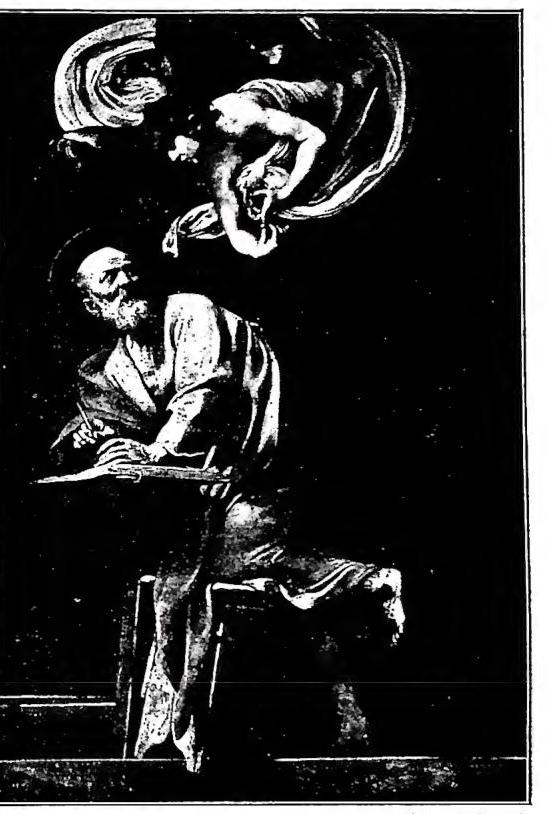
**I. S. M. and the Angel.** Painting by Caravaggio (1592) — Rome, church of S. Luigi dei Francesi.
The martyrdom of St. Matthew was traditionally depicted in the cycle of the *Life of the Apostles* in the church of the *Schiavoni* in Venice; his martyrdom was the subject of a mosaic in the 13th century in the Basilica of S. Marco in Venice. Both of these scenes found their most famous pictorial interpretation in the two large lateral canvases of the Contarelli Chapel in S. Luigi dei Francesi in Rome, masterpieces by Caravaggio, painted between 1592 and 1598. — *See* pl. XXVIII.
**
**II. GOSPEL OF MATTHEW (APOCRYPHAL)**
Apocryphal work, also called *The Book of the Origin of the Blessed Mary and the Infancy of the Savior*. Two spurious letters from the bishops Chromatius and Heliodorus to St. Jerome, along with his response, serve as an introduction and attribute it to the Apostle Matthew. St. Jerome is said to have recovered and translated into Latin the original Hebrew text.
It consists of two parts: the first (chapters 1-24), titled *Historia de nativitate Mariae et infantia Salvatoris*, is substantially akin to the *Protoevangelium of James* (*see*), with notable amplifications and additions, though it is uncertain whether it depends on II. The second (chapters 25-42) follows the *Gospel of Thomas* and is titled *De miraculis infantiae Domini Iesu Christi*.
It is the only apocryphal work that recounts (chapters 18-24) the miracles performed by Jesus during the journey and stay of the Holy Family in Egypt. It tends to develop the miracles it shares with the *Protoevangelium of James*. In chapters 25-42, it narrates the prodigious life of Jesus after returning from Egypt, now on the banks of the Jordan, now in Capernaum, now in Nazareth, reworking the *Gospel of Thomas* with increasing extravagance. Some less orthodox elements are noted here and there. The *Gospel of Matthew* was composed in the West between the 5th and 6th centuries, certainly not before the 4th.
The apocryphal *De nativitate Mariae*, among the works of St. Jerome (*Epist.* 50: *PL* 30, 307-15), is an adaptation of the first part of the *Gospel of Matthew*, with a tendency to synthesize, attenuate, and render it more orthodox through some slight additions and in fairly elegant Latin. It is reproduced in the *Speculum historiale* of Vincent of Beauvais and in the *Golden Legend* of Jacopo da Voragine. It is believed to date from the Carolingian period.
Another apocryphal work, which largely coincides with the *Gospel of Matthew* and the *Gospel of Thomas*, is the *Gospel of the Infancy of the Savior*, concerning the birth of Mary and the birth and infancy of Jesus, published by James in two markedly divergent versions: the Hereford manuscript (13th century) and the Arundel manuscript. The former attributes it to James, the latter to Matthew. However, its origin remains unclear—whether it depends on the *Gospel of Matthew*, the *Protoevangelium of James*, or the *Gospel of Peter*—has not been fully elucidated.
**
**III. ACTS OF MATTHEW (APOCRYPHAL)**
Apocryphal work, published under the title *Martyrium Matthaei* by Lipsius-Bonnet (*see* Bibl., II, II, pp. 217-62), in Greek and in a very poor Latin text. It forms a homogeneous group with the *Acta Andreae et Matthiae in urbe anthropophagorum* (a Catholic reworking of the *Acta Andreae* in Greek, Latin, Syriac, Coptic, and Ethiopic), with the *Acta sanctorum apostolorum Petri et Andreae* (in Greek, Slavonic, Ethiopic), with the *Acta Pauli et Andreae*, and with the *Acta Bartholomaei*. Their origin is uncertain.
The subject of the *Acts of Matthew* in the Latin text is highly fantastic. Matthew is sent to preach in the land of the anthropophagi (Media). He is received by Bishop Platon, from whose staff a huge tree emerges that reaches into Paradise. From the tree flows a river that irrigates the city of the Myrmidons. Matthew frees the wife and son of Emperor Bufa from a demon, whereupon Bufa decides to kill Matthew, who is comforted by the appearance of Jesus. The devil, in the form of a soldier, incites Bufa against Matthew, but the soldiers sent to capture or devour him are struck blind. Bufa goes to arrest Matthew, but upon seeing him, he becomes paralyzed. Matthew heals him. Ingrate, Bufa has him crucified on the ground by the sea. He orders Matthew to be burned, but the fire is extinguished by Matthew’s prayer and instead burns Bufa’s idols. The fire turns into a dragon that pursues Bufa to his palace; he is freed by Matthew, who dies at the sixth hour, then rises and ascends to heaven crowned... Bufa, witnessing these marvels, converts, is baptized, and receives communion. Matthew appears and ordains Bufa (aged 30) as a priest, his wife (aged 30) as a deaconess, and his son (aged 17) as a deacon. After Plato dies three days later, Bufa (renamed Matthew by Matthew) becomes bishop. The Greek text begins with the appearance of Jesus Christ to Matthew in the guise of one of the Holy Innocents chanting in Paradise.
There exist a *Martyrium Matthaei* in Pontus, a Gnostic work; the Ethiopic *Acts of Matthew* in Kahanat; a Parthian legend of Matthew; the Coptic (Ethiopic) martyrdom of Matthew; a local legend of Hierapolis; and another Ethiopic legend connected with the Indian legend of Bartholomew.
**
**IV. ANONYMOUS COMMENTARY ON MATTHEW**
Five fragments of a Latin commentary on Matthew were first published by G. Mercati and attributed by him to Victorinus of Pettau due to their millenarianism and because Victorinus is the author of a *Commentary on Matthew*.
However, both A. Souter and Th. Zahn agree in attributing these fragments to the so-called *Ambrosiaster* (*see*), while Turner holds the opposite view.
**