
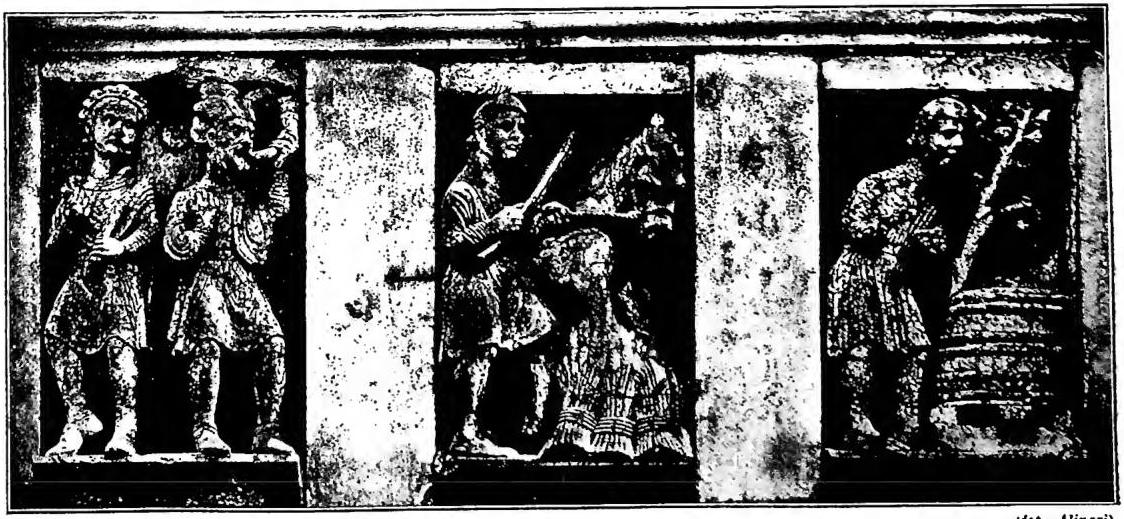
**MEDITATOR – Allegories of the Months of the Year. Sculptures (12th century) – Ferrara, cathedral.**
---
It represents the programme that the Roman Church intended to pursue to bring Christian society back to the evangelical principles, as it interprets and implements them.
The first point of the programme is the affirmation of Roman primacy over the entire Church, tempering the traditional claims of autocephaly of some major episcopal sees such as Ravenna, Milan, and Reims.
More arduous is the task of freeing the secular and regular clergy from the bonds of lay investiture. The struggle against such investiture is preached and intensified, as it is considered the primary cause of simony and Nicolaism; the anti-Catholic conception of the particular Church is attacked; the Papacy frees itself, in the Roman Council of 1059, from any dependence on the Empire, and then proclaims and imposes, in the severe struggle with Henry IV and Henry V, its theocratic principle. The Concordat of Worms (1122), however, showed the impossibility for the Church to abandon its ties with the political organisation through the feudal institution: European society remained faithful to the tradition of the dual religious and civil character and demanded the preservation of the bonds between Church and State, giving rise to new conflicts over supremacy and dominion over the world. Through the new struggles with the Empire, the Roman Papacy directed its action in the 12th century towards the complete subjection of all manifestations of social life to religious principles: its ideal was the absolute fusion of Church and political society, namely the realisation in earthly life of the *Civitas Dei*.
To this end, the solemnly proclaimed theocracy was to serve; the most important means was the administration of spiritual goods; the communion of the faithful was the same civil society; those who withdrew from the authority of the Church were deprived of the enjoyment of charisms and found themselves at once outside the Church and outside society. Such was the function of the system of excommunications and interdicts. Within this framework fell the struggle against every theory deforming orthodoxy; the presence of heretics in a region was a danger of disintegration for the episcopal organisation and, consequently, for civil and state life.
The fight against heresy was first waged by local religious and civil authorities, then a centralised inquisitorial organisation arose, generally entrusted to the two new religious Orders: the Franciscans and, even more, the Dominicans, while civil power was limited to the mere ministerial function (secular arm) based on imperial constitutions (Frederick I, Frederick II) which drew upon the ancient Justinian legislation.
The awareness of having to defend the justice of God and social peace justified the Church in its programme of substituting itself for deficient state bodies in the necessary work of repressing the anarchy resulting from feudal private wars. From the episcopal organisation already invigorated by the monastic spirit sprang the search for means of pacification, consecrating immunity from any warlike offence not only for ecclesiastics but also for the weak (widows, orphans, pilgrims, merchants) with the *Peace of God*, and suspending military operations in certain periods of the year with the *Tregua di Dio* [Truce of God].
Thus an attempt was made to humanise war by imposing upon warfare the defence of persons and religious principles, establishing a religious and moral code of chivalry to which war was admitted only as a defence of truth and justice.
IX. THE EXPANSION OF THE CHURCH
But the Church was concerned with stirring the fervour of the faithful for the cause of the propagation of the Faith. The recovery of territories lost in previous centuries to the Islamic revolution was the programme proclaimed in the 11th century and embodied in the Crusade for the conquest of the Holy Sepulchre (1099); but alongside it were the struggles to curb Muslim expansion in the Italian islands and the Iberian peninsula. Meanwhile, the work of converting the Scandinavian populations of the North and the Slavs of Eastern Europe was in full swing; the German episcopate, supported by German feudalism, attended to this; an episcopal hierarchy directly dependent on Rome arose; monastic Orders such as the Cistercians spread their religious-economic system. The boundaries of Roman Catholicism expanded to those that would become the limits of modern Europe. The Crusades in Syria, however, failed, from which the Latin element was entirely expelled before the end of the 13th century (fall of Acre: 1291); the only fruit was the overthrow of the Byzantine Empire (Fourth Crusade: 1204), but in the Balkan regions papal hegemony was fleeting, as it disappeared with the progressive withdrawal of Latin dominations; yet fleeting too was the revival of Byzantine civilisation under the Palaeologi, which would vanish before the triumph of the Ottoman Turks (fall of Constantinople: 1453).From the Crusading movement, once its military and conquering framework had collapsed, what remained was its fundamental idea, the propagation of the faith, in the peaceful missions that Franciscans and Dominicans began under the direction of the Papacy in the Asian continent towards the middle of the 13th century. The preaching of the Gospel from Mongolia to China, and even to Japan, seemed at the end of the 13th century destined for great results and relegated the problem of the Holy Land to the background.
X. CHURCH AND EMPIRE
By the end of the 13th century, that civil Europe which was to last until the modern age was fully formed under the direction of the Roman See: it was made up of three groups of peoples, Neolithic, Germanic, and Slavic, who drew from the spirit of Catholicism the primary elements of their religious and moral life. Now the fruits of that Christianisation of the masses that had taken place before the year 1000 were visible. Every region, every city was a centre of lively, distinctive activity. While the Church preserved Latin as its official language and fostered a fundamental Latin literary activity as a continuation of the classical, everywhere, as a manifestation of this vitality, the new vernacular languages were forming; in the 12th century, literary activity in the vernacular appeared in various areas, the first affirmation of the nations slowly taking shape; richer and more substantial in the 13th century.While the Holy Roman Empire failed in its programme of political unification of the Christian world and was reduced to being a mere juridical institution of little practical importance, even contested in the theoretical sphere, old and new feudal dynasties became the initiators and organisers of vast state organisms: France, England, Scotland, Portugal, Aragon, Sicily, Hungary, Bohemia, Poland, Denmark, Sweden.
The Roman Church, while fighting the Empire for its domineering pretensions, favoured the rise of territorial monarchies which it nevertheless sought to bind to itself with feudal ties; by virtue of the *ratio peccati* [reason of sin], it affirmed the right to intervene as the supreme tribunal in disputes between monarchs, substituting its judgement based on religious and moral concepts for the crude conception of the ordeal (judgement of God).