
LITERARY MISCELLANEA.
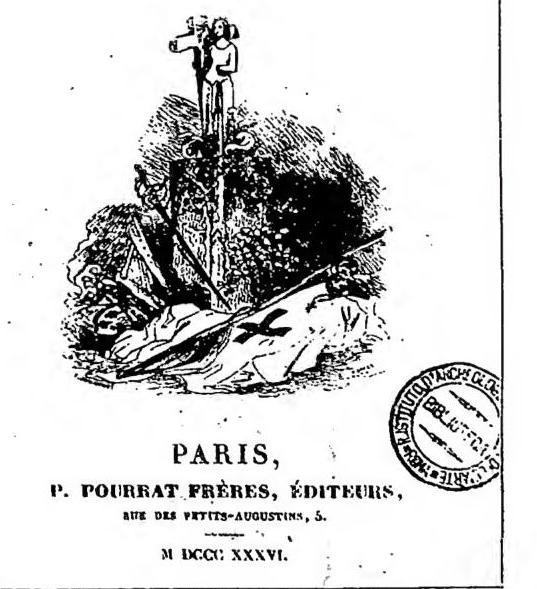
Chateaubriand, François-René - Title page of the Oeuvres complètes, Paris 1836 - Rome, library of the Institute of Archaeology and Art History.
The definitive ruin. His was an idealistic and uncompromising conception of government, founded on morality and realism, which the sovereigns and their ministers, forced into continual compromises with the reality created by the Revolution, could not follow. At one moment the writer appeared the most ultra-legitimist, at another the most advanced in liberal tendencies. His pen and his oratory successively combated the governments of Louis XVIII and Charles X and made the monarchy tremble. Power in pure hands; the Charter for honest men: such was his programme, which, in theory, sought to reconcile absolutism with liberty (La Monarchie selon la Charte, 1816). And yet, despite this, he received offices and honours: ambassador to Sweden (whither he did not go), to Berlin, to London, to Rome; Peer and Minister of State; representative of France at the Congress of Verona; Minister of Foreign Affairs. He inspired and politically directed the war in Spain; he influenced the conclave that elected Pius VII; revealing in his governmental action concrete and positive qualities of statesman and diplomat, and an infallible prescience of the new times. When the legitimate monarchy fell, he declared himself in solidarity with it and opposed the Orléans. On 7 August 1830, in the Chamber of Peers, he delivered a vehement speech to affirm his loyalty to the Bourbons, who “for the third and last time were setting out into exile.” He renounced dignities and offices, thereby, in fidelity of spirit to the monarchy he had so strenuously fought, renouncing even his sole means of support.
He returned to his labours as a writer. With the Aventures du dernier Abencérage (1826) and the Voyage en Amérique, published in the same year, he brought to an end his narrative and fantastic works. Now he wrote the Études historiques and published De la Restauration et de la Monarchie élective, followed in his later years by a Mémoire sur la captivité de Mme la duchesse de Berry, a translation of The Last Paradise, an Essai sur la littérature anglaise, some Considérations sur le génie des hommes, des temps et des révolutions. On 16 July 1841 he wrote the final lines of the Mémoires d’outre-tombe; in 1844, the Vie de Rancé.
Old and ill, yet ever lucid in mind, he assisted his former sovereigns, exiled, with counsel and judgment, especially in the thorny affair of the Duchess of Berry; he visited them in Prague and, in November 1843, paid homage in London “to his king,” now grown older. On 9 February 1847 his wife died, with whom in his later years he had devoted himself to the work of the Infermiere for the care of priests persecuted by the Revolution. On the evening of 24 February 1848 he learned of the fall of Louis-Philippe. He died as that Christian he had always wished to be, despite many failings and repeated infidelities. He was buried on a rock of the Breton coast facing the Atlantic.
To F.-R. de C. we owe that renewal of human sensibility which, opposing the dead schemas of classicist rhetoric, stands at the origin of modern literature. A genius of prodigious wealth, he possessed a melancholic nature, boundless imagination, a spirit of independence, pride of race, vanity and volatility of feeling, consciousness of his own worth, a certain taste for gesture and pose; and yet, beneath all the trials and experiences of a life both full and tempestuous, he ever found boredom and felt alone despite the friendships and devotion that always surrounded him. His René fixes in poetic traits this nature. The moral malady of which the tale is a document was later called the mal du siècle: an overabundance of life and, at the same time, secret languor; unbridled imagination and boredom with all things. Yet it would be mistaken to insist on too close an identity between the character and his author, who felt the strongest distaste (when René multiplied in the decades that followed) for the influence exerted and, in his own person, by his extraordinarily active life, his prodigious study, and his fidelity to the Catholic cause, showed a strong mastery, wrought by will, over the morbid tendencies of his nature.
The concept of ideal beauty, of classicist origin, which had been the canon of his work as a writer, was transformed into a new and fertile principle of poetry through its application to the feelings of great hearts, to eminent characters, to magnanimous actions, re-placed within the framework of Christian sentiment and Christian history, almost ignored by classicism. Moral delicacy, the eroticism of difficult virtues, the passion of hearts in which faith shines resplendently, entered with him, regally, as motifs and sources of poetry into literature; and with them that feeling for nature to which the eighteenth century had already turned with delight.
When, after the question posed in the Essai sur les révolutions—later reworked with a different spirit—he understood that only the old religion answered the yearnings of his heart and intellect, he set himself to win souls to the faith through the seduction of its beauty and the proof of the civilizing work it inspired and promoted. He wished to demonstrate that the Christian religion is, of all religions, the most humane, the most poetic, the most favourable to liberty, to the arts, to letters: that to it the world owes everything, from agriculture to abstract sciences, from charitable hospices to great temples. Le Génie is the apology of a poet who addresses himself chiefly to hearts after minds had been led astray by the inhuman and sacrilegious excesses of a reason worshipped as a pitiless idol. One must not demand from a work of this kind a constant demonstrative rigour and an argumentation convincing in every thesis, which are not in its nature; yet even from this standpoint it would suffice to give it validity the writer’s strong conviction that, in analysing great literary works, reveals how much moral refinement Christianity has introduced into souls. Le Génie concludes the old dispute of the Ancients and the Moderns in favour of the latter by revealing the poetic richness of religion and the rediscovery of nature.
Les Martyrs were meant to confirm, by example, the thesis of Le Génie, demonstrating how Christian marvels can rival pagan marvels and indeed lend greater truth to characters and passions. The prose epic, through too close adherence to classicist structural schemas and the external depiction of supernatural intervention in human affairs and the feelings of hearts, partly betrayed its intentions: more plastic than analytic, more historical than psychological, exhausted almost entirely in evocative and descriptive magic to which the movements of souls and the conflicts of feeling are not equal in clarity. Yet Eudore, Cymodocée, Démodocus, Velléda, Hiersclès are among the most beautiful and lofty figures in literature of all time, and the incomparable scenes that succeed one another in the poem, the evocation of the past, of places, of rites, of customs, of persecutions and Christian heroisms of the third century, the beauty of the prose and the richness of the documents make of Les Martyrs a poetic work that stands on a level with Jerusalem Delivered, Paradise Lost, Athalie.
Three tales, Les Natchez, Atala, René, first intended to form part of Le Génie and then published separately, are set within the natural scenery of the regions (partly wild) of the New World that the poet visited: and the luxuriant landscape forms the backdrop to the “romantic malady” of René. A passionate soul and a madcap imagination, he has fled into exile after the shattering revelation of a tenderness almost incestuous, but in vain seeks oblivion and consolation in the melancholy and tragic love of Céluta and in the evocation of Atala’s sorrowful fate: he dies slain by a rival.
The Mémoires d’outre-tombe, one of the most exalted works of human genius, is the posthumous monument that C. erected to himself. An historical epoch of extraordinary upheavals and one of its eminent actors are evoked in one of the most beautiful prose works ever written. Even as a historical and documentary work the Mémoires is a first-rate achievement, despite the author’s frequent tendency to embellish his prose and the transfigurations of memory.
The work is divided into four parts: from birth to return from exile (1800); the literary career (up to 1814); the political career (up to 1850); the final years. It was published, as the author wished and as the title indicates, after his death.