
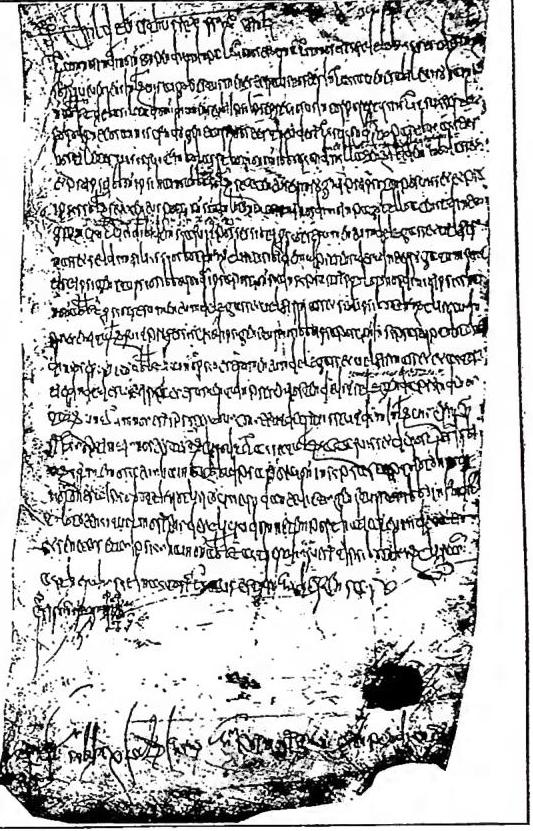
MEROVINGIAN SCRIPT AND MINIATURE. — With this term Mabillon designated the script developed in the Frankish Kingdom up to the age of Charlemagne, used for both documentary and book scripts. Today the term is given a more restricted meaning, referring to the script derived in Frankish territory along the course of the 6th century from cursive minuscule, particularly used in the Chancery of the Merovingians and early Carolingians, rarely adapted to book forms (semi-cursive m.); in the script of the codices, however, various types of pre-Caroline scripts are recognized (v. CAROLINE SCRIPT), with influences now more or less pronounced of m. Among the national scripts it is the shortest-lived: in the 9th century it survives, alongside Caroline, in some royal and imperial diplomas of particularly artificial execution; in the 10th century only sporadic traces are found.
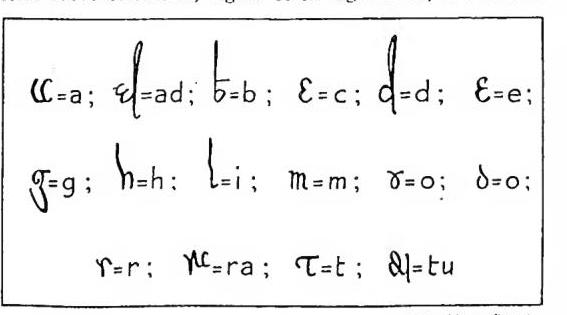
In the formation of m., the chancery element plays a predominant part: the papyrus fragment of the Homilies of St. Avitus (National Library of Paris, ms. lat. 8o13, f. 15; first half of the 6th century), in which paleographers recognize the oldest example of such script, reveals a type of evolving cursive minuscule, where Merovingian elements are hinted at as a tendency rather than fixed in their characteristics. This canonization of Merovingian elements, however, takes place within the royal Chancery, with a marked tendency toward artificial forms, with strong development of long strokes, especially upper ones, abundance of ligatures sometimes very complex, inclination of the ascenders to the left, and wavy or even broken shading. The letters are very narrow, closely spaced, and of unequal size. Particularly characteristic (v. table) are: the open a, with the two rigid strokes at the top; in ligature it is often written above the line and of smaller size; the b, which often has a horizontal stroke above the belly, with which it is linked to the following letter; the c, which besides the common form of minuscule has a particular form like two overlapping semicircles; the d, almost always in minuscule form, with the ascender descending below the line: the belly remains open at the top when the letter is linked to the previous one; the e, similar to a Greek e, which rises above the other short letters and is linked on the right with a small tongue; the g, of a semiconical type, with the tail open and the head now wavy, now bent into a ring to the left; the h, with the ascender strongly inclined to the left; the i, often elongated, upward at the beginning of a word, downward in ligature; the m and n with the legs very close together and the last often folded back: the n, however, often retains the majuscule form; the o, which has two points, in continuation of the curved line that describes the ring, from left to right, derived from the cursive minuscule form in ligature both with the preceding and following letter: by the 8th century the prolongation of the right curve tends to overhang the other, so that the o assumes the form of an 8 or an oncial d; the r with the upper element curved if isolated, rigid if in ligature; the t with the horizontal stroke bending leftward toward the inside, sometimes drawing a veritable ring: in ligature the vertical stroke bends describing an ellipse from top to bottom and from left to right, while the upper stroke curves in the same direction but from bottom to top: the result is a sort of e whose curves are closed by the vertical stroke of the letter with which the t is linked; the u, sometimes in the position of a superscript letter.
In the diplomas of the Carolingians, under the influence of the Caroline minuscule, the Merovingian elements gradually diminish. In private deeds m. generally presents freer forms; toward the end of the 8th century, however, a more careful execution is achieved, which increases at the beginning of the 9th century, until even here m. completely gives way to Caroline.
THE MINIATURE. — Given the chancery character of this script, strictly speaking one cannot speak of m. miniature. However, it is customary to indicate by this term the ornamentation of Frankish codices of the 7th and 8th centuries, i.e., the pre-Caroline miniature of France. Moreover, it is limited to decorative designs around the initials, obtained now with simple friezes, now with fantastic elements (especially birds and fish), in which, especially for some centers, the insular influence is evident. In general, the ornamentation stands out for the vividness of colors and the bizarre quality of the architecture, but always insists on the same motifs, treated moreover with rather rough technique. Figured panels do not appear in Frankish codices before the Carolingian age.
BIBL.:
a. Malton.-Pertat.-Marichal. L'écriture latine de la capitale romaine à minuscule, Paris 1939, tav. 7, 35
MEROVINGIAN SCRIPT AND MINIATURE — Diploma of Childebert III, dated from Compiègne, 23 Dec. 695 — Paris, Archives nationales, K. 3, n. 9.