Machine translation of the 1948–1954 Italian original. The original text is authoritative.
MESSICO, ARCIDIOCESI di - Archdiocese and capital city of the Republic and center of the Federal District. It has an area of 28,300 sq. km., with a population of 4,000,000 inhabitants, of whom 3,500,640 are Catholics; it has 264 parishes, served by 315 diocesan priests and 280
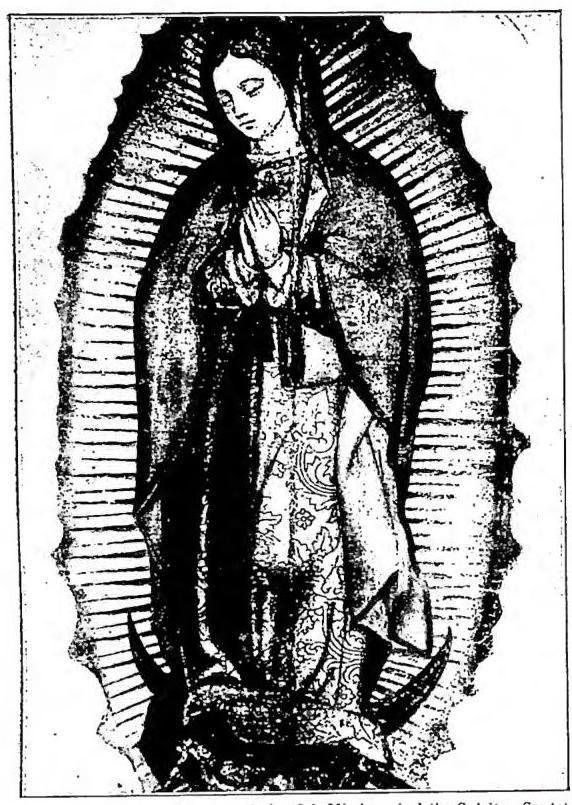
(courtesy of the Missionaries of the Holy Spirit) MESSICO, ARCIDIOCESI di - Our Lady of Guadalupe.regular priests, 342 male and 99 female communities (Ann. Pont., 1951, p. 269).
The diocese was created by Clement VII in 1530; it was elevated to an archdiocese in 1545. Pope Pius XII, with the apostolic constitution Si tam amplo of June 4, 1950, dismembered a western portion of the archdiocese, creating the new diocese of Toluca (v. : AAS, 42 [1950], pp. 711-13).
Its suffragan dioceses are Chilapa, Cuernavaca, Toluca, Tulancingo, and Vera Cruz. The Cathedral is dedicated to the B. V. ASSENZA; it occupies the site of the first Christian church built in M. as early as 1525 and of the Iglesia Mayor, which was demolished in 1573 to erect the Cathedral based on a design by A. Pérez de Casta, with modifications by J. Gomez de Mora; the construction, interrupted several times, was only completed in 1791. It suffered damage in the earthquake of 1907. The building is in the Ionic style with two large towers and five domes. In the Chapter's «Capilla pequeña», Murillo's Virgen de Belén is preserved. Other notable churches are: S. Maria degli Angeli, S. Ippolito (1525-1546); S. Brigida (1548); Gesù Nazareno (1575-1665); S. Maria della Consolazione (1581-1675); S. Diego (1593); Gesù e Maria (1597); S. Caterina da Siena (1615); S. Teresa, «la Antigua» (1678-84) with an 18th-century dome; the convento Judio and the church of Corpus Christi (1720); S. Ferdinando (1735-55); S.ma Trinità (1755-83); S. Giovanni di Dio (1766); S. Felipe de Jesús on the site of the old convent of S. Francesco (1886-97, rebuilt in 1909). The ancient church of S. Agostino is occupied by the National Library. Characteristic is the cloister of the convent of the Merced. The University was founded in 1551.
BIBL.: Eubel, III, p. 243; IV, pp. 240-41; J. Basurto, El Arzobispado de México, Messico 1901; anon., Méjico, in Enc. Eur. Am., XXXIX, pp. 346-77; J. Montes de Oca y Obregon, s. V. in Cath. Enc., X, pp. 269-70. Enrico Josi
SANTUARIO DELLA MADONNA DI GUADALUPE. - In the archdiocese is found the most famous and venerated sanctuary in all of America, namely that of Our Lady of Guadalupe, located on the hill of Tepeyac, where the blessed Virgin appeared to the Indian Juan Diego in Dec. 1531. At the site of the apparition, a small chapel was immediately built under the care of Bishop Zumárraga; a second, larger structure was erected between 1555 and 75. The third was completed in 1662. The first stone of the present Sanctuary was laid by Msgr. Aguiar y Seijas on March 25, 1695, with the generous contribution of all the Mexican people; the building was solemnly opened in 1709. A century later it was reinforced and renovated on the inside. On Dec. 12, 1747, Pope Benedict XIV proclaimed Our Lady of Guadalupe primary patroness of Mexico and two years later the same Pontiff elevated the Sanctuary to a collegiate church. On Oct. 12, 1895, the miraculous image was crowned after the Sanctuary had been further enlarged and restored for that occasion. Pope Pius X proclaimed Our Lady of Guadalupe patroness of all Latin America in 1910. Today the grandiose building is too small to contain the incessant pilgrims who crowd it in numbers of about half a million a year, among whom are counted at least 100,000 Indians who profess a most ardent devotion to their Madonna.
The exterior of the Basilica is in a semi-Moorish style with many domes and numerous octagonal towers. The interior, on the other hand, is in the Byzantine style; the altar and the rich baldachin are in Carrara marble. The miraculous image has a frame of purest gold.
BIBL.: A. García Cubas, Diccionario geográfico, histórico y biográfico de los Estados Unidos Mexicanos, III, Messico 1889; E. Articoli, Historia de la aparición de Nuestra Señora de Guadalupe, 2 voll., ivi 1897; M. Cuevas, Album histórico guadalupano del IV centenario, ivi 1930; Bernal Díaz del Castillo, Historia verdadera de la conquista de la Nueva España, 3 voll., ivi 1939; L. G. Villanueva, La Inmaculada del Tepeyac, 3ª ed., ivi 1945; M. Cuevas, Historia de la Iglesia en México, 5 voll., ivi 1946-47. Ernesto Burrus
Cite this article
“MESSICO, ARCIDIOCESI DI.” Enciclopedia Cattolica, vol. VIII (1952), p. 517. Azione Romana digital edition, https://azioneromana.com/article/messico-arcidiocesi-di.