
MICHELANGELO BUONARROTI (in his own handwritten works MICHELAGNOLO). — Sculptor, painter, architect, and poet, born at Caprese (now Caprese-Michelangelo) in Tuscany, in the valley of the Tiber, on 6 March 1475, to Ludovico di Leonardo di Buonarroto Simoni, podestà of that borough and of Chiusi, and Francesca di ser Miniato del Sera and di Bonda Rucellai, both from Florence. The claim, which he himself believed, of descent of the Buonarroti Simoni (an ancient Florentine family) from the counts of Canossa is unfounded.
Taken to Florence a few days after his birth, he was placed as a boy in the grammar school of the humanist Francesco Galeota da Urbino, known as il Greco, but without much profit, so that his father, yielding to his clear vocation, entrusted him on 1 April 1488 to Domenico and David del Ghirlandaio to learn the art of painting. No certain work from this period survives, but sources recall various drawings, among them a Temptation of St Anthony (lost), a coloured copy of an engraving by Schongauer. Frequenting, on the advice of Granacci, his fellow pupil, the Medici gardens of San Marco, filled with ancient statues and reliefs, and where Bertoldo, a pupil of Donatello, taught sculpture, Michelangelo discovered his true path and, around 1489, left the workshop of the Ghirlandaio. A Head of an Old Faun (lost), which he freely reworked from a classical fragment, attracted the attention of Lorenzo the Magnificent, who, having come to an agreement with his father, took him into his household, educating him with his own sons in an environment of refined humanist culture, dominated by Poliziano (1490–94). The latter’s Neoplatonism, and later the fiery sermons of Savonarola, deeply influenced Michelangelo’s spirit, echoes of which are heard in his poetry.
From those early years some drawings remain, already very personal in their linework (copies of the frescoes by Giotto in Santa Croce and by Masaccio at the Carmine) and two marble bas-reliefs: the Madonna of the Stairs (Florence, Casa Buonarroti) and the Battle of the Centaurs (there), a subject suggested to him by Poliziano; works that reveal in Donatello and in antique art the dual source of his early manner. While drawing in the Brancacci Chapel, a punch from the envious Torrigiani broke his nose, disfiguring his face forever, a mishap that contributed not a little to increasing his natural misanthropy. From the same period, though later, are also a marble Hercules, carved for the Strozzi in 1492 (lost at Fontainebleau in 1713), and a wooden Crucifix for Santo Spirito (the one preserved there today is of disputed authenticity).
From the very outset, therefore, the nude human figure stood out as the ideal theme of his art, and Vasari records his anatomical studies carried out on cadavers. After the death of Lorenzo the Magnificent (8 April 1492), Piero de’ Medici continued to offer Michelangelo hospitality, but not the paternal patronage; he had him model only a snow statue in the courtyard of the Palazzo di Via Larga (probably in 1494). In October 1494, alarmed by a dream of a Medici kinsman that foretold the imminent expulsion of his masters (which occurred on 8 November 1494), Michelangelo fled from Florence to Bologna, as a guest of Gianfrancesco Aldovrandi. These sudden and impulsive flights recurred many times in his life and are indicative of an abnormal nervous sensitivity. In Bologna he came under the influence of Jacopo della Quercia (reliefs on the doors of the Cathedral) and carved for the tomb of St Dominic an Angel holding a candelabrum (Bologna, San Domenico) and the statuettes of SS Peter and Proculus (there).
Returning to Florence (1495), now dominated by Savonarola, he modelled a St John (lost) and a Sleeping Cupid (lost), sold as an antique to Cardinal Raffaello Riario, who, once the deception was discovered, nonetheless admired the artist and summoned him to Rome, where he arrived on 25 June 1496.
There he drew the cartoon for a St Francis receiving the Stigmata (lost), intended for the church of San Pietro in Montorio. For Jacopo Galli, his Roman patron, he carved a Cupid (lost) and, from 1497 to about 1500, the Drunken Bacchus (Florence, Bargello), a polished statue, yet cold in its formal perfection, reflecting his new experience of classical sculpture. The unrighteous pursuit of those youthful years is revealed in the altogether different style of another work of his (the only one he signed), likewise executed in the same period, namely, the Pietà in St Peter’s in the Vatican, which at once made him famous. The group was commissioned under a contract dated 27 August 1498 by Cardinal Jean de Bilhères de Lagraulas (and not Villiers de la Groslaye, as is usually read) for the round chapel of St Petronilla, attached to the ancient Vatican Basilica. A milestone between the two centuries of the Renaissance, this marble still recalls the Quattrocento in its many Donatellesque, Leonardesque, and even Ferrarese reminiscences, while in its ideal naturalism and the almost Baroque virtuosity of its sculptural technique it already, albeit with a certain timidity, anticipates the canons of cinquecento aesthetics. In his old age Michelangelo sought to explain to Condivi the profound religious sentiment that had inspired him in executing that work.
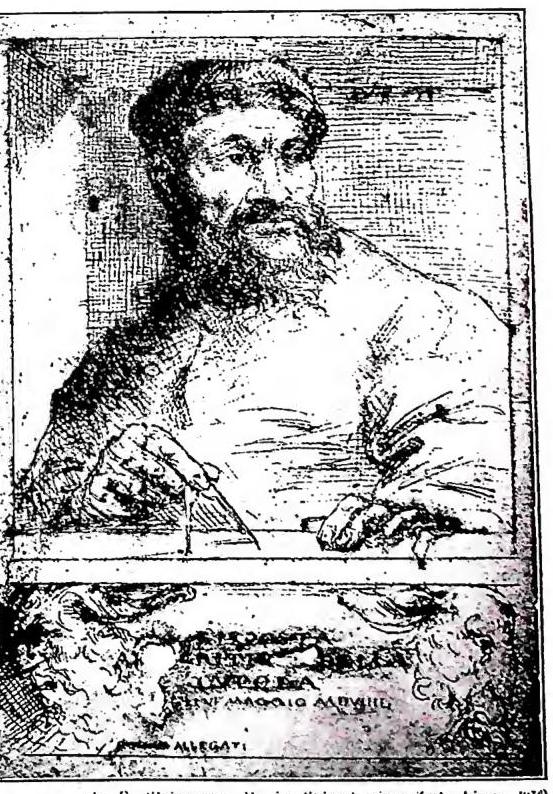
MICHELANGELO BUONARROTI — Pen drawing by an unknown artist. Rome, Gabinetto Nazionale delle Stampe.
MICHELANGELO BUONARROTI — David (detail) — Florence, Galleria d’Arte antica e moderna.
With a private deed dated 5 June 1501 from Rome, Cardinal Francesco Piccolomini (the future Pope Pius III) entrusted him with the execution of fifteen statuettes of saints for the niches of Andrea Bregno’s altar (the Piccolomini altar) in Siena Cathedral. Returning to his homeland that summer, M. completed only four of these: SS Peter, Paul, Gregory and Pius (Siena, Duomo), working on them roughly from June 1501 to autumn 1504. F. Kriegbaum (1942) rightly vindicated the interest of these lesser works, almost always neglected by scholars.
Obtaining from the consuls of the Wool Guild and the Operai of Santa Maria del Fiore (contract of 16 August 1501) a large block of marble that lay abandoned and poorly blocked out in the courtyard of the Opera, M. carved from it for the insignia of the palace (Vasari) a nude David (Florence, Accademia) with sling, five and a half metres high, known to the Florentines as the “Giant.” Begun on 13 September 1501, the work was finished in January 1504, and on 8 June 1504 the statue—after the opinion of a committee that included Botticelli, Leonardo da Vinci and Perugino—was placed on the platform before the Palazzo Vecchio, where until then stood Donatello’s Judith (replaced by a copy in 1873). In the David the heroic conception of the nude first appears in monumental form, a conception that would triumph on the Sistine ceiling and whose roots lie deep in Roman statuary (Vasari was quite right to recall, apropos of this work, the Dioscuri of the Quirinal, the Tiber and the Nile of the Belvedere).
Another David (now lost), in bronze, with the head of Goliath under its foot (a pen drawing survives in the Louvre), was commissioned by the Signoria (contract of 12 August 1502) to be presented to Marshal Pierre de Rohan. Completed in September 1508 and reworked by Benedetto da Rovezzano, it was sent to France to Florimond Robertet (Rohan meanwhile having fallen from favour) and vanished in the seventeenth century.
Of the Twelve Apostles he had undertaken for Florence Cathedral (contract of 24 April 1503), he roughed out only St Matthew (Florence, Accademia), a cerulean figure emerging from the rock, which marks a notable advance over the marble David and inaugurates the phase of his mature style. M. liked to work stone directly, without other masons, so that his “unfinished” statues (and there are many) never look incomplete: in them the aesthetic vision is always suggested in its entirety, with a mysterious and almost musical expressive power.
From October 1504 to August 1505 he drew the cartoon for the fresco of the Battle of Cascina (now lost), intended to adorn one of the long walls of the Sala dei Cinquecento in the Palazzo Vecchio in competition with Leonardo da Vinci, who on the opposite wall had already begun the Battle of Anghiari. These two celebrated cartoons were for the first generation of sixteenth-century artists what Masaccio’s Brancacci Chapel had been for the preceding generation: a “studio of craftsmen” (Vasari) and a school for masters, among them the young Raphael. Unfortunately the paintings were never executed, and the sheets were destroyed during the civic tumults of 1512, so that today only a faint reflection survives in a few original sketches or contemporary copies and prints of mediocre value.
While Leonardo had depicted in his smoky chiaroscuro a mêlée of knights around a standard, M.’s design showed Florentine soldiers surprised by an enemy assault while bathing in the Arno (an episode from the Pisan war of 1364). It was a pretext to exalt the nude in a rich and animated composition, and the fresco would doubtless have resembled, in the precise and incisive contour of forms, the plastic clarity of modelling and the clear sobriety of colour, the Deluge painted a few years later on the Sistine vault.
To the same Florentine sojourn belong further important works of uncertain date, listed below.
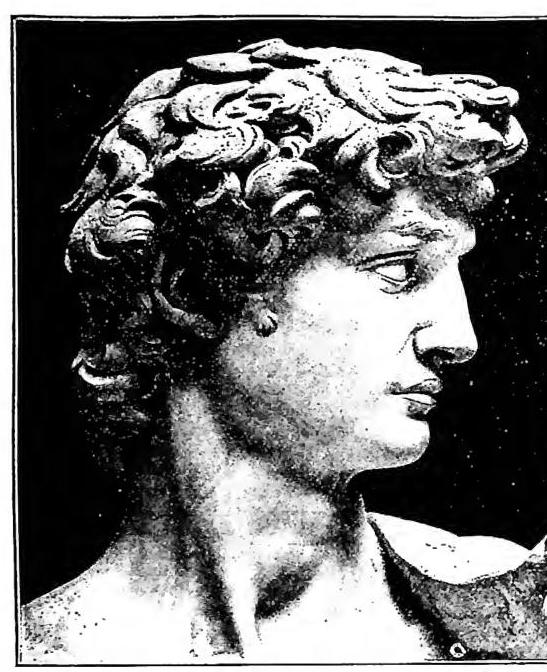
Michelangelo Buonarroti – David (detail) – Florence, Galleria d’Arte antica e moderna.
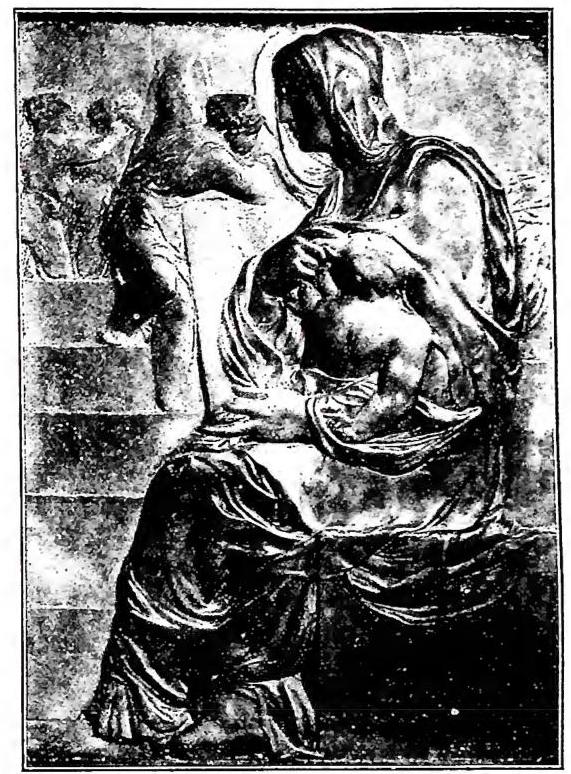
The Bruges Madonna (Bruges, Notre-Dame), a marble sold by M. in 1506 to the Mouscron and sent to Flanders, shows the Virgin pensive, almost prophetic, seated in hieratic pose (the statue is composed for frontal view, like the altarpieces of the Dugento), in dramatic contrast with the unaware Child standing between her knees. Although the forms here are more restrained, especially in the drapery and the modelling of the putto (akin to that in the Doni Tondo), the stylistic and technical affinity with the Pietà of St Peter’s is so evident as to make acceptable the hypothesis that the group still belongs to the Roman period.
Two circular marble reliefs, both unfinished, depicting the Virgin with the Child and known as the Taddei Madonna (London, Academy) and the Pitti Madonna (Florence, Bargello), seem to have been executed after 1505, the latter especially not far removed from the manner of the Sistine. Of that same year, very probably, is the only panel by M. still preserved, namely the Doni Holy Family (Florence, Uffizi), a composition marvellously balanced in the tondo format. The absolute completeness of the drawing (as conceived by Renaissance aesthetics) is here clothed in a vivid chromatic vivacity, enlivened by bold colouristic effects unique in his art.
Slightly earlier appear to be two unfinished paintings: the Madonna with Angels (London, National Gallery) and the Entombment of Christ (there), both still partly tied to late-Quattrocento stylistic modes and not universally accepted as autograph works.
In the early months of 1505, Julius II della Rovere, a pope worthy of M. for the bold grandeur of his enterprises, summoned him to Rome (apparently on the advice of Giuliano da Sangallo) and in March of that year commissioned his own Tomb (Rome, S. Pietro in Vincoli), which was to be erected in the Vatican Basilica, rebuilt by Bramante. According to the first grandiose design (known only from the descriptions by Vasari and Condivi), this truly imperial mausoleum was to resemble an isolated funerary edicule, rectangular in shape (approx. m. 10.80 x 7.20), with façades adorned with niches and pedestals bearing statues of the Arts and Virtues subdued by the death of the papal patron, and—Vasari adds—of the provinces subjected to the Church (the so-called Slaves), flanked by Termini supporting the cornice. At the corners of this structure, four large seated statues were to be placed, of which only Moses was executed; Vasari also mentions those of the Active Life, the Contemplative Life, and a St. Paul. The roof of the building, constructed with stepped, tapering sections and adorned with bronze reliefs depicting events from the life of Julius II, was to be crowned by statues of Cybele and Uranus, that is, of Earth and Heaven, holding an ark—Cybele sorrowful for having lost so great a sovereign, Uranus joyful for having received his spirit. Inside the monument, an oval chamber with two niche-like entrances on the minor façades was to house the sarcophagus of the deceased pontiff.
In April 1505, M. went to Carrara and spent eight months there selecting and quarrying the marbles, dreaming of creating a work that, in beauty, would have “no equal in the whole world” (letter from M. to G. da Sangallo, 2 May 1506). Suddenly, however, for reasons unknown, the Pope changed his mind and on 17 April 1506 refused even to receive M., who had gone to the Vatican to discuss the matter. Indignant, M. left (perhaps that same day) for Florence, where he resumed and completed the interrupted cartoon for the Battle, despite three papal briefs sent to the Signoria summoning him back (the text of that of 20 July 1506 is extant). The long dispute that followed with the heirs of Julius II over the fulfillment of the contract he called “the tragedy of the tomb” (Condivi), and it ended only with the agreement of 20 August 1542, the last of six (others known are those of 6 May 1513—i.e., the second—and 8 July 1516, one from 1525, known from correspondence, and that of 29 April 1532) that reduced the original majestic design to the modest wall monument now in S. Pietro in Vincoli, redeemed only by the powerful statue of Moses (carved around 1515), the sole one of the originally planned forty to be installed, while those of Leah and Rachel in the side niches, modeled by M. without enthusiasm around 1542, are of a cold beauty. The rest was executed by collaborators of modest talent, such as Raffaello da Montelupo and others.
Still extant from the various later projects are the following marbles: the two Slaves (Paris, Louvre), one rebellious without hope, the other resigned to his fate (both executed, like Moses, for the second contract; M. was working on it in 1513); the Trionfale Triste (Florence, Palazzo Vecchio), scornful of its own triumph (probably modeled in Florence in 1506, and perhaps one of the Virtues); and four other unfinished Slaves (Florence, Accademia).
But on 11 November 1506, the Pope, at war with the Bentivoglio, entered Bologna, and the Signoria, fearing his proximity, ordered M. to visit him under safe conduct to make peace, which occurred toward the end of the month during a stormy audience. After pardoning his flight, M. was commissioned to cast a bronze statue of Julius II (now lost), about three times life size, seated on a throne, wearing the tiara, with his right hand raised in blessing and the keys in the other. Lacking experience with bronze, M. had it cast, not without difficulty, by Maestro Bernardino d’Antonio del Ponte, and on 21 February 1508 it was solemnly raised in a marble niche on the façade of S. Petronio as a sign of dominion. It remained there only briefly, for the Bentivoglio, having retaken the city, cast it down onto the piazza and brutally destroyed it in a popular frenzy on 30 December 1511, leaving no surviving drawing or print beyond some cursory records.
M. had barely returned to Florence in early March 1508, intending to complete the Apostles for the Duomo, when Julius II summoned him to Rome and, reviving a plan he had entertained since 1506, urged him to fresco the vault of the Sistine Chapel (Vatican). Hoping to continue the work of the Se
M. attempted to avoid the new commission, pleading that he was not a painter, but he eventually yielded to the Pope’s insistence and, moreover, replaced the initial modest design (the twelve Apostles seated on thrones on the pendentives) with a vast cycle representing the history of Genesis, from the very first moment up to the Flood and the renewal of life on earth in the family of Noah. The choice of subject clearly reveals the desire to link with the two series of 15th-century paintings on the side walls, which depict episodes from the lives of Moses and Christ: to the drama of original sin is added the promise of Redemption, preserved for centuries by Israel and fulfilled in the Messiah.
On 10 May 1508 M. began work on the Vault (according to an autograph note), assisted by a group of six painters specially summoned from Florence, less perhaps to help him than to show him how fresco was painted, an art he had little or no practice in up to that time. Indeed, after completing the panel of the Flood, which he had started, and where (according to observations made by Biagetti during the most recent restorations) traces of this collaboration can still be seen, he dismissed almost all of them, retaining only a few to assist with minor tasks (painted frames, etc.).
On 14 August 1511 Julius II wished to unveil the first half of the Vault, which had been finished since the previous September, and on 31 October 1512 he had the remaining scaffolding removed, inaugurating it the following day (All Saints’ Day).
The biblical themes depicted by M. are: the Separation of Light from Darkness, where the Spirit of God moving over chaos is barely suggested with a minimum of pictorial material; the Creation of the Sun, Moon and Plants, a powerful synthesis in which the figure of the Eternal appears twice, suggesting an act of material creation in time and space; the Separation of the Earth from the Waters and the Creation of Fishes, an episode placed after the following one but positioned here to leave more space for it; the Creation of Man, in whom the limbs, already formed with ideal beauty, receive the spark of life from the finger of God brought close to his; the Creation of Woman, drawn forth in adoration from the side of the sleeping Adam; the Original Sin and the Expulsion from Paradise, a diptych in which guilt and punishment seem to spring from the same trunk of the Tree of Good and Evil; the Sacrifice of Noah, who remained faithful to God in a corrupt world; the Universal Flood, which shows the painter’s initial inexperience in figures too small for the great height; and finally the Drunkenness of Noah, a poignant epilogue to the solemn cycle, where the evil that escaped the Flood is seen with the few survivors.
The figure of the first patriarch links the stories of Genesis with the 15th-century scenes of the Life of Moses (below), making the entire painted decoration of the Sistine a unified whole. The individual scenes are arranged in five larger and four smaller rectangles alternating along the axis of the vault, and seem to appear through the gaps in the rich architectural framework, as if they were celestial visions. Yet they are painted without illusionistic foreshortening, as simple wall frescoes meant to be viewed from the entrance door, arranged in an approximately chronological order that begins above the altar and then proceeds in reverse to the order in which they were executed.
The drama is reflected in the joy and sorrow of the twenty ignudi, flanking, two by two, the smaller rectangles; it echoes in the thought of the seven Prophets and five Sibyls seated on thrones in the pendentives; and it lives on in the promise of Redemption within the obscure faith of the so-called Ancestors of Christ (the medieval “Tree of Jesse”) depicted on the spandrels and lunettes. In the spandrels are four episodes alluding to the Messiah: David and Goliath, Judith and Holofernes, the Punishment of Haman and the Brazen Serpent.
The unveiling of the Sistine Vault marks perhaps the most memorable date. It was the apogee of the Tuscan Renaissance, which beheld in it the perfect fulfillment of its fundamental aesthetic principle: that of *disegno*, as it had developed from Giotto to Masaccio and Ghirlandaio. In these frescoes, a theme of the highest human interest was translated into images whose realism contemporaries were to regard as idealized in the very sense suggested by the “true,” following the example of classical art, and whose expressive power was entrusted above all to *disegno*, understood as the linear harmony of the contour and the sense of plastic relief, given by chiaroscuro and enlivened by colour in a subordinate role.
The famous saying of M., that sculpture is the “lantern of painting” (M.’s letter to Benedetto Varchi, 1549), finds a marvellous commentary in the Sistine Vault, where he has in part transferred, unable to express them in marble, certain motifs akin to those he had imagined for the tomb of Pope della Rovere. And yet these frescoes, executed by a sculptor and almost by compulsion, are the most monumental pictorial work of the 16th century, of decisive importance for the further development of Italian art.
After the death of Julius II (21 February 1513), M. had returned to his beloved work on the Tomb, for which he had made a new design (in the form of a chapel attached to the wall) and a second contract (6 May 1513). But on 5 December 1516 he had to go to Rome from Carrara, where he had been obtaining marble for that monument, summoned by Leo X de’ Medici (elected 11 March 1513), who had chosen his design for the façade of San Lorenzo in Florence (contract of 19 January 1518), presented in competition with other artists, among them Antonio da Sangallo and Raphael. M. began work on his design, resolved to make it “a mirror of all Italy in architecture and sculpture” (M.’s letter to Domenico Buonincontri, 2 May 1517), but after more than three years spent in vain in the quarries of Pietrasanta, on 10 March 1520 he regained his freedom from the Pope, who desired “to finish the said façade more quickly” (M.’s note on that date); of it, beyond the foundations, only a wooden model survives (Florence, Casa Buonarroti).
Between 1519 and 1520 he had also carved for Metello Vari (contract of 14 June 1514) a Risen Christ with the Cross (Rome, Santa Maria sopra Minerva), a marble partly spoiled by his assistant Pietro Urbani but then reworked by Federico Frizzi and finished by M. himself in 1521. This is perhaps, as it now appears, the least Michelangelesque of his figures.
After the death of LEO X on 1 December 1521, the Dutchman ADRIAN VI FLORENS succeeded him on 9 January 1522. A pope of severe morals, he was little inclined toward men of letters and artists, who deserted Rome during his brief reign, which ended on 14 September 1523. At that time Michelangelo was engaged in Florence on the Tomb of Julius II. Cardinal Giulio de’ Medici, elected on 18 November 1523 under the name of CLEMENT VII, confirmed to Michelangelo the commission that had been entrusted to him since late 1520 (work had begun in March 1521) to construct the interior of the New Sacristy of San Lorenzo (Florence) and to carve within it the tombs of Giuliano, Duke of Nemours; Lorenzo, Duke of Urbino; Lorenzo the Magnificent; Giuliano his brother; those of Leo X; and his own (allocated in 1524 but not executed), intending it to serve as the mausoleum of his House.
Following the example of Brunelleschi, Michelangelo clad the white walls, which were to be partly frescoed, in a solid framework of cornices, arches, and pilasters, divided into two superimposed orders and executed in dark macigno, covering the rectangular space (extended by a small sacrarium) with a hemispherical coffered dome surmounted by a lantern of novel form (completed in 1525). In this architecture the elegance of Florentine modules reveals unsuspected possibilities of vigour, reworked as they are in a highly personal style, whose absolute novelty was already noted by Vasari, even while respecting classical tradition. The original design (1520–1524) had grouped the monuments at the centre of the chapel, but this was soon abandoned in favour of a new project of three tombs set against the wall, each adorned with two recumbent figures on the chests and two Rivers lying on the ground, on which Michelangelo worked from 1524 to 1526. From this phase date the marbles of Day (unfinished), Night (famous also for the exchange of epigrams between G. Strozzi and Michelangelo), the Duke Lorenzo (an ideal figure, not a portrait, as also that of Giuliano), the fragmentary clay model of a River (Florence, Accademia), and the Young Slave (Leningrad, Hermitage), perhaps a study for a caryatid. Begun much earlier, however, was the Madonna and Child (unfinished), reminiscent of the youthful version in the Scala, absorbed in the same sorrowful meditation.
After 1531 were carved the Duke Giuliano, Dusk (completed), and Dawn. Day and Night were meant to lie atop the flat lid of a sarcophagus at the feet of the Madonna, with two Rivers on the ground; their present, not altogether felicitous placement (their legs unsupported), due to Tribolo, dates from after Michelangelo’s definitive departure for Rome in 1534. Of the various projects there remain today the monument of the restless Giuliano with the statues of Day, in an attitude of defence, and Night, tormented by a nightmare (to the right of one facing the altar), that of Lorenzo (opposite), the mournful Thought, with the resigned Dusk and the hopeless Dawn, as well as, facing the altar, the anguished Madonna and the statues of SS. Cosmas and Damian (patrons of the Medici family), executed from the master’s design by Montorsoli and Raffaello da Montelupo. In the finished parts these marbles approach the art of the chisel without sacrificing any of their essential sobriety and plastic power.
The New Sacristy is the only monumental ensemble by Michelangelo that matured somewhat beyond the pale reflection of the initial idea. Its statues and its architecture, animated by a shared passion, display the same crystalline perfection as the frescoes of the Sistine vault, and in this most vigilant idiom they express the almost despairing vision with which, even then, Michelangelo regarded all human things.
Of a similar style (and Vasari rightly notes its “resolved grace”) is the reading room of the Medicean Library (now the Laurentian Library), built beside San Lorenzo and allocated to him, with the dais and wooden benches, by Clement VII in 1524. Michelangelo directed the works from about 1526 until 1534, when they ceased owing to the Pope’s death, and even in 1558 he sent Ammannati the design for the capricious staircase of the atrium, completed only in our own day.
---
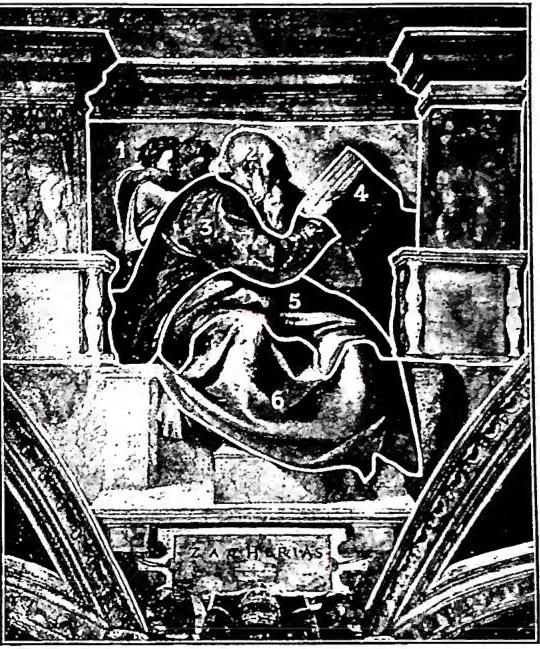
**MICHELANGELO BUONARROTI – The Prophet Zechariah (white lines mark the seams delimiting the working zones) – Sistine Chapel.**
Upon learning of the Sack of Rome, the Florentines once more expelled the Medici (17 May 1527) and restored the Republic. When the armies of Clement VII and the Emperor, now reconciled, moved against the city, Michelangelo was named one of the Nine of the Militia (10 January 1529) and general superintendent of the fortifications (6 April 1529). In that capacity he took an active part in the defence, carrying out military missions to Pisa, Livorno, and Ferrara, and fortifying the Hill of San Miniato. Warned during the siege of the imminent treachery of Malatesta Baglioni, he fled to Ferrara (21 September 1529) and thence to Venice, so that he was placed under ban by the Republic (22 September 1529). Shortly afterward, however, he returned home, and upon the commutation of his sentence (23 November 1529) resumed his duties. After the fall of Florence (2 August 1530), Michelangelo, pardoned by the Pope, devoted himself entirely to the works of the Sacristy and the Laurentian Library. Also from this period are the Shrine for relics above the main door of San Lorenzo (1531), a painted panel of Leda for Alfonso d’Este, later given to Antonio Mini and destroyed in France, the cartoon for a Venus kissed by Cupid, coloured by Pontormo (Florence, Uffizi), and an unfinished marble Apollo (Florence, Bargello) for Baccio Valori.
From 1532 to 1534 Michelangelo divided his activity between Florence and Rome, where he had resumed work on the Tomb of Julius II, hoping finally to bring it to completion, when on 23 September 1534 he moved permanently to Rome. Within two days Clement VII died, and his successor Paul III Farnese (elected 13 October 1534) appointed him painter, sculptor, and architect of the Sacred Palaces (brief of 1 September 1535), imposing upon him, despite his resistance, the execution at the age of sixty of the immense fresco of the Last Judgement in the Sistine Chapel (Vatican). The cartoon (now lost) of this work, seen by the new Pope during a visit to Michelangelo’s studio, had been drawn at the request (1533) of Pope Clement, who had revived this unusual theme in Renaissance art and decided to have it painted not on the main door of the Chapel, its traditional
A figure often mistakenly taken to be Adam. In the middle section are the risen ascending to heaven (on the left), the angels (in the center) with trumpets and the books of Life and Death (the former small, the latter enormous), and the ruin of the damned vainly rebelling against the celestial host (on the right). In the lower zone is the resurrection of the dead, contested between angels and demons (on the left), a cavern filled with devils (in the center), and Charon’s boat overturning its load at the threshold of Hell, where Minos (portrayed as Biagio Martinelli of Cesena, master of ceremonies to Paul III and incautious critic of the *Last Judgment*) receives the sinners (on the right). Two episodes are drawn from the *Divine Comedy* (others, noted by Steinmann, remain uncertain), while the influence of Holy Scripture (particularly investigated by Thode) operates indirectly through iconographic tradition. That of the *Dies Irae* is evident in many details, such as the terror of the just (dum vix iustus sit securus) and the pensive skull among the rising dead (Mors stupebit). Classical reminiscences are clear in the trumpet-bearing angels, akin to the Winds, but above all in Christ, whose limbs are those of a Hercules and whose face, with strange syncretism, recalls the Apollo Belvedere. Michelangelo, wishing to represent the body of the risen Son of God, here, as a man of his time, attempts to Christianize the ancient symbols of strength and beauty, even though he was unjustly reproached for paganizing a Christian ideal. To the pre-Tridentine religious controversies, however, other elements of the fresco refer, such as the Virgin enclosed, as it were, in the same nimbus as the Redeemer, the value of good works symbolized in the martyrs who present to the Judge the instruments of their torment, the prominence given to the gigantic figure of St Peter with his enormous keys, and finally the efficacy of Marian devotion shown in the two risen lifted to heaven by an angel clinging to a rosary.
Thus, after evoking on the Sistine Ceiling the beginning of the universe, Michelangelo depicts its end on the vast wall. In the quarter-century separating the two works, his spirit and art had changed. In that profoundly Christian soul, his affection for Vittoria Colonna, his disregard for death, and the tempests raging against the Church had exalted religious feeling to the point of mysticism. Hence arose his so-called “third manner,” the outcome of a simultaneous ethical and aesthetic crisis that in the *Last Judgment* makes its first appearance. Faced with the urgency to express, at all costs, the hopes and anxieties of his tormented faith, the interest in the “beautiful,” as conceived by his century, gave way: “Make me hate whatever the world esteems— / And all the beauties I once prized and loved” (C. Frey [q.V. bibliography], no. CL). In the *Last Judgment* he treats proportion and perspective, the two aesthetic dogmas of the Renaissance, with a freedom inconceivable at the time of the Ceiling and incomprehensible to his contemporaries, no less perhaps than the other audacities of that work (such as the nudity of the figures, the beardless angels) reproached him in the well-known *Dialogi* of Gilio da Fabriano (1565).
From the same period is the unfinished but astonishingly sketched bust of Brutus (Florence, Bargello), carved after 1539 at the request of Donato Giannotti for Cardinal Ridolfi and allusive to Lorenzino de’ Medici, the assassin of the despotic Duke Alessandro (1537). The manly effigy of the tyrannicide, perhaps inspired by an ancient bust of Caracalla, despite its incompleteness (and perhaps precisely because of it), proclaims Michelangelo’s love for his country’s freedom with a vehemence all the stronger in artistic expression for having been repressed in life. Also from these years is the so-called Palestrina Pietà.