
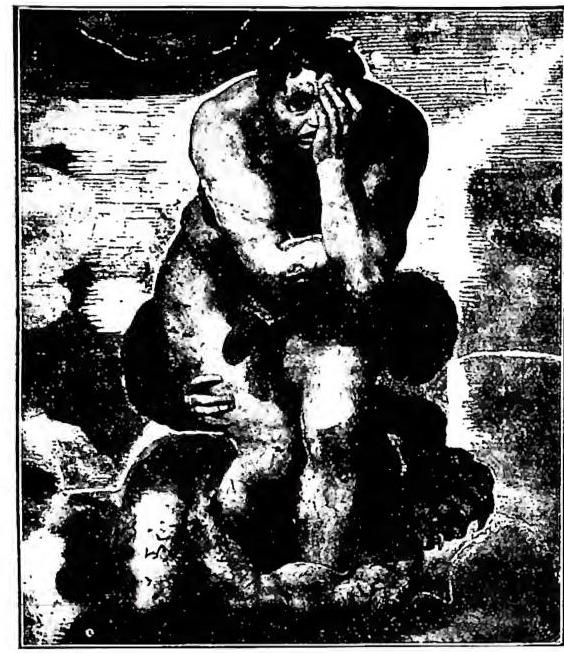
MICHELANGELO BUONARROTI – A damned soul. Detail of The Last Judgment – Rome, Sistine Chapel.
The subject of the fresco, which is vast and corresponds to the liturgy, is on the altar wall (Condivi), perhaps in memory of the Sack of Rome in May 1527, regarded by many as a divine judgment upon the excesses of the Renaissance. For Paul III, however, the psalm of the unhappy Medici pope became the grand manifesto of the Catholic Reformation, which he tenaciously desired and brought to fruition only at the Council of Trent. This interpretation seems confirmed by not a few details in the fresco alluding to the theological controversies of the time. These, and especially the disputes concerning Grace and works, deeply interested Michelangelo, particularly after he came into contact, around 1536 through Vittoria Colonna, with her circle of friends (Contarini, Pole, Morone, Lattanzio Tolomei and others), the center of the so-called Italian evangelism (v.), whose theories on Grace were inspired by an extreme Augustinianism. Preliminary work began in April 1535, and the execution of the fresco lasted from the summer of 1536 to the autumn of 1541. Paul III dedicated the painting on 31 October 1541, to the “stupore e meraviglia” (Vasari) of contemporaries, who were stunned by Michelangelo’s new manner and the “terribilità” (as they called it) of a work that seemed truly the Dies Irae of a dying Renaissance. In its essential iconographic elements and its zoned arrangement, the composition, though seemingly confused, does not depart greatly from the usual medieval scheme of the Last Judgment. The two lunettes at the top show angels bearing the instruments of the Passion. In the upper zone the blessed (men on the right, women on the left) gaze in terror at the condemning gesture of Christ the Judge (at the center), around whom, with SS. Peter, Andrew, Lawrence and Bartholomew (in whose flayed skin a self-portrait of Michelangelo appears), are seen the Virgin and the Baptist (the Byzantine deesis).
---
A work of sculpture that has been little studied is the so-called Florentine Pietà (Florence, Accademia), likewise unfinished, a colossal marble group not mentioned in the sources and not universally accepted as his work. It was attributed to Michelangelo in L. Cecconi’s Storia di Palestrina (Ascoli 1756), then forgotten, rediscovered only in 1875 by P. Gori and finally published in 1907 by A. Grenier; in this group Mariani rightly sees the style of the Last Judgment transferred into sculpture.
In October 1541, before the Sistine wall was even uncovered, Paul III had already commissioned Michelangelo to fresco in the Pauline Chapel (Vatican) the Conversion of Saul and the Martyrdom of St. Peter (a subject perhaps substituted for an original Delivery of the Keys). The work, delayed by two illnesses of Michelangelo and disturbed by the death of Vittoria Colonna (25 February 1547), lasted from the last months of 1542 to about the middle of 1545 for the first painting, and from the autumn of that year until about March 1550 for the second. Here the “third manner,” already hinted at in the Last Judgment, triumphs unchallenged, so that the incomprehension of contemporaries and later generations toward these late works has always been complete. Michelangelo himself may have been struck by the profound change in his art: certainly, as long as he lived he never again took up the brush, devoting his final years to the abstract and non-human beauty of architecture, almost as if seeking peace there, though even in that medium he infused the reflection of his spiritual conflicts.
After the death of Antonio da Sangallo, Michelangelo succeeded him as architect of St. Peter’s Basilica (Paul III’s brief of 10 January 1547, dispatched 11 October 1549), working there “for the love of God and without any reward” (Vasari). He returned to Bramante’s Greek-cross plan and its simplicity, making the façades a single order of grand Corinthian pilasters as the base for the dome, which dominates the atrium façade. When Michelangelo died, construction had reached the drum, and the architects G. Della Porta and D. Fontana, charged with completing it, deviated slightly from the wooden model (Vatican, St. Peter’s) by giving the external shell a less hemispherical profile for structural reasons and refining the ribs.
Other architectural works of this period include: the funerary monument of Cecchino dei Bracci (Rome, S. Maria in Araceli), built in 1545, which also contains a bust of the deceased, probably executed from his model; various parts, and in particular the cornice of Palazzo Farnese (Rome), of the following year; the arrangement of the Piazza del Campidoglio with the new Palazzo dei Conservatori and Palazzo Senatorio, completed according to his designs but not without alterations to the original plan, especially in the central windows, after his death (Michelangelo had been granted Roman citizenship on 17 December 1537); the Porta Pia (Rome, c. 1561), and other constructions such as the Vigna di Giulio III (Rome) or the destroyed Ponte di S. Trinita in Florence, to which he contributed with designs or advice.
These were his public works in those years, but for himself and almost in secret (as Vasari affirms), he carved for his tomb, between about 1550 and 1553, the Pietà of the Duomo (Florence, S. Maria del Fiore), with a self-portrait in the figure of Nicodemus, and in the last days of his life he was still chiseling away at the phantom-like Rondanini Pietà (Rome, house of the Counts Sanseverino), both left unfinished. In this final work, on the threshold of his ninetieth year, Michelangelo attempts once more to transform his style entirely, reducing the titanic figures of a previous and likewise unfinished group (a detached arm remains beside the Christ) to spectral bodies, of an almost Rembrandtian aspect, pared down to the bare minimum necessary to render the spirit perceptible. His predilection for this theme of the Pietà, a sign of his intense faith, is echoed in the invocation to the embrace of the Crucified that closes one of his sonnets and proclaims the great renunciation: “Né pinger, né scolpir fé piu che quieti — L'anima, volta a quell'amor divino — C'aperse a prender noi 'n croce le braccia” (C. Frey [V. BIBLICA.], no. CXLVI).
Michelangelo died in Rome, in his house in Macel de’ Corvi (destroyed), on 18 February 1564, and was provisionally buried in SS. Apostoli, whence he was secretly exhumed, transferred to Florence and laid to rest with solemn funeral rites in the monument designed by Vasari in S. Croce.
— Vedi tav. LIX-LX.