
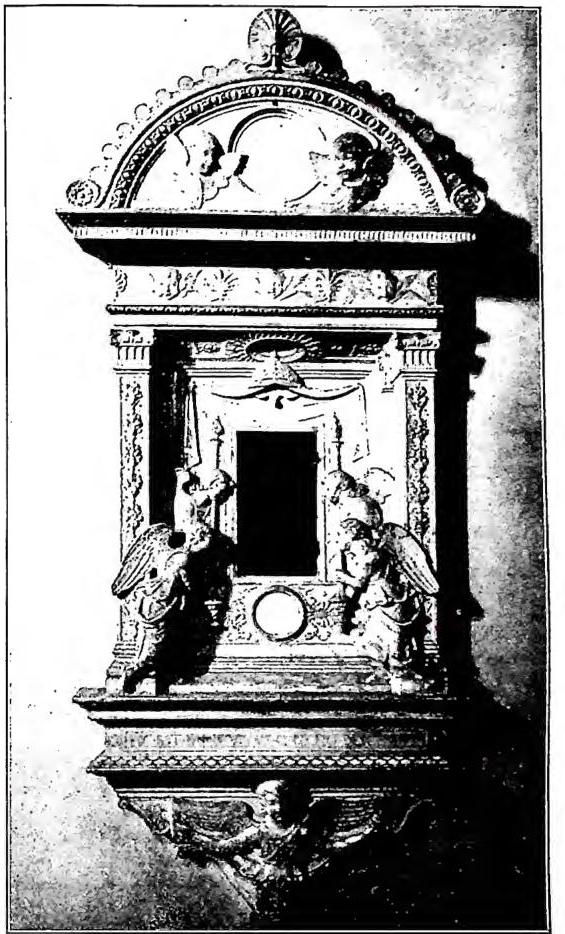
MINO da FIESOLE (M. di GIOVANNI MINI da POPPO or M. da FLORENTIA). — Sculptor, born at Poppi in Casentino between 1430 and 1431, died in Florence in 1484. He worked in Florence, Perugia, Volterra, and Rome. A pupil or follower of Desiderio da Settignano, from 1454 he made frequent trips to Rome; he was indeed still there between 1461 and 1463 when he worked on the pulpit for the benediction of Pius II, and he even settled there between 1473 and 1480. Among his earliest and most characteristic works, in addition to several busts that are more or less debated by critics, is the monument to Bishop Salutati in the cathedral of Fiesole (c. 1466), where Mino also executed a marble triptych. In Florence his works include the tomb of Bernardo Guigni (1468) in the Badia church, where there is also the altar with a marble triptych he carved for Diotaiuti Neroni (1470), and the later funerary monument of Count Ugo. Also in Florence are a ciborium in Santa Croce and a tabernacle in Sant’Ambrogio (1481), while the National Museum of the Bargello preserves several reliefs attributed to him, including a supremely refined Madonna and Child and the bust of Rinaldo della Luna, considered his masterpiece in the field of portraiture. In Volterra is a tabernacle in the cathedral, in Perugia an altarpiece in the church of San Pietro (1475), and in Rome, besides various collaborations in the enterprises of Andrea Bregno, the monument to Cardinal Forteguerri (1473) in Santa Cecilia and the truly elegant one to Francesco Tornabuoni (1480) in Santa Maria sopra Minerva.
The judgment passed on Mino by Vasari—“più graziato che fondato nell’arte” (“more graced than grounded in art”)—after the exaltations of the 19th century, has regained validity. This is made possible because the values of the most noble sculpture of Desiderio da Settignano, from which Mino’s art derives, have been more clearly defined. From it Mino derives only an outward imitation, if ever directed toward perfecting the technical work of marble in extreme refinements that add only a superficial grace to the images, to which, however, it would be unjust to deny positive qualities of elegance and compositional balance. This is testified, if nothing else, by the comparison that can be made in Rome between his works and those of Mino del Reame, who in the ciborium of Santa Maria Maggiore and in other marbles imitated the forms of his Tuscan namesake.