
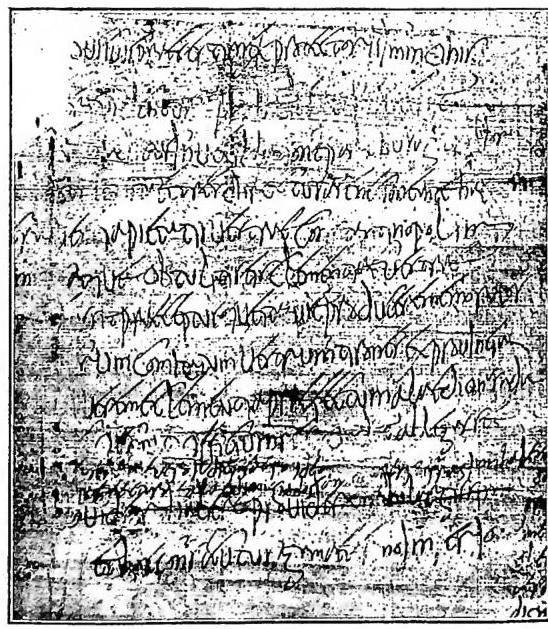
MINUSCOLA PRECAROLINA, WRITING — AND MINIATURE: V. CAROLINA WRITING AND MINIATURE.
MINUSCULE, WRITING.
Like the term "majuscule" (v.), the term "minuscule" also encompasses a general idea based on the reciprocal relationship of the size of the letters within the same alphabet, and is properly applied to all those scripts in which the upper and lower extremities of the letters are delimited by a quadrilinear system (v. the illustration under the heading MAJUSCULE, WRITING). However, the word has also been taken as a noun to indicate a particular type of script, both in Greek paleography—where it designates a set form of writing distinct from the uncial—and in Latin paleography, though the meaning is not always unambiguous.
### 1. In Greek Paleography.
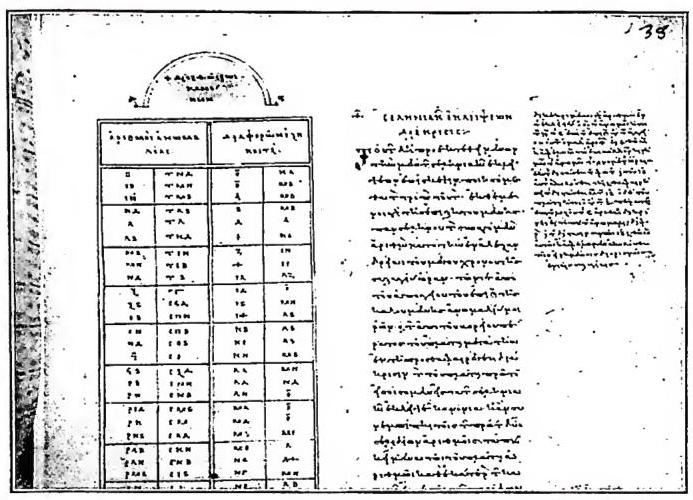
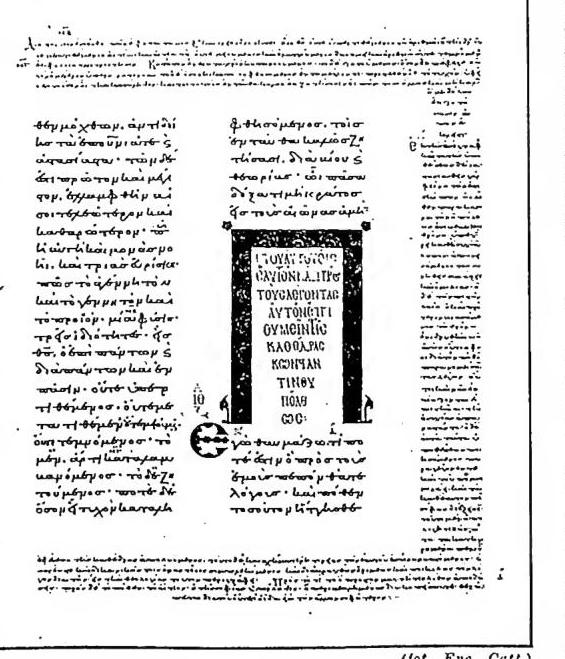
In the 8th century, a minuscule script emerged and gradually evolved from the Byzantine type of cursive writing (v.). Initially, it was nothing more than the contemporary cursive script written with greater care and elegance of form, also due to the writing material used: parchment. But by the 9th century, it had assumed its definitive form, which it retained, more or less, in subsequent periods. In this century, it replaced the uncial script in literary use, which continued to be employed only in liturgical manuscripts. The earliest dated document in this script is the so-called Uspenski Gospel (named after the bishop who discovered it in the library of the monastery of St. Sabas in Jerusalem and acquired it), completed on May 7, 835, in the famous Monastery of Studium in Constantinople, according to the opinion of T. W. Allen, and now preserved in the Library of Leningrad (cod. no. 219).
In the earliest documents, the Greek minuscule presents straight letters lacking flexibility, with small accents and angular breathings (↓, ↓, ↓) characteristic of uncial writing. Later, while retaining its beauty and elegance of form, it gained greater freedom. Until the beginning of the 10th century, the minuscule remained free from any uncial forms, but from the mid-10th century onward, no manuscripts in pure minuscule are known. Initially, there was a tendency to include uncial letters only at the beginning or end of a line; then uncial letters appeared in increasing numbers until they prevailed over the minuscule forms, and the two styles alternated without clear distinction. At the same time, some letters became disproportionately wide, ligatures became so capricious that they sometimes altered the original form of the letters, accents and breathings enlarged (the latter taking on the modern rounded form) and were joined together or to the letters they referred to. From this type of script, the earliest printed characters were derived.
With regard to age, manuscripts in Greek minuscule are divided into: *codices vetustissimi*, up to the mid-10th century; *codices vetusti*, until around the mid-12th century; *codices recentiores*, until around the mid-15th century; and finally *codices novelli*, those from later periods.
### 2. In Latin Paleography.
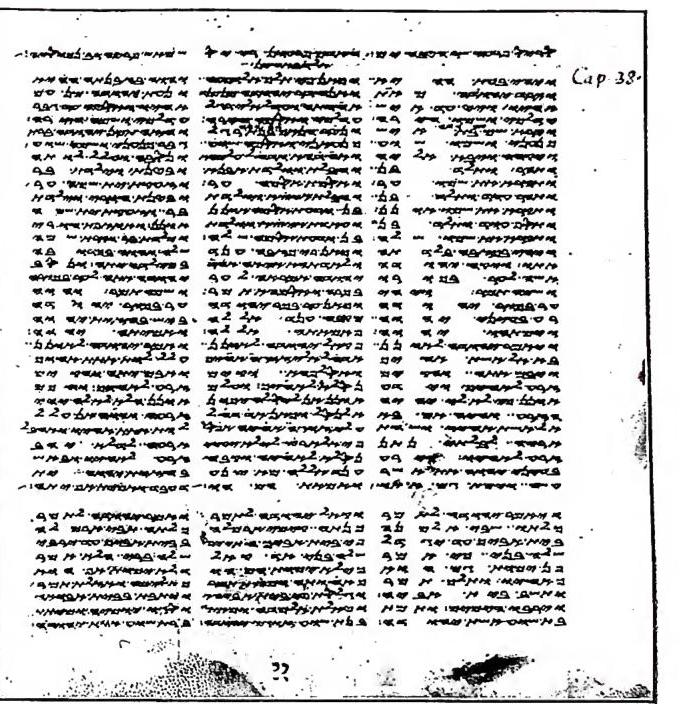
In the field of Latin paleography, the term "minuscule" is predominantly used to indicate the set form of writing as opposed to the cursive form, where both styles coexist for the same script (Visigothic, Gothic, Humanistic), or to designate the set minuscule script par excellence, the Carolingian (v.). Some treatises also use the expression "ancient minuscule" to refer to the semi-uncial script (v. ONCIAL AND SEMI-UNCAL, WRITING), as it is the oldest Latin book script to show a predominance of minuscule forms. However, such terminology is easily misleading, since the cursive script, which developed roughly contemporaneously with the semi-uncial (v. CORSIVA, WRITING), is also a minuscule script. All things considered, it seems preferable to restrict the term "minuscule" to its proper meaning (i.e., as the opposite of "majuscule"), rejecting its use in the sense of non-cursive writing. For the evolution from majuscule to minuscule forms, V. PALEOGRAPHY.