
MONSABRE, Jacques-Marie-Louis Ristrato.
MONSABRE, Jacques-Marie-Louis Ristrato.
was an ascetic center from which St. Ignatius himself later drew benefit when, in 1522, he tested his spiritual weapons there. Between 1499–1500 and 1518–26 the monastery possessed a renowned printing press. During the 16th and 17th centuries, Monsabré enjoyed great cultural splendor. The principal disciplines cultivated there included Sacred Scripture (Lloret, Capellades, Ricci), theology (Malvenda, Tàpies, Escaules), ascetics and mysticism (Ven. Cisneros, Ven. Chanon, Ven. Alfonso de Burgos, Garriga, Ven. Giuseppe di S. Benedetto, called “de les Llànties”), painting (G. Andrea Ricci, Barre), music (alongside the direction of the Escolania, which dates back to the 12th century; Marqués, Lopez, Cererols, Viola, Casanovas), classical letters (Brenach, Solà), history (Burgos, Montegut, Genc, Guerin, Ribas, Bragado), and the physical sciences (Ametller, Castell). Especially notable in these centuries was the spread of devotion to the Virgin of Monsabré in many countries of Central Europe and South America. Numerous churches, including cathedrals and abbeys, were dedicated to her; in Italy alone, there are no fewer than 150 altars, chapels, and churches dedicated to her.
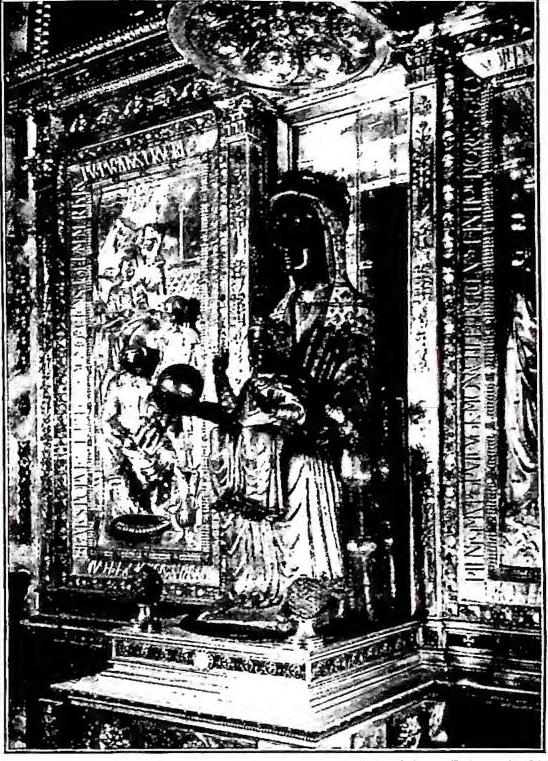
After overcoming no small difficulties arising from the coexistence of Catalan and Castilian monks who alternated in the temporal abbacy, the monastery reached a period of splendor at the beginning of the 19th century. The almost total destruction of the monastery in the fire caused by Napoleon’s troops in 1811, followed by its spoliation by the government in 1835, ruined centuries of work. In 1844, the community returned to the monastery after a forced absence of nine years. It was due to the monastic zeal of the last abbots, especially Michele Muntadas (1865–85) and Antonio Marcet (1912–46), that, under the current abbot Aurelio Escarré, the monastery has regained its former religious and cultural splendor. During the last Spanish Civil War (1936–39), 23 of its monks were killed by anarchist hatred. The Holy Icon of the Madonna (late 12th century, in polychrome wood), canonically crowned in 1881, was solemnly enthroned by Cardinal Legate Arce in 1947 upon a new precious throne, with silver lamps and musical offerings from Catalan devotees around the world.
From the 12th century, following the first miracles attested in writing, pilgrimages began and grew ever more numerous in the following centuries. In 1225, the Confraternity of the Madonna was established, which soon counted among its members bishops, kings, and popes (new regulations in 1445, 1881). Already in the 14th century, popular piety, embellishing the somewhat obscure origins, wove the most beautiful and poetic legends around them. Poets of all ages have sung of her miracles and beauties, from King Alfonso the Wise of Castile in his *Cantigas* to Lope de Vega, Verdaguer, and Sagarra—though the connection with the legend of the Holy Grail, often mentioned in relation to Wagner’s *Parsifal*, is not true. In the 17th–19th centuries, the Benedictine Congregation of Monsabré expanded into Austria, Bohemia, and Brazil, as well as Australia and the Philippine Islands. Today, the pilgrims who annually ascend to the Sanctuary often number as many as 500,000.
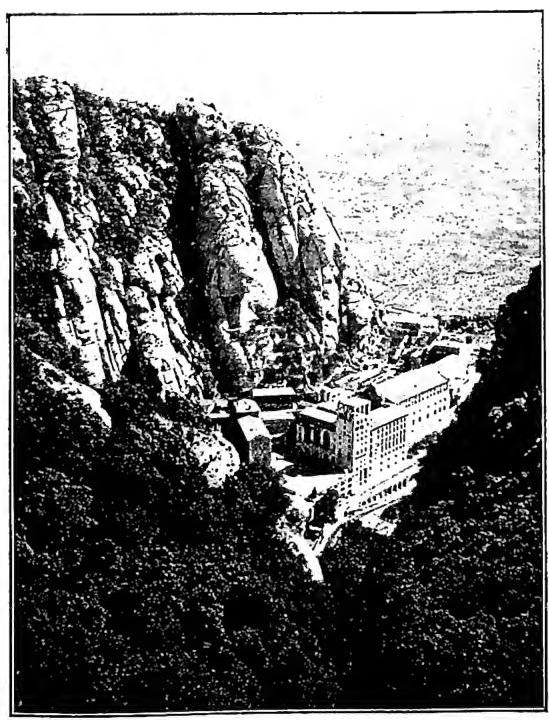
The church (a basilica since 1881) dates to the second half of the 16th century (interior decoration from the late 19th and 20th centuries); only the Romanesque sculpted portal (12th century) remains from the ancient structure. The bell tower is an old defensive tower (14th–16th centuries); the Gothic cloister was built during the time of Cardinal Della Rovere (c. 1480); the monastery itself dates from 1755 to 1764. Nearby (2 km away), the monastic church of St. Cecilia, consecrated in 957, still stands, with remains of contemporary frescoes. Scattered across the mountain are several chapels that once housed hermits; the oldest preserved ones are: St. Margaret (Visigothic, 8th or 9th century?), St. Paul (11th–12th centuries), St. Acisclus (within the present monastery, 11th–13th centuries), and the Holy Trinity (remains from the 15th century).
The monastery possesses a library (c. 170,000 volumes, 1,150 manuscripts, 400 incunabula, 30,000 pamphlets), a music archive (2,000 manuscripts), an archive (5,000 parchments, c. 30,000 documents on Catalan monasteries), a picture gallery (over 300 paintings; Perin del Vaga, Sassoferrato, Il Francia, El Greco, van Dyck, Ricci, Morales, Bermejo, Berruguete, Catalan panels from the 15th century, modern works), an Egyptian and Biblical museum, and a printing press that publishes the following collections: the *Bible of Monsabré*, a Catalan version with commentary (in 20 volumes of text and 10 illustrations, by Ubach, Obiols, Augé, Junqué, Riera, Bellet; in progress), *Analecta Montserratensia* and *Catalonia Monastica* (historical collections; 7 and 2 volumes respectively), *Mestres de l’Escolania de Montserrat* (5 volumes, Pujol), *Místicas de Montserrat*, *Biblioteca Monàstica*, *Biblioteca Litúrgica*, etc.