
MONTENEGRO. – Today one of the six federated Republics in the Yugoslav state.
I. GEOGRAPHY
Montenegro (or Cernagora) is formed by the southernmost part of the Dinaric range, on the border between Herzegovina and the Albanian Alps, and is a rugged, mountainous country where broad karst “doline” and “fields” alternate with deep gorges and valleys (Zeta, Morača); it is therefore generally arid and often barren and desolate. The short Adriatic coastline opens into the winding indentation of the Bay of Kotor and ends at the mouth of the Bojana, which drains Lake Scutari, partly in Albania. The economy is pastoral-agricultural (vines, olives, fruit, and tobacco). There are few notable inhabited centers. The capital of the present-day Republic (13,067 sq. km. with 376,573 inhabitants; density 27 per sq. km.), Podgorica (now Titograd, 12,000 inhabitants), has replaced the old capital, Cetinje.II. CIVIL HISTORY
The present-day Montenegro only assumed that name and a distinct physiognomy in the first half of the 15th century, as a development of one of the earliest state formations among the Serbs (most of whose inhabitants followed the schism of Michael Cerularius), the so-called Zeta (12th century), a territory that, remaining substantially immune—because of its rugged, mountainous character—from invasions, long maintained a Western and Latin imprint. Indeed, Montenegro enters history in 1452 under the aegis of Venice, which entrusts Stefano Crnojević with the office of captain and duke of Upper Zeta. As such, Montenegro long represented in the Balkans the outpost of Venice and Christendom against the Turk, who, after repeated assaults and bitter struggles, in 1499 overcame the resistance of the Montenegrins and occupied Cetinje, driving out the Crnojević. From this moment and for about two centuries the Montenegrins lived isolated in their mountains without, in fact, submitting to Ottoman rule, finding their spiritual and political unity in the *vladika* (bishop) of Cetinje, dependent on the patriarch of Peć, and in the “Orthodox” religion. Those who remained faithful to Rome gathered around Antivari, which succeeded Dioclea in 1024 as the metropolitan see of Upper Dalmatia or Prevalitana, with primatial rights recognized by Alexander II in 1067 and by Clement III in 1083. When, after Vienna (1683),Christendom resumed its offensive against the Ottoman Empire along the Danube, the first to rise were the Montenegrin tribes under the aegis of Venice, which, however, failed at Carlowitz (1699) to free them from Ottoman subjection.
In this struggle, which was both religious and national, the *vladika* emerged with a role that was also political and military, in addition to religious and ecclesiastical. Thus, from 1700 onward, with the election of Danilo Petrović-Njegoš as hereditary *vladika*—a dignity to which political power was also joined—the country was ruled by a kind of hereditary theocratic monarchy from uncle to nephew, which continued, without quarter, to fight the Turks. From 1711, when they rose in response to the exhortation of Peter the Great of Russia, the Montenegrins began a sentimental and practical connection with Tsarist Russia, whose influence naturally contrasted with that of Venice, but the decline of Venice now shifted the emphasis to the great Slavic and “Orthodox” power that looked to the small Slavs and presented itself as contending with the Turks for the Byzantine inheritance.
After figures of lesser importance, toward the end of the 18th and the beginning of the 19th century, the strong personality of *Vladika* Peter I emerged; in addition to reorganizing the administration and strengthening his own power, he managed to annihilate the pasha of Scutari (1796); but despite all efforts he did not obtain the Bay of Kotor, assigned to Austria by the Congress of Vienna. With his successor Peter II (1830–51), known as Vladika Rade, Montenegro enjoyed a period of peace and prosperity, during which the wise rule of the *vladika*—an inspired poet, a cultured man, and a patron—brought a breath of modernity to the patriarchal life of the Black Mountain, intervening in all spheres. His nephew Danilo II abandoned the dignity of *vladika* and for the first time assumed the princely title of *gospodar*. The struggle against the Turks saw him victorious at Grahovo (1858), but he was assassinated the same year in a private vendetta. He was succeeded by Nicholas I (1860–1918), and from the Congress of Berlin (1878) Montenegro saw its independence recognized, expanding as far as the Bojana and Lake Scutari to the south, and roughly including the valleys of the Lim and Piva as far as the Drina to the east and northwest. With its territory thus enlarged, Montenegro also grew in international importance as a result of the marriages of Nicholas’s daughters: he was connected to the Russian court through Anastasia and Milica, who wed two grand dukes; to the Serbian court through the marriage of Zorka to Peter Karađorđević, who later ascended the throne of Serbia; and finally to the Italian court through the marriage of Elena in 1896 to Victor Emmanuel, who later became king of Italy. Having entered into alliance with Serbia, Greece, and Bulgaria against Turkey, Montenegro participated in the First Balkan War, obtaining with the Peace of Bucharest (10 Aug. 1913) a part of the Sanjak of Novi Pazar. During the First World War Nicholas I adopted a very equivocal and rather self-serving stance, which contributed to the estrangement of the dynasty from Montenegro, which on 12 Nov. 1918 proclaimed its annexation to Serbia.
After a brief independence proclaimed on 12 July 1941 during the Second World War (when Montenegro was occupied by Italian troops), Montenegro has again become part of Yugoslavia, of which it now constitutes the sixth federated Republic.
Angelo Tamborra
III. ECCLESIASTICAL HISTORY
Among the dioceses of the Roman province of Prevalitana subject to the metropolitan of Scutari, that of Dioclea is remembered in the 6th century; the city was destroyed by the Avars in 602, and its ruins lie 5 km north of Podgorica.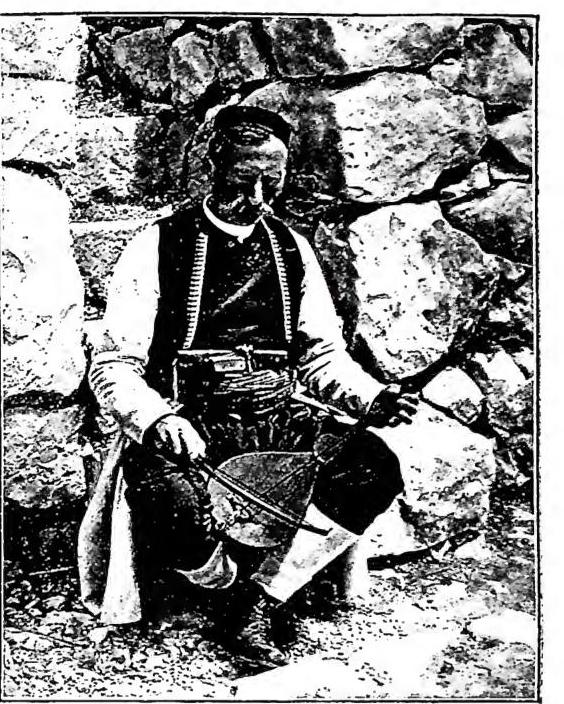
Montenegro – Montenegrin in costume with the “gusle.”