
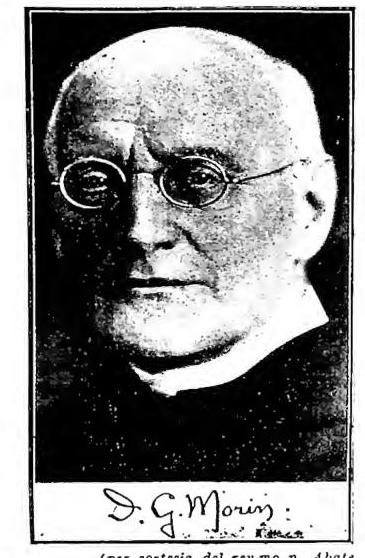
MORIN, LÉO-POLD-GERMAIN. - Benedictine, b. at Caen (Normandy) on 16 Nov. 1861, d. at Orselina “al Sasso” (Locarno) on 12 Feb. 1946. In 1881 he entered the abbey of Maredsous (Belgium), where he developed that ardent spirit of inquiry and acute critical sense which enabled him to tackle with sure hand the most difficult questions and the most debated theses concerning monastic life and history, patrology, ancient liturgy, and the sacred literature of the early Middle Ages; though he did not solve all of them, and indeed later corrected himself on some (not always with justification), he certainly shed new light on them all and clarified their problems.
He was particularly aided by that happy intuition which he possessed in using the perilous instrument of internal criticism, which guided him in his best textual identifications. Travelling ceaselessly, he visited the most important libraries of Europe, discovering new texts, correcting attributions, and reclaiming for their rightful authors works assigned to others or rejected, thus making a notable contribution to advanced scholarship. In 1907, by establishing his habitual residence in the abbey of St Boniface in Munich, he was able to deepen his research in the Bavarian and German libraries. The war of 1914 forced him to take refuge in Fribourg in Switzerland; after returning to Munich in 1918, the Second World War caused him to return to Fribourg in 1930. He held honorary doctorates from the most celebrated universities of Europe and was a member of the most illustrious learned institutes.
He played a large part in the founding of the *Revue bénédictine* (1884) and constantly devoted articles and notes to II. Of particular importance are his researches on the *De Sacramentis* attributed to St Ambrose, on the mysterious *Ambrosiaster*, on the *Capitulare Evangeliorum* of the Würzburg codex (*Revue bénédictine*, 27 [1910], pp. 41-74); on the *Micrologus*, on the *Athanasian Creed*, and the critical editions of some unpublished pamphlets by the heretic Gottschalk and by Arnobius the Younger. He vindicated the literary work of Gregory of Elvira, Pacian of Barcelona, and Nicetas of Remesiana, to whom he attributed the *De Deum*. In the *Anecdota Maredsodana* (3 vols., Maredsous 1893-1903) he published critically the Mozarabic *Liber comicus*, the *Most ancient Latin version of the Epistles of St Clement of Rome to the Corinthians*, *St Jerome’s Commentarioli on the Psalms*; id., *Tractatus in Psalmos... Tractatus on Isaiah*, etc., besides other texts. Minor researches, but not lacking in importance, are included in: *Etudes, Textes, Découvertes. Contributions à la littérature et à l'histoire des douze premiers siècles* (1913). Great acclaim greeted: *Sancti Augustini Sermones post Maurinos reperti*, published in vol. I of the *Miscellanea Agostiniana* (Rome 1930); of these, 51 were recovered by him personally, thanks to his special knowledge of the Saint’s works; and *S. Caesarii Arelatensis episcopi opera omnia nunc primum in unum collecta* (Maredsous 1937-42, in 2 vols., the second of which, destroyed during the war, was later reprinted through the munificence of Pius XII). This was the work to which M. devoted almost 60 years, through endless vicissitudes and throughout his scholarly career, to unmask what was apocryphal under the name of the great Gallic bishop and to reclaim for him what was attributed to others or regarded as uncertainly his; among these were monastic rules and the testament.
In 1905 he found time to indicate: *De la besogne pour les jeunes* (*Rev. d'hist. eccl.*, 2 [1905], p. 327 ff.). This was a subject of critical research. Later he published: *L'idéal monastique et la vie chrétienne des premiers jours*, Paris 1921, also translated into Italian (Sorrento 1927) and German (Sect. Ottilien 1949).