
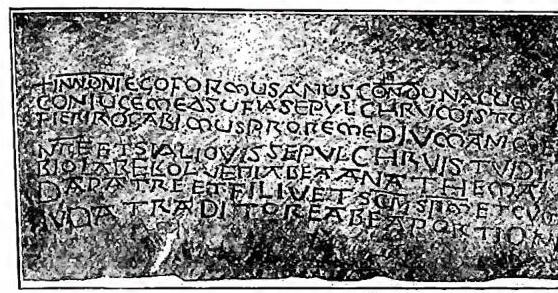
In Christian archaeology. — As in pagan sepulchral inscriptions, so too in Christian ones, deprecatory formulae were used to prevent the violation of tombs, accompanied by threats of divine punishment; one adjures in the name of God, or of the three Persons of the Most Holy Trinity, in the name of the day of the dread judgment; whoever is guilty, *Anathema sit, habeat*; he shall answer for it before Christ on the day of judgment, suffer eternal punishment with Judas, be struck with the leprosy of Naaman the Syrian, of Gehazi, disciple of Elisha, die a bad death, remain unburied, not rise again; one even threatens the violator that what is said in Ps. 109 may befall him, or that he may receive the anathema of the 318 Fathers (of the Council of Nicaea).
The use of such formulae appears at the end of the 4th century and develops in the 5th; it persists even into the Middle Ages, where such imprecations are repeated to strengthen the force of documents.
In the East, St. Gregory Nazianzen composed 81 epigrams against tomb violators, threatening them even with the torments of Tantalus, of Tityus, of Tartarus (PG 38, 99).