
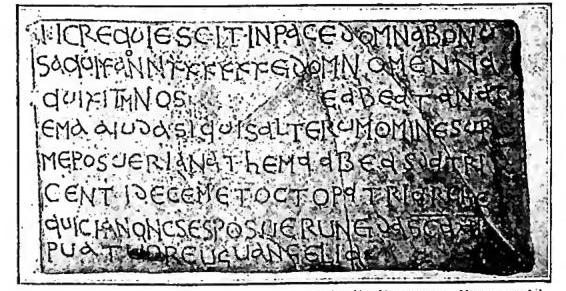
ANATHEMA - Christian sepulchral inscription with an anathema against violators of tombs - Rome, Lateran Christian Museum.
et monumenta, II, Rome 1868, pp. 251-57. Other fragments of works in PG 89, 1404-1408. Feast on April 21.
Bibliography8 works
Mario Scaduto
ANATHEMA (Gr. ἀνάθη(ε)μα [τὸ ἀνατεθειμένον], "that which is placed on high, suspended"). - Among the pagan classics, in II Macc. 9:16, in Judg. 13:23 (19) and in Lk. 21:5, it indicates an object consecrated to the divinity, hung on the walls or columns of the temple, a kind of "ex voto." In the Septuagint, however, it translates the Hebrew hērem.
Since ἀνατίθημι designates, in religious usage, consecration to the infernal divinities, it is doubtful whether at the time of the Septuagint (3rd-2nd century B.C.) ἀνάθη(ε)μα meant in common usage "object of malediction" and ἀναθηματίζειν "to curse," as in the tablets of Cnidos and the inscriptions of Megara (2nd-1st century B.C.), or whether they took on this meaning later, under Judeo-Hellenistic influence.
In the New Testament (apart from Lk. 21:5) it indicates: a) an oath to be fulfilled under penalty of grave privations (Acts 23:14); b) "an object of malediction and execration" (Gal. 1:8-9). To utter it of Jesus was a blasphemous formula, incompatible with the supernatural charisms (I Cor. 12:3). Paul hypothetically resigns himself to becoming an a., that is, deprived of salvation in Christ, if only he might see the Jews converted (Rom. 9:3). From a. arose the Hellenistic anathematize (Mk. 14:71; Acts 23:12, 14, 21).
Since the Jews had substituted for the death penalty required by the hērem that of the loss of goods and exclusion from the society of the faithful (Ezra 10:8), the concept of synagogal excommunication was being formed from the time of Ezra; hence in the New Testament ἀποσυνάγωγος and ἀφορίζειν "to be expelled or separated from the synagogue" already appear as coined terms (Jn. 9:22; 12:42; 16:42; Lk. 6:22). In the Talmud two forms of such excommunication are distinguished: the niddūj involving temporary exclusion (30, 60, 90 days) from the sacred assemblies and perhaps also from society, and the hērem, that is, solemn and perpetual exclusion from every association with the faithful, with the commination of the curses of Deut. 28.
Bibliography5 works
Bonaventura Mariani
IN THE LANGUAGE OF THE CHRISTIAN CHURCH
The word a. had a sense analogous to the one it had in Sacred Scripture, namely: separation from Christ and consequently excommunication or separation from his Church. From the earliest centuries the councils took up the habit of striking with the a. Christians guilty of grave crimes and above all heretics, against whom it was ordinarily reserved. When the canons of councils strike a doctrine with the a., anathematizing those who uphold it, it means that it is heretical. Hence the term anathematism, or conciliar decision concerning the faith (the 12 anathematisms of St. Cyril of Alexandria, accepted by the Council of Ephesus of 431, are famous).
In the sources of the CIC and in the ancient authors, the term a. is often found used to indicate major excommunication (that is, total separation from the society of the faithful), as opposed to minor excommunication (consisting in simple exclusion from the Sacraments). Today, with minor excommunication abolished, the word a. - according to what can. 2257, § 2 of the CIC warns - is a synonym of excommunication (v.), but is especially referred to those cases in which excommunication is inflicted with the solemnities described by the Roman Pontifical under the title Ordo excommunicandi et absolventi.
Bibliography2 works
IN CHRISTIAN ARCHAEOLOGY
As in pagan sepulchral inscriptions, so too in Christian ones deprecatory formulas were used to prevent the violation of tombs, accompanied by threats of divine punishment; one adjures in the name of God, or of the three Persons of the Most Holy Trinity, in the name of the day of the dreadful judgment; whoever makes himself guilty Anathema sit, habeat; he will have to answer for it before Christ on the day of judgment, suffer eternal punishment with Judas, be struck with the leprosy of Naaman the Syrian, of Gehazi, the disciple of Elisha, die a bad death, remain unburied, not rise again; one even goes so far as to threaten the violator that there may befall him what is said in Ps. 109, or that he may receive the a. from the 318 Fathers (of the Council of Nicaea).
The use of such formulas appears at the end of the 4th century and develops in the 5th and subsequent centuries; it persists also in the Middle Ages, where such imprecations are repeated to lend greater firmness to documents.
In the East St. Gregory of Nazianzus dictated 81 epigrams against violators of tombs, threatening them even with the tortures of Tantalus, of Tityus, of Tartarus (PG 38, 99).
Bibliography3 works
Enrico Josi