
OBJECT OF O. — 1. First of all, certain categories of animals may be the object of o. These are usually distinguished as wild animals (fera), animals that have become wild (efferata), tamed animals (cicurata), and domestic animals (mansueta).
The object of o., that is, of hunting, consists only of wild or feral animals living in a state of natural liberty. Tamed animals are not the object of hunting, except when, having gained their freedom, they once again become res nullius.
In Italian law, certain tamed animals (e.g., bees, rabbits, fish: art. 924 ff.) are governed by special provisions. The owner may pursue them within a certain period; if he does not pursue them or ceases to pursue them, he loses ownership in favor of the owner of the land where they have settled, unless the animals themselves were attracted there by deceit (in that case, the good faith that legitimizes the acquisition of the animals would be lacking).
2. According to natural law, the so-called bona vacantia may also be the object of o., that is, those goods that have never belonged to anyone or that have lost their connection with their owner. The Italian Civil Code permits o. only with regard to movable property (art. 923). With regard to immovable property, the Code establishes that, as soon as it is left without an owner, it is immediately acquired by the State and becomes part of its patrimony (art. 827); under the Code of 1865, o. was also possible in the case of immovable property.
3. Things abandoned by their owner (res derelictae), with the intention of no longer considering them his property, may be the object of o. Where there is doubt, this intention cannot be presumed, since it is extremely rare. Ears of grain, grapes, walnuts, etc. left in the field after the harvest are ordinarily regarded as abandoned things. Neither things abandoned on the occasion of a fire, occupation, or air raid, nor things thrown away by persons exposed to particular dangers (e.g., shipwrecks, earthquakes, etc.) are to be regarded as res derelictae; nor are the belongings of shipwreck victims, as long as there remains hope of recovering them (the civil legislation of certain countries—France, England, and the United States—confirms this natural right. In Italy, arts. 510–13 of the Code of Navigation, in the case of the discovery of wreckage at sea or of objects cast up by the sea in places belonging to the maritime domain, establish rules analogous to those contained in arts. 927 ff. concerning lost things. For the discovery of aircraft and aircraft wreckage V. arts. 993–95 of the Code of Navigation).
4. Lost things (res nuper amissae) may likewise be the object of o. Under natural law, a lost thing remains the property of the person who lost it as long as there remains hope of finding it again. It is therefore obligatory to observe the rules established in this regard by civil laws. Under natural law, a person who finds another’s property is not bound in justice to pick it up and preserve it; on occasion, however, he may be obliged to do so ex caritate. Whoever takes it becomes its custodian and must return it to its rightful owner as soon as the latter is known, while being entitled to demand fair compensation. Once he has exercised due diligence in identifying the owner and the owner has not appeared, the finder-custodian may retain the thing as his own; this is justified in natural law by the twofold principle that ownership of things was introduced so that they might be used and that, when their loss prevents this use, the things themselves become, after a certain period of time has elapsed (after which there is no longer any hope of finding their owner), vacuae possessionis, so as to enable others to enjoy them.
5. Under natural law, treasure, understood as res nullius, belongs entirely to the person who found II. The same may be said of mines. Civil legislation, however, imposes certain limitations in view of the common good (v. TESORO).
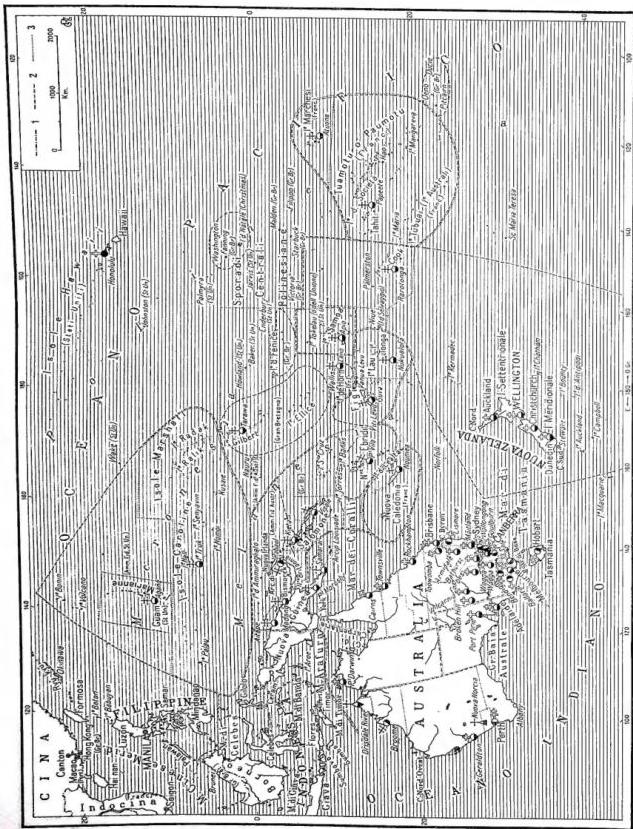
OCEANIA — 1) State boundary; 2) boundary of the states of the Australian Confederation and of the colonies; 3) boundary of an ecclesiastical jurisdiction. See also the maps reproduced under the entries AUSTRALIA; HONOLULU; INDONESIA.
(propr. Enc. Catt.)
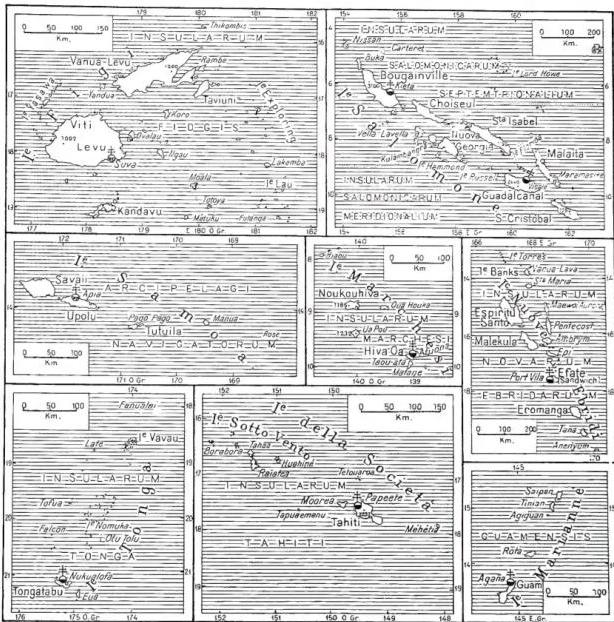
OCEANIA – Development of the principal island groups (Fiji, Solomon Islands, Samoa, Marquesas, New Hebrides, Tonga, Society Islands, Marianas).