
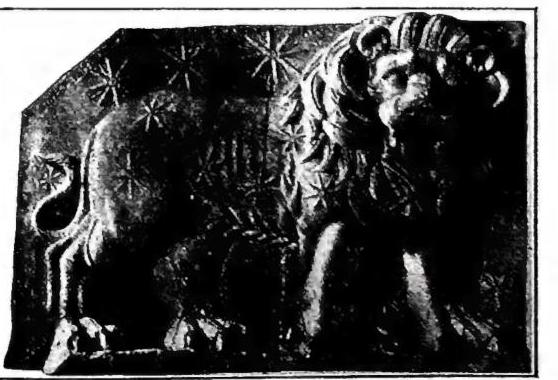
OROSCOPE (ὀσκοπός). – The term o. in astrology denotes the precise moment (ὄσχι) when the positions of the stars are observed (ὄσχιεν) as they rise on the horizon at the instant of an individual’s birth. The exact determination of this moment is necessary to establish the individual’s future; and also to consult the stars during the course of life, though always subordinated to the positions they held at the moment of birth.
As can be seen, the o. is firmly connected with divinatory astrology, which rests on the following principles: a) the stars exert a preponderant influence on the balance of the universe, which is affected by the characteristic qualities of each of them; b) this influence is determined by the position, at a given moment, of the stars in the sky and can be positive or negative, i.e., favorable or adverse. Each of the seven planets (Moon, Mercury, Venus, Sun, Mars, Jupiter, Saturn) has its own house (ὁλκος, *mansio*) in one of the twelve signs of the zodiac, where it draws its greatest energy (Firmicus) and from which it exerts its influence. Moreover, once these planets are identified with certain ages of life (e.g., Moon = early childhood, Mercury = youth, etc., up to Saturn = old age [Ptolemy, IV, 9]) and certain good or bad characteristics are attributed to the zodiacal signs, it is believed that there exists a strong analogy and connection between the newborn child and the star that rises at that moment on the horizon. Thus, where the stars can exert all their youthful vigor, astrology places the o., i.e., the precise point where the moment of birth is linked to destiny.
The o., like astrology itself, originated in Babylon, from where it spread; it was widely used among the rulers of Asia Minor, some of whom engraved their natal charts on
OROSCOPE – O. of Antiochus of Commagene.
In response to the accusation of pagans that Christianity was to blame for the calamities of the Empire, Orosius had replied in the 3rd book of his *Historiae adversus paganos* (a. 418) that the evils of those days were not greater than those of pre-Christian times. This was the guiding idea of his *Historiae adversus paganos*. In them, leaving to other historians the narration of wars, he sets forth the evils that derive from them: *illi bella, nos bellorum miserias evolvamus*; and with them, plague, famine, earthquakes, floods, storms, volcanic eruptions: *Moesta mundi*, according to the title that medieval paleography gave to this work. Yet the course of humanity is not abandoned to chance, and here enters Orosius’ providentialism: the flow of the ages is a harmonious complex wisely governed by Providence. Nothing is accidental in the picture. Even the most seemingly distant and disconnected events correspond to one another as members of a single intentionally preordained whole. The work, a compendium of universal history, is divided into four periods and seven books; from Adam to the year 417. Sources: Holy Scripture first of all, then Livy, Caesar’s commentaries (Orosius attributes them to Suetonius), Tacitus, Justin, Florus, Eutropius, Eusebius’ *Chronica* in the Jerome translation and reworking, Rufinus, and St. Augustine. The work acquires more personal value from 378 onward. Typical is Orosius’ optimism in historical evaluation: the invasions of the barbarians are warnings of divine goodness. As a good Spaniard, in the final chapter, devoted to the history of his homeland, he places Spain at the center of the world’s destiny since, through Ataulf and Wallia, it sustained the very steadfastness of the Roman Empire. Yet at the same time, he feels and celebrates with enthusiasm the ecumenical unity created by Rome and the Gospel. “I am among the Romans, a Roman; a Christian among Christians; among men, a man... *Ubique patria, ubique lex et religio mea est*” (5, 2). He is one of the first to use the term *Romania* to denote the domain of Romano-Christian culture. His fervent eloquence and the Virgilian imitation to which he conforms ensured the *Historiae* of Orosius a brilliant survival in the Middle Ages: 200 manuscripts transmit it; Isidore, Bede, Gregory of Tours, down to Dante, made use of it; Alfred the Great translated it into Anglo-Saxon; the Emperor of Constantinople sent it to ‘Abd ar-Rahmān III of Córdoba for translation into Arabic: it is described by Dante as “the highest prose” equal to that of Livy.