
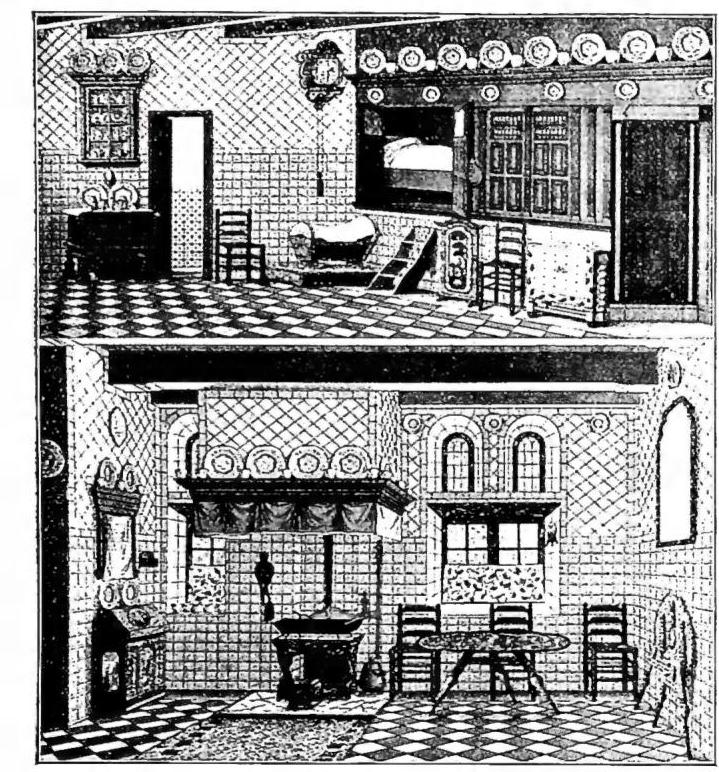
NETHERLANDS - Interior of a Dutch house (19th century). Top: bedroom; bottom: dining room.

In the 17th century, Dutch literature reflected in realistic colors the life of Amsterdam of its time. Jacob Cats established himself in didactic and moralizing poetry. C. Huygens, father of the famous physicist, is the principal author of epigrams of his era. Among the poets of more pronounced spiritual inspiration are mentioned Johannes Stalpaert van der Wielen, parish priest of Delft, and the Calvinist preachers Revius and Camphuysen. In the south of the Netherlands, the Jesuit Adriaen Poiriers distinguished himself in poetry and prose of an edifying nature, with a particular freshness of expression. The parish priest Justus de Harduyn composed poetry of a spiritual tone.
The 18th century marks a period of decline: at the end of the century, two young ladies, Aagje Wolff and Betje Deken, together wrote a characteristic epistolary novel, set in a domestic and bourgeois milieu: *Sara Burgerhart*, which still has reprints. Willem Bilderdijk (1756–1831) exerted a notable influence with his verses, which, however, do not say much to the contemporary reader. More worthy of note are the few ballads of A. C. W. Staring. J. A. Alberdingk Thijm (1826–89), a Catholic writer and pioneer of Catholic emancipation, is connected with Bilderdijk. He authored important historical and polemical articles and strove to bring Catholic tradition closer to the sensibilities of his contemporaries (*Carolingian Tales* and *Portraits of Jost van den Vondel*). E. J. Potgieter (1808–75), an exponent of liberal orientations, was undoubtedly the most important figure of this period. In his important journal *De Gids*, he published stories, poems, and critical essays, but his best work remains *Florence*, a terza rima poem written on the occasion of the Dante celebrations in Florence (1865), where he stayed in the company of his friend Busken Huet, a very fine literary critic. The historical novel was represented by the writer A. G. Bosboom-Toussaint, a Protestant, who focused especially on the early period of the Protestant "Reformation." Worth mentioning is *Camera obscura* by Nicolaas Beets (1814–1903), a collection of humorous sketches; the volume has recently reached its 50th reprint. Undoubtedly a precursor of the renewal in Dutch literature was Eduard Douwes Dekker, better known under the pseudonym Multatuli. His novel *Max Havelaar*, set in Indonesia and blending contrasting romantic and social notes, truly marks a break with conventional prose. He exerted considerable influence on subsequent currents of "free-thinkers" and revolutionaries. Meanwhile, in the Flemish regions, J. F. Willems initiated the *Vlaamse Beweging* ("Flemish Movement"), zealously supported in his work by the writer H. Conscience (1812–83). Particularly worthy of mention is the priest Guido Gezelle (1830–1899), for his refined lyric poetry inspired by nature and rich in spiritual motifs. Around 1880, a group of young writers emerged in Amsterdam under the guidance of the poet and critic Willem Kloos (1859–1938), who, primarily inspired by the English poets Shelley and Keats, began to forge new paths (*J. Perk* can be considered a precursor of this literary revival with his cycle of sonnets *Mathilde*). These young writers reacted against content-focused tendencies, embracing the doctrine of art for art's sake.
French naturalism found a notable follower in K. J. Alberdingk Thijm (pseudonym: Lodewijk van Deyssel; 1864–1952), known for the novel *A Love Affair* and his work as a literary critic. Also part of this group was Frederik van Eeden (1860–1932), whose fairy tale *The Little John* gained enormous popularity. The pinnacle of the great literary renewal around 1880 can be considered the poem *May* by Herman Gorter (1864–1917).
In the next generation, the figure of Henriette Roland Holst-van der Schalk (b. 1869) stands out: her poetry, captivating in its melodiousness, initially drew on social inspirations, expressed without rhetoric; over time, her lyricism deepened, taking on a marked religious tone. Also noteworthy are P. C. Boutens (1870–1943), of Platonizing inspiration, and H. Leopold (1865–1925), much followed by young readers. L. Couperus was a prominent prose writer (remembered for *Eline Vere*); also worth mentioning are J. van Looy (*Jaapje*, a novel about a boy), the Catholic critic F. Erens and his brother Emile Erens, author of fine lives of saints, and H. Heyermans, known especially for a drama with socialist tendencies. Among the Catholic writers of this period are E. Brom, A. Steenhof-Smulders, M. Koenen, F. Rutten, and K. Meekel. Among the most modern poets, A. Roland Holst (b. 1888) stands in the forefront: his poetry is strongly influenced by the world of Celtic legends. As a novelist, A. van Schendel (1874–1946) distinguishes himself.
Of the generation that emerged after 1920, the "vitalists" and expressionists are remembered: J. Slauerhoff, H. Marsman, M. ter Braak, and E. Du Perron. As novelists, S. Vestdijk and F. Bordewijk distinguished themselves. Also remembered are the "humanists" D. Coster, M. Nijhoff, A. Donker, and the Catholic writers A. van Duinkerken, J. Engelman, H. Bruning, A. Coolen, H. de Man, and A. Kuyle.
In Flanders, K. van de Woestijne (1873–1927) created his plastic and decadent poetry. Stijn Streuvels, b. 1871, depicted in his novels the rural life of West Flanders (*The Flemish Farm*); also worth mentioning are his *Christmas Tales*. The priest C. Verhaeren, known for his life of Christ (*Jesus*), was also a poet, playwright, and critic. But the most well-known writer remains Felix Timmermans (1886–1947), who achieved fame with his *Pallieter*; also mentioned is his *The Child Jesus in Flanders*.
W. Moens and P. van Ostayen distinguished themselves with their expressionist tendencies; among the younger generation, M. Gijzen, A. Musch, and M. Roelants are remembered; in prose, W. Elsschot and G. Walschap stood out.
ART. - I. *Architecture*.
For the history of art in the Netherlands, it is necessary to begin with a fundamental distinction. This history, that is, is divided into two clearly separate branches: one is that of Flemish art (v.) and the other is that of Dutch art. This section deals particularly with the latter. There are few surviving buildings from the early Middle Ages, the oldest of which (9th century) were built by Benedictine monks: the crypt of the abbey of Rolduc dates from the 12th century, while Notre Dame and St Servaas in Maastricht date from the 11th–12th centuries, the latter having been given a large side portal in the 13th century with a clear French influence. Notre Dame in Roermond, dedicated in 1222, is typical of the transitional period to Gothic architecture, with structural features of the Rhenish school. French influence (from Tournai) is also evident in the churches of Notre Dame in Arenberg in Zeeland (13th century), in the chapel of Bois-le-Duc cathedral, and finally in Utrecht cathedral.
Dutch churches developed a distinctive character through the use of brick, sometimes combined with stone in decorative ways. Similar features recur in the churches of the 14th–15th centuries and the first half of the 16th, when the simplicity of exteriors and interiors was rarely (e.g., Bois-le-Duc cathedral) replaced by the richness characteristic of late French Gothic, which is also reflected in the verticality of numerous bell towers. The German type of hall church with three naves of equal height (*Hallenkirche*) became very popular, and the pitched roof was widely used, especially in northern Holland.
Among the most notable Gothic churches of this period are those of Alkmaar, Goes, the *Nieuwe Kerk* in Amsterdam, and that of Delft, some of which are topped by slender and elegant spires.
In the 16th–17th centuries, with the rise of the Protestant Reformation, the religious building changed its character to suit the needs of worship. Hendrick de Keyser (1567–1621) created the new type of Protestant church with a central plan, in which the architectural focus coincides with the preacher’s pulpit (cf. the *Westerkerk* in Amsterdam). Civil architecture, which had previously been dominated by the Gothic style (town halls of Middelburg and Gouda), developed in response to the needs and tastes of the merchant bourgeoisie; alongside *hôtels de ville*, monumental city gates and weighhouses (*pese*) were built.

Italian Renaissance influence penetrated only slowly (Nassau Castle, 1536), while a distinctive national style emerged, characterized by monumental structures heavily adorned with reliefs and bold polychromy achieved through the contrast of brick and ashlar (*hôtel de ville* in The Hague, 1564; in Leiden, 1597; *Halle aux bouchers* in Haarlem, 1602). Some cities acquired their characteristic appearance at this time, as in the case of Amsterdam, shaped by Hendrick de Keyser.
After the mid-17th century, under the influence of Italian theorists (Serlio, Palladio, Scamozzi), Dutch architecture tended toward simpler, more sober, and symmetrical forms (*hôtel de ville* in Amsterdam, built 1648–1665 by Jacob van Campen; Mauritshuis in The Hague, by J. van Campen and Pieter Post), though often with a monotonous effect.
By the late 17th and 18th centuries, French influence prevailed, while at the beginning of the 19th century neoclassicism became widely diffused. In the Romantic period, attempts were made to imitate Gothic architecture and the style of H. de Keyser and Lieven Key (Rijksmuseum in Amsterdam). H. P. Berlage became the herald of architectural renewal (Amsterdam Commodity Exchange, 1897–1903). His approach was opposed by the Amsterdam School, which returned to aspects of national architecture; in turn, this tendency was countered by the Rotterdam School, which championed the principle of the “functionality” of buildings.
---
2. *Sculpture*.
The history of sculpture is initially intertwined with that of Flanders. From the 15th–16th centuries, however, plastic production is marked by a study of reality and assumes a distinctly national character: the tomb of Jan van Polanen in Breda; a mid-15th-century statue in the Utrecht Museum; decorative sculptures in the church of St-Jean in Bois-le-Duc. The Protestant Reformation and the consequent abolition of images in churches severely limited the development of plastic art in the 17th century.
The funerary monument and portraiture were the only genres to which sculptors devoted themselves, revealing the same qualities of powerful realism found in contemporary painting. The leading sculptors were Hendrick de Keyser, father of Pieter (tomb of William the Silent in the *Nieuwe Kerk* in Delft; painted terracotta bust in the Rijksmuseum, c. 1606), and Rombout Verhulst (1624–98), who traveled in Italy and worked extensively at home (decoration of the *hôtel de ville* in Amsterdam and the public weighhouse in Leiden, with genre reliefs; tombs of the Baron of Gendt in Utrecht cathedral, of Admiral Tromp in Delft; numerous busts). Toward the end of the century, sculpture, like painting, began to decline, and the 18th century fared no better (decoration of the main façade of The Hague’s *hôtel de ville* by J. B. Xavier). The 19th century also saw limited representation, with artists such as Royer (1793–1868), the Strache brothers (1817–91), Jean Tjéodor, Léo Paulus, Lecomblé, Simons, and Ferdinand Leenhof (1841–1914) producing monotonously classical works. This tradition was broken by the original personality of Christophe van Wijk (1875–1917), who drew on the purest national vein in works of fervent realism. Mendes da Costa (b. 1863) and Zijk (b. 1866) demonstrated a lively imagination in small terracotta and bronze statues. After 1914, sculpture definitively freed itself from architecture, to which it had been closely tied since the renewal of 1890. Representatives of the most modern trends include John Raedeker (b. 1885) and Hildo Krop (b. 1886).
---
3. *Painting*.
Dutch painting only achieved a truly “national” identity toward the end of the 16th century and in the 17th, the era of the Netherlands’ greatest political power.
With the rise of Protestantism, the Church no longer provided patronage for the arts, and there was no royal court. Painting thus flourished under bourgeois patronage, to which it remained closely tied and which offered it a field of investigation that fostered the particular quality of intense and profound observation of living reality. This gave rise to the pictorial “genres” that flourished in the 17th century—from portraiture to genre scenes, from landscape to still life.
In earlier centuries, the activity of Netherlandish painters was entirely united with that of Flanders. At the beginning of the 15th century, the Van Eyck brothers dominated the Haarlem school, to which Albert van Ouwater and his pupil Gérard de St-Jean (second half of the century) belonged. De St-Jean distinguished himself from the Flemish painters through qualities of softer luminosity and a greater sense of intimacy, traits destined to become typical of Dutch painting (Adoration of the Magi, Rijksmuseum, Amsterdam).
In the 16th century, the influence of the Italian Renaissance begins to be felt among the various schools and individual artists, some of the most gifted of whom—though they do not fail to maintain those qualities of penetrating observation of reality and fantastic reworking of it peculiar to Dutch art—find their first and most prestigious exponent in Hieronymus Bosch (ca. 1450–1516; v.), head of a school in ’s‑Hertogenbosch and initiator of a tradition that would extend down to David Teniers. After Cornelis Engebrechtsz (1468–1533), the Leiden school includes Lucas van Leyden ([V. 1494–1533], the leading artistic personality of the period alongside Bosch, who, while not escaping Italian influences, never allowed himself to be dominated by them), while in Amsterdam Jacob Cornelisz van Oostsanen (ca. 1470–1533) reveals clear Lombard influences (Salome, Rijksmuseum). In Utrecht—where Jan Gossaert of Maubeuge had first brought Italian influence—Jan van Scorel (1495–1562) combines Venetian and Roman modes (Magdalene, Bathsheba, Rijksmuseum) and launches the Romantic trend with his pupils, including Martin van Heemskerck (1498–1574), who is openly Michelangelesque (Triptych with the Deposition, Brussels Museum), and Anthonis Mor (ca. 1512–1576), a most noble portraitist. In the first half of the century, the Haarlem school appears more independent, with Jan Mostaert (ca. 1474–1555) continuing the 15th‑century tradition; but after the mid‑1500s, under Cornelis Cornelisz (1562–1638) and Hendrick Goltzius (1558–1616), Italian influence predominates, fostering an insistent interest in the plastic definition of form. A closer adherence to the typically Dutch tradition of straightforward observation of reality is seen in Pieter Aertsen (1509–1575 ca.), representative of genre painting, which, after the impulse given by the Fleming Pieter Bruegel the Elder, would bear such abundant fruit in the full 17th century rather than among his immediate heirs such as Hendrick Avercamp (1585–1665), Arent Aertsen (1585–1635), and Adriaen van de Venne (1589–1662). Likewise, portraitists such as Cornelis Ketel (1548–1616), Dirck Barendsz (1534–1592), and Michiel van Miereveld (1567–1641) established, toward the close of the 16th and in the first half of the 17th century, that quality of “veracity” that would make public and private portraiture the most characteristic expression of great Dutch art.
The 17th century is the golden age of Dutch painting, and while there were supreme artists such as Rembrandt van Rijn (1606–1669), who attained the highest level in both figure painting and landscape, most Dutch painters tended toward a kind of specialization that led them to devote themselves throughout their lives to a single pictorial genre. As for the Utrecht school, because it was linked to the Roman Caravaggist movement, it must be distinguished from the rest of Dutch painting, even though it shared certain qualities that define the Dutch Caravaggists as a distinct group: the school’s founder at Utrecht was Abraham Bloemaert (1564–1651), from whom sprang Hendrick ter Brugghen (1588–1629), Gerard van Honthorst (1592–1656), Dirk van Baburen (1595–1624), and Hendrick van der Burgh (1624 ca.), all of whom, during their sojourns in Italy, were decisively drawn to Caravaggio and his school. The Utrecht school also includes Leendert van der Cooghen and Judith Leyster (1600–1660), who, under the influence of the Caravaggesque study of light, modeled themselves on Frans Hals.
a) Portraiture. — Portraiture developed to such an extent that it assumed “national” importance. The foremost portrait painters were Frans Hals (1580–1666) and Rembrandt, the two greatest representatives of Dutch painting, which they definitively shaped; other fine portraitists were Nicolaes Eliaszoon Pickenoy (1591–1654 or ’56) and Thomas de Keyser (1596–1667 ca.), who gave subtle characterization to their sitters, portrayed without the ostentatious concern for wealth typical of portraiture after van Dyck’s arrival in Holland (1628) and represented by Govert Flinck (1615–1660), Ferdinand Bol (1616–1680), Nicolaes Maes (1634–1693)—all pupils of Rembrandt—and Bartholomeus van der Helst (1613–1670). A portraitist of great expressive power was Carel Fabritius (1622–1654), also a pupil of Rembrandt.
b) Genre painting. — It was only after the strong characterizations of certain figures by Frans Hals and the warm golden luminosity of Rembrandt’s canvases that genre painting took on its unmistakable aspects: painters of genre scenes included Dirk Hals, brother of Frans, Anthonie Palamedesz (1601–1673), and Pieter Codde (1599–1678); and from Adriaen Brouwer (1605–1638), a pupil of Frans Hals in Haarlem, came Adriaen van Ostade (1610–1685), painter of lively rural interiors and tavern scenes suffused, however, with a melancholic Rembrandtesque light. He was the initiator of the *petits maîtres*, exquisite narrators of scenes from everyday life observed with a subtle penetration that, in the best works, rises to a pictorial transfiguration of the pure poetry inherent in the simplest aspects of life. Delicately sentimental are Gerard Dou (1613–1675) and Gabriel Metsu (1630–1667); lively, humorous, and satirical is Jan Steen (1626–1679); supremely refined in the precious quality of color and choice of subject is Gerard Terborch (1617–1681); and supreme among them are Pieter de Hooch (1629–1683) and Jan Vermeer (1632–1675), both of the Delft school, who evoke with delicate intimacy and poetic serenity the quiet of an interior or a corner of the old city streets. Linked to genre painting are also the battle painters, such as Philips Wouwerman (1619–1668) and Jan Lingelbach (1623–1674), of German origin; and the taste for it had its herald beyond the borders in Pieter van Laer (1583–1642), called Bamboccio, who, having come to Rome, created there a distinctive pictorial direction that took its name from him, the *Bamboccianti*.
c) Landscape. — Painters so attentive to the realities of life could hardly neglect landscape, and one of the most beautiful “views” ever painted is owed to Vermeer: *View of Delft* (ca. 1658).
Landscape painting, in which the landscape is the “end” of the picture rather than a commentary on a figure composition, is in any case a typical product of Northern art and remains one of the characteristic expressions of Dutch painting: even Rembrandt left, in both paintings and etchings, one of the most “romantic” landscapes ever painted. Adriaen van de Venne (1589–1662), Esaias van de Velde (1591–1630), and Hercules Seghers (1590–1640) are among the earliest landscapists, and it was Jan van Goyen (1596–1656), who knew Rembrandt’s work, who gave that sense of solitary poetry that pervades the landscape and was inherited by Jacob van Ruisdael (1628–1682), who infused a religious emotion into his depictions of the countryside. Contrasting with the dramatic landscapes of Ruisdael is the serene cheerfulness of those by Meindert Hobbema (1638–1709); to Ruisdael is linked Jan Wijnants (1630–1684 ca.), and among the finest landscapists must be mentioned Aert van der Neer (1603–1677), Allaert van Everdingen (1621–1675), and Adriaen van de Velde (1636–1672). Closely connected with landscape painting is the painting of “architecture”: this genre originated around the mid‑16th century with Hans Vredeman de Vries (1527–1606), who depicted scenographic perspectives not without Italianizing influence. But in the new century, architectural painting turned toward a more familiar, bourgeois realism and prepared the way for the intimate interiors of the *petits maîtres*: Dirck van Delen (1605–1671 ca.) and, more especially, Pieter Saenredam (1597–1665), Gerrit Houckgeest (1600–1661), and Emanuel de Witte (1617–1692 ca.) painted the vast interiors of Protestant churches, while others, such as Jan van der Heyden (1637–1712), depicted houses mirrored in the still waters of the canals.
d) Still-life and animal painting. — The same keen sense of observation of reality that characterizes all Dutch painting is evident in the still-life painters, who were acute and precise to the point of trompe-l'oeil (cf. works by Pieter Claesz, ca. 1590–1661; Willem Claesz Heda, 1594–1680; Abraham van Beyeren, ca. 1620–90; Jan Davidsz de Heem, 1606–84; Willem van Aelst, 1626–83; Jan Huijsman, 1682–1749).
The same can be said of animal painters, who were exact in their study of their subjects (cf. Jan Weenix, 1621–63; Gillis, Gijsbert, and Melchior Hondecoeter; Paulus Potter, 1625–54, the finest of them all), who sometimes captured a dramatic moment in the life of an animal (Albert Cuyp, 1620–91; Jan Asselyn, 1610–52), or, more rarely, a gentle solitude imbued with poetry (cf. *The Goldfinch* by Carel Fabritius, in the Mauritshuis, The Hague).
In the 18th century, Dutch painting entered a period of decline: it decayed and perished in the classical reaction led by Gérard de Lairesse. The only painters worthy of note were the Rhenish Jean-Maurice Quinchhardt (1688–1772) and Cornelis Troost (1697–1750).
From the academic movement that followed the classical reaction, only one notable artist emerged: Jacob de Witt (1695–1754). Until the mid-19th century, Dutch painting, with the exception of Ary Scheffer (1795–1858), remained closed and estranged from the European movement.
Landscape, marine, and genre painters continued to work, repeating the models of the 17th century (cf. David Bles, 1821–99); Augustus Allebé (1838–1914) did not stray far from them, while Alma Tadema (1836–1916), after turning to historical subjects during his stay in England, achieved a fame disproportionate to his merits. Around 1870, a painting center formed in The Hague that sought to renew Dutch painting on the basis of a "realism" understood in the spirit of the best tradition: Bosboom (1817–51), Jozef Israëls (1824–1911), Matthijs Maris (1839–1917), Jan Toorop (b. 1858), and Breitner (1857–1923) subsequently adhered to and animated II. From the Hague School also came J. B. Jongkind (1819–91), who later moved to France and contributed with his art to the transition from the Barbizon School to Impressionism, and Vincent van Gogh (1853–90), whose artistic personality, though initially shaped by Dutch influences, would later develop its definitive aspects in contact with the French atmosphere. In recent decades, Dutch painting has aligned itself with the currents of French and European art while retaining some characteristics of its centuries-old tradition.
e) Minor arts. — Engraving enjoyed particular success in Holland, and supreme artists devoted themselves to II. By the late 15th century, engraving with the burin was already in use (Jacob Cornelisz and Lucas van Leyden), and in the 17th century, etching and drypoint were added to this technique, both for reproducing contemporary paintings and for creating original works of art. Among landscape engravers were Jacob Ruysdael, Isaïe van de Velde, and Allart van Everdingen; among animal painters, P. Potter and A. Cuyp; among genre painters, A. van Ostade; while Rembrandt, in his portrait and landscape engravings, left an exceptionally high expression of his art. The etchings of Hercules Seghers are distinguished by a particular character due to his use of color. In the 18th century, engraving lost importance, while French influence prevailed.
Maiolica held notable importance from the Middle Ages, but it was in the 16th century that it flourished, developing to such an extent that in the following century it became celebrated worldwide. Among the most renowned manufactories was that of Delft, known for its intense blue enamel on a white background.

Great refinement was also achieved in the 16th and 17th centuries in the artistic working of metals (grilles, baptismal fonts in churches), which goldsmiths chased with the utmost elegance and skill (goblets, plates, clothing ornaments); nor do wooden furnishings and utensils lag behind in richness and elegance, adorning churches as well as homes and municipal palaces.
VI. SCHOOL SYSTEM
Dutch education is shaped by the pedagogical doctrines of Comenius, Pestalozzi, Fröbel, Dalton, Parkhurst, and Montessori. It is also influenced by legislative measures.1) The government laws of 1801 and 1806 declared education a public and secular service administered by the municipalities; Catholics were placed on equal footing with Calvinists; Comenius’s method was supplemented by Pestalozzi’s.
2) King William’s law of 1815 placed all schools under his control through the universities, which became strongholds of the union between Belgium and Holland.
3) The royal decree of 18 January 1842 granted greater freedom to Catholic and Calvinist private schools. The constitutional law of 1848 proclaimed freedom of education but required a diploma for teaching in primary and secondary schools.
4) The van der Bruggen law of 1857 abolished, with Catholic support, the official teaching of the Bible.
5) The law of 2 May 1863 reformed secondary education.
6) The law of 1878 required spacious buildings for all schools, imposing a burden on private schools and introducing reforms in teacher training seminaries, establishing two diplomas: one for primary school teachers and another for primary school principals.
7) The Mackay law of 1889, known as the pacification law, granted state subsidies to denominational private schools in exchange for an education modeled on public schools.
8) The law of 1899 introduced compulsory education.
9) The Pierson law of 1901 ensured equal state funding for the construction of private and public school buildings.
10) The Kuyper law of 1905 granted equal treatment to teachers in denominational private schools.
11) The De Visser law of 1920, interpreting the constitution of 1917, granted parity to denominational primary schools.
12) The law of 1922 granted financial subsidies to all religious schools modeled on public *Hoogere burgerschool*.
Religious instruction is not compulsory in public schools due to their religious neutrality. In Catholic secondary schools, religious instruction is provided for two hours per week by priests holding professorial rank. Since 1910, the basis of Catholic religious instruction has been a single catechism for all dioceses, while for Calvinism it is the Bible.
Dutch education is divided into private and *bizzondere school* and public and *openbare school*. School attendance is compulsory from ages 7 to 15. Public schools are neutral from a religious standpoint; however, upon the request of 12 families, a non-neutral class must be established within the public school.
At the age of three, Dutch children may be sent to "preschool institutes" (*Bewaarschoolen*), which are divided into Fröbel schools, Dalton schools, Parkhurst schools, and Montessori schools. The duration of the course is four years. At the age of seven, elementary education begins, lasting six years. Upon completion of elementary school, the student has three possible paths: 1) extended primary school (*M.U.L.O.*) of four years; 2) secondary school divided into gymnasium (four years); 3) higher school (*Hoogere Burgerschool*, two years), from which one can access the following universities or higher institutes: University of Amsterdam, founded in 1631, Free Calvinist University of Amsterdam, founded in 1860, University of Groningen, founded in 1644, University of Leiden, founded in 1575, Catholic University of Nijmegen, founded in 1923, Delft Polytechnic, founded in 1905, the Higher School of Agriculture in Wageningen, founded in 1919, Higher Commercial Studies in Rotterdam, founded in 1913, Higher Commercial Studies for Catholics in Tilburg, founded in 1927. Those intending to pursue legal studies may do so at the University of Nijmegen. Teacher training takes place in 89 normal schools, which are accessed after extended primary school or higher primary school. The training of Catholic clergy occurs in each diocese at its own minor and major seminary. — See pls. XXXVII-XXXVIII.