
Parable
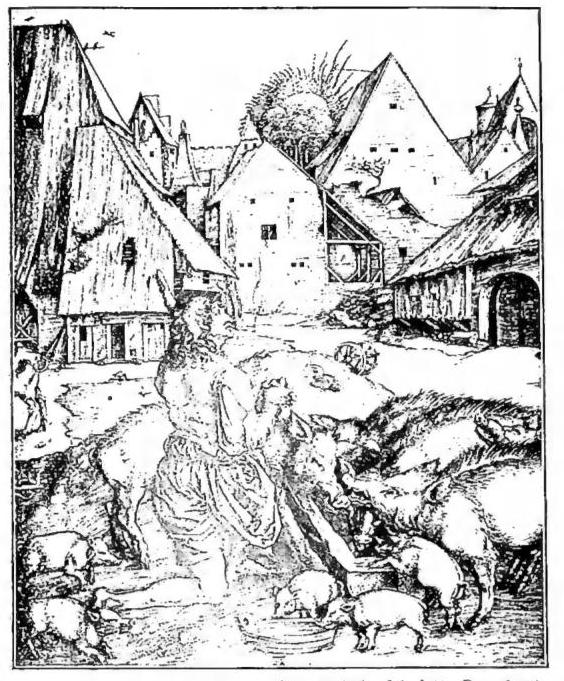
**The Prodigal Son.** Engraving by A. Dürer (16th cent.).
A highly effective literary device for conferring beauty and appeal upon a composition, as well as for rendering moral teaching more accessible and perspicuous.
There still remains an important question concerning the purpose Jesus had in mind in His abundant use of the parable. From the differing interpretations of a famous text (Mt. 13:10-15; cf. Mk. 4:10-12; Lk. 8:9 sq.) there arises the theory of a vindictive justice or that of mercy. Some affirm that Jesus resorts to such language in order to punish with a moral and intellectual blindness, caused by the obscurity or difficulty of the parable, the culpable unbelief of the Jews: He would have aimed at the hardening of their hearts, foretold by Is. 6:9 sq.; the light, offered under the veil of a metaphorical language, in ill-disposed intellects would have produced an ever greater blindness; thus do not a few Catholic exegetes express themselves (Maldonatus, Knabenbauer, Fonck, Durand, Skrinjar, etc.). This interpretation rests upon the most probable exegesis of the text of Isaiah, but seems little consonant with the intrinsic character of the parable, which aims at simplifying an abstruse concept, and with the entire mission of Jesus: for this reason M.-J. Lagrange, F. Prat, J. Huby, J.-M. Vosté, U. Holzmeister, H. Höpfl, L. Pirot, etc., see in the parable a means dictated by goodness and pedagogical insight, to enlighten the minds of the hearers. The obscurity of the expression would be occasioned by the difficulty of the idea to be inculcated and by the desire to arouse more keenly the curiosity of those who listened.
Jesus was always ready to explain His parables to docile and desirous spirits (cf. Mt. 13:36 sq.; Mk. 4:10 sq.). He would gladly have adopted the same method with all, but on account of the indifference of the crowd the parable, an excellent means for illustrating a truth, in practice produced a culpable intellectual blindness through its inevitable obscurity. What was a manifestation of goodness and divine mercy becomes, not through a punitive or vindictive will, but solely through the fault of the hearers, an occasion of spiritual darkness and sin. It is a divine grace rejected by a perverse will. This is the interpretation dictated by the entire context.