
### PASTORALE
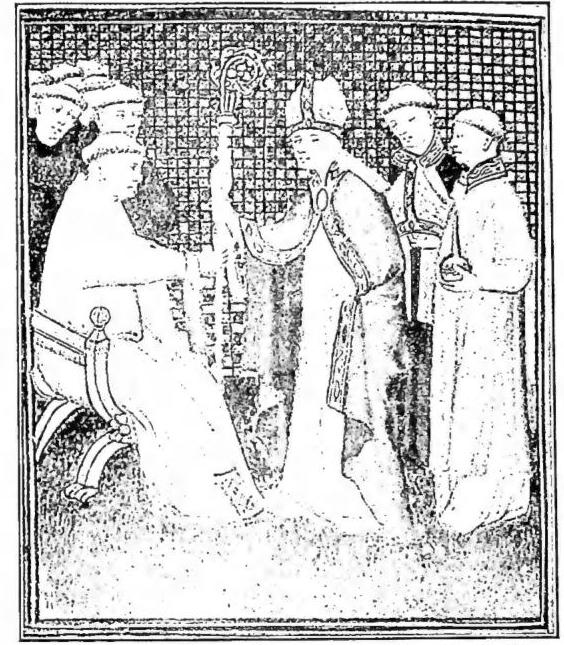
The Bishop presents the abbot with the pastoral staff adorned with the veil used in the Middle Ages. Miniature from the Missal-Pontifical of Stefano Loyneau, Bishop of Luçon (late 14th century) — Paris, Bibliothèque nationale, ms. lat. 8886, f. 297.
---
### ART
In the Romanesque period, many pastoral staffs (p.) were produced in the workshops of Limoges (13th century) and were made of copper with light green and blue enamels, featuring a serpent’s head or another animal at the end of the volute, and various statuettes inside the volute (e.g., in Paris, Ascoli Piceno Cathedral; Catania, Civic Museum, etc.). In the Gothic period, the knot took the form of a cusped tabernacle with full-round statues, the end of the volute displayed representations of the Annunciation or the Coronation, and between the shaft and the volute, winged angels were depicted. Translucent enamel decoration, in keeping with the style of the time, adorned both the shaft (sometimes covered with polylobed tracery) and the volutes. Some examples demonstrate the beauty achieved through the skillful integration of plastic elements with vividly enameled surfaces: the pastoral staff of Ciccarello by Francesco in the cathedral of Sulmona, another in the Opera del Duomo Museum in Siena, another in Città di Castello and in the cathedral of Treviso, and others, so similar as to suggest they came from the same Sicilian workshop, such as the pastoral staff of the cathedral of Reggio Calabria and that of the cathedral of Tropea, and that of Agira with a quadrilobed enamel within the volute, etc.
In the 15th and 16th centuries, enamel decoration disappeared; pilasters, columns, and round arches replaced Gothic forms in the knot, while the statuettes at the end of the volute had more naturalistic modeling.
Relief motifs of cherubim heads and curled leaves on the volute appear in pastoral staffs of this period (e.g., in the cathedral of S. Severina in Nicotera; in Orvieto, in the Opera del Duomo Museum, etc.). In the Baroque period, the line of the volute, which had remained firm despite the addition of decorative elements, became wavy and was formed by curled shapes (Monreale, S. Martino delle Scale; Crotone, Cathedral) or by
---
### PASTOR, BUON (THE GOOD SHEPHERD)
---
The Good Shepherd (B. P.) is mentioned in the Old Testament (Ps. 22:1; 79:2; Is. 40:11; Jer. 31:10; Ezek. 34) and in the New Testament (Jn. 10:1-18; Heb. 13:20; 1 Pt. 2:25; 5:4), where Christ is presented as the true Shepherd who gathers and protects his flock, contrasting with false shepherds who scatter and destroy the Lord’s flock (23:1-4; 50:6), a theme further developed by Ezekiel (34).
The figure of the Good Shepherd is found in early Christian art, especially in the catacombs. In the catacomb of Domitilla, for example, there is a depiction of the Good Shepherd in the act of carrying the lost sheep on his shoulders (Wilpert, Sarcofagi, I, pl. 52, 8), or outside Rome, in the museums of Istanbul (ibid., p. 73, pl. 52, 7 and 9) and Athens (ibid., pl. 52, 6). In the cemetery “inter duas lauros,” there are two small herms with the Good Shepherd, which served as altar bases (ibid., figs. 34 and 35). In the cemetery of Bassilla, there is a sepulchral stele of Tolia Asclepiaca (ibid., p. 74 and fig. 36). In Ravenna, there is the cippus of Antifonte. The image of the Good Shepherd is also frequently found in gilded glass (R. Garrucci, Storia dell’arte cristiana nei primi otto secoli della Chiesa, IV, Prato 1879, pp. 169-77) and in terracotta lamps (ibid., loc. cit.). Tertullian attests that the Good Shepherd was depicted on drinking vessels (De pudicitia, 7, 10), as well as on rings as a gem (G. B. De Rossi, in Bull. arch. crist., 3rd ser., 3 [1881], p. 113; O. Marucchi, Roma sotterranea, nuova serie, Rome 1914, p. 137, fig. 27; A. De Waal, Der Gute Hirt, in Römische Quartalschrift, 29 [1915], p. 111), and in medallions (R. Garrucci, Storia dell’arte cristiana, VI, Prato 1881, pl. 585, no. 6). Even later, in the fresco of the oratory of the Benedictine abbey built over the basilica of S. Ermete in the cemetery of Bassilla, the open book held by the Redeemer repeats: “Ego sum pastor bonus et cognosco oves meas” (E. Josi, Scoperta di un altare e di pitture nella basilica di S. Ermete, in Riv. arch. crist., 17 [1940], p. 199, fig. 5). Even today, the hymn of Matins on Low Sunday includes the verse: “Qui Pastor aeternus gregem / aquam lavas baptismatis.” The catechumens of Baptism become the “new lambs” of the flock of Christ the Shepherd. In the *Ordo commendationis animae*, one reads: “Constituat te Christus filius Dei vivi intra Paradisi amoenam vireta et inter oves suas te verus ille Pastor agnoscat.”
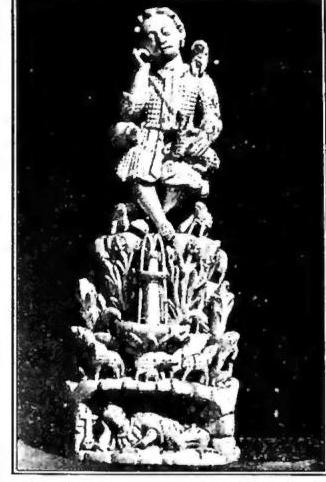
Rare are the representations of the Good Shepherd in medieval art and especially in modern art. Notable examples include the 16th-century ivory sculpture of Indian art in the Oriental Room of the Sacred Art Museum of the Vatican Library and the image of the Good Shepherd painted by C. Mezzana (20th century) in a chapel in the above-ground part of the Catacomb of Callisto.
In early Christian epigraphy, the idea of the shepherd and the flock sometimes recurs. Thus, Damasus, extolling the heroism of Sixtus II, writes: “pastoris meritum numerum gregis ipse tuetur” (A. Ferrua, Epigrammata Damasiana, Vatican City 1942, p. 124); similarly, in the inscription from Spoleto commemorating Bishop Achille, founder of the basilica in honor of the Prince of the Apostles (G. B. De Rossi, Bull. arch. crist., 2 [1871], p. 118). It also appears in an inscription of Bishop John of Ravenna (578-95; CIL, XI, 301) and in Vercelli (ibid., V, 6725), in the inscription of Bishop Celso of Vercelli: “custos gregis ovium Christi.”