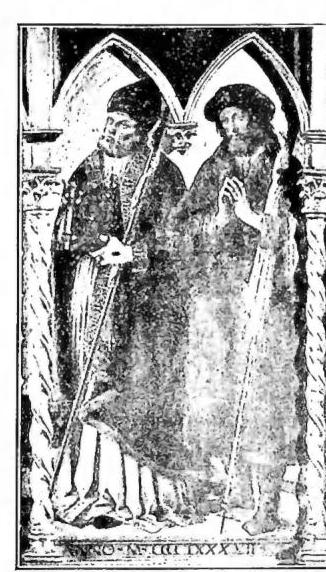
PELLEGRINI (PEREGRINI ET VAGI)

PELLEGRINI (PEREGRINI ET VAGI) - Peregrinus è per il diritto canonico colui che si trova per qualsiasi

PILGRIMS (PERSONS ON PILGRIMAGE AND VAGRANT PERSONS) — In canon law, a *peregrinus* is one who, for any reason, is temporarily situated in a place other than that of his domicile (v.) or quasi-domicile (CIC, can. 14); a *vagus* is one who possesses neither domicile nor quasi-domicile (ibid.).

In relation to these particular conditions, such persons sometimes find their juridical capacity modified within the various spheres of canon law. Specifically: 1) pilgrims are not subject to the particular laws of their own territory when they sojourn elsewhere, even if they have done so to evade a legal prohibition (can. 13 § 2), except where the transgression of the law causes harm to the territory of origin or concerns personal laws (can. 14 § 1, n. 1). 2) They are not bound to observe the particular laws in force in the territory where they are found. Since they lack the requirement of domicile or quasi-domicile, they are not subjects of the local Ordinary as legislator. Exceptions are made, however, for laws enacted specifically for pilgrims, those safeguarding public order, and those regulating the form and solemnity of acts (*locus regit actum*); general laws, even if not in force in their own territory, bind them if they are in force where they are (can. 14 § 1, n. 3).

Vagrant persons, as defined by the CIC, are subject to the law and jurisdiction of the place where they are found (can. 14 § 2). Like *incolae*, vagrant persons are subjects of the local Ordinary, who may issue special laws for them (v. can. 91, 92, 94, 88, 103, 1097, etc). It is clear, however, that such laws bind only for as long as the vagrant persons remain in that territory. Pilgrims, though distant from their domicile or quasi-domicile, remain subjects of their own parish priest or Ordinary. Yet if these cannot exercise their office toward their pilgrim subjects, the parish priest and Ordinary of the place where the pilgrims are found may exercise particular powers over them. Thus, local Ordinaries and parish priests may dispense pilgrims even from the law of fasting and abstinence (can. 1245 § 1); exercise all faculties granted in danger of death and, in urgent cases, toward pilgrims in accordance with can. 1043–45. Ordinaries may dispense pilgrims from non-reserved vows (can. 1313, 1°) and from promissory oaths (can. 1320). All these provisions, however, do not establish a general juridical principle in favor of pilgrims but are strictly interpreted.

Ordinary and parish priests possess many faculties toward pilgrims and vagrant persons, including in matters of the Sacraments (v. the relevant entries).

BIBL.: besides commentaries on Book I, tit. 2 and 4 of the CIC, V. Hove, *De legibus ecclesiasticis*, Malines-Roma 1930, pp. 219–236; I. M. Costello, *Domicile and Quasi-Domicile*, Washington 1930; P. Gillet, *Denominationes personarum ex loco habitationis*, in *Collectanea Mechliniensia*, 23 (1934), pp. 557–60; Ch. Lefebvre, *La théorie du domicile et l'équité canonique*, Bruges 1947. Francesco Ercolani