
**PIETRUS PICTAVIENSIS (PETER OF POITIERS).** – Theologian, first half of the 12th century, d. in Paris in 1205. A disciple of PETER LOMBARD (q.v.), in 1169 he succeeded PETER COMESTOR (q.v.) in the theological teaching at Notre-Dame, and in 1193 he succeeded HILDUIN as chancellor of Paris (cancellarius Parisiensis): he held both offices until his death. Highly esteemed, he was entrusted with delicate missions by Celestine III and Innocent III.
Before 1175 he wrote the *Libri quinque Sententiarum* (PL 211, 789-1280; new ed. Ph. S. Moore–J. N. Garvin, M. Dulong, *Sententiae Petri Pictavienis* [I–II, Publicatio in Mediaeval Studies, 7 and 11], Notre Dame, Indiana 1943–50), in which he treats, with a somewhat different division, the same subject matter as the *Sentences* of PETER LOMBARD (q.v.), following his approach and method. Notable are his clarifications on the sacraments (e.g., *Sacramentum*, *res Sacramenti*, regarding the Eucharist) and his mention of Aristotle’s *Metaphysics*. Attacked by GUALTERUS OF ST. VICTOR (q.v.) in 1180 as one of the four labyrinths of France, he defended the positions of the school of PETER LOMBARD with honor. He also wrote: *Genealogia et chronologia sanctorum Patrum ab Adamo ad Christum*, also called *Compendium historiae Veteris et Novi Testamenti* (Basel 1592): a summary, dry and inexact, of sacred history; *Allegoriae super Tabernaculum Moysi* (ed. Ph. S. Moore and J. A. Corbett, Indiana 1938): the author explains from the verses of Exodus whatever lends itself to allegorical considerations; other commentaries (glosses, allegories, distinctions) on Scripture remain unpublished.
---
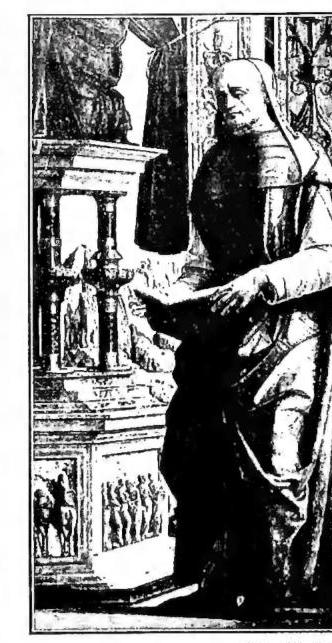
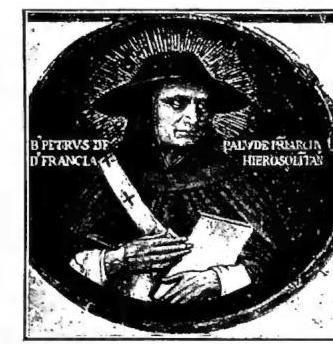
**PIETRUS PICTOR (PETER OF POITIERS).** – Portrait. Detail of the Crucifixion. Fresco by the Blessed ANGELICO (first half of the 15th c.). Florence, Convent of S. Marco.
**PIETRUS PICTOR (PETER OF POITIERS).** – Portrait. Detail of the Crucifixion. Fresco by the B. P. PETRUS PICTOR. – Poet and theologian, about whom few biographical details are known. He lived between the end of the 11th century and the beginning of the 12th and was a canon of St-Omer.
He wrote several Latin poems of some value: *Contra simoniam* (ed. H. Boehmer, in MGH, *Libelli de lite*, III, pp. 708–10): a violent attack against the Roman clergy; *De vita Pilati*; *De illa quae impudentur filium suum adamavit*: a re-evocation of the drama of Phaedra and Hippolytus; *De laude Flandriae* (*Flandria dulce solum*), with allusions to contemporary events. Far more important is the composition *De sacra Eucharistia* or *De sacro Sacramento altaris* (different recensions: Busée in PL 207, 1135–54 [among the works of PETRUS BLESIENSIS] preferable: Beaugendre, ibid., 171, 1195–1212 [among the works of HILDEBERTUS CENOMANENSIS]): an exposition of Eucharistic doctrine inspired by the work of PASCHASIUS RADBERTUS (q.v.).
---
**PIETRUS PICTOR (PETER OF POITIERS).** – Portrait. Detail of the Crucifixion. Fresco by the Blessed ANGELICO (first half of the 15th c.). Florence, Convent of S. Marco.
**PIETRUS PICTOR (PETER OF POITIERS).** – Portrait. Detail of the Crucifixion. Fresco by the B. P. PETRUS PICTOR. – Poet and theologian, about whom few biographical details are known. He lived between the end of the 11th century and the beginning of the 12th and was a canon of St-Omer.
He wrote several Latin poems of some value: *Contra simoniam* (ed. H. Boehmer, in MGH, *Libelli de lite*, III, pp. 708–10): a violent attack against the Roman clergy; *De vita Pilati*; *De illa quae impudentur filium suum adamavit*: a re-evocation of the drama of Phaedra and Hippolytus; *De laude Flandriae* (*Flandria dulce solum*), with allusions to contemporary events. Far more important is the composition *De sacra Eucharistia* or *De sacro Sacramento altaris* (different recensions: Busée in PL 207, 1135–54 [among the works of PETRUS BLESIENSIS] preferable: Beaugendre, ibid., 171, 1195–1212 [among the works of HILDEBERTUS CENOMANENSIS]): an exposition of Eucharistic doctrine inspired by the work of PASCHASIUS RADBERTUS (q.v.).
He wrote several Latin poems of no small merit: *Contra simoniam* (ed. H. Boehmer, in MGH, *Libelli de lite*, III, pp. 708–10): a violent attack on the Roman clergy; *De vita Pilati*; *De illa quae impudentur filium suum adamavit*: a re-evocation of the tragedy of Phaedra and Hippolytus; *De laude Flandriae* (*Flandria dulce solum*), with allusions to contemporary events. Far more important is the composition *De sacra Eucharistia* or *De sacra Sacramento altaris* (different recensions: Busée in PL 207, 1135–54 [among the works of Peter of Blois] preferable: Beaugendre, ibid., 171, 1195–1212 [among the works of Hildebert of Lavardin]): an exposition of Eucharistic doctrine inspired by the work of Paschasius Radbertus (v.).
PIETRO DELLA PALUDE - Portrait. Detail from the Crucifixion. Fresco by the Blessed Angelico (1st half of the 15th c.). Florence, Convent of S. Marco.
PIETRO DELLA PALUDE - Portrait. Detail from the Crucifixion. Fresco by the B. P. Pietro di Potters (Petrus Pictor). - Poet and theologian, of whom no particular biographical details are known. He lived between the end of the 11th century and the beginning of the 12th and was a canon of St-Omer.
He wrote several Latin poems of no small merit: *Contra simoniam* (ed. H. Boehmer, in MGH, *Libelli de lite*, III, pp. 708–