
PIO VII, of Cesena, Barnaba (Gregorio) Chiaramonti, 14, 21 March 1800 – 20 Aug. 1823.
LEO XII, of Genga (Fabriano), Annibale della Genga, 28 Sept., 5 Oct. 1823 – 10 Feb. 1829.
PIUS VIII, of Cingoli, Francesco Saverio Castiglioni, 31 March, 5 Apr. 1829 – 30 Nov. 1830.
GREGORY XVI, of Belluno, Bartolomeo Alberto (Mauro) Cappellari, 2, 6 Feb. 1831 – 1 June 1846.
PIUS IX, of Senigallia, Giovanni Maria Mastai Ferretti, 16, 21 June 1846 – 7 Feb. 1878.
LEO XIII, of Carpineto (Anagni), Gioacchino Pecci, 20 Feb., 3 Mar. 1878 – 20 July 1903.
B. PIUS X, of Riese (Treviso), Giuseppe Sarto, 4, 9 Aug. 1903 – 20 Aug. 1914.
BENEDICT XV, of Genoa, Giacomo della Chiesa, 8, 6 Sept. 1914 – 22 Jan. 1922.
PIUS XI, of Desio (Milan), Achille Ratti, 6, 12 Feb. 1922 – 10 Feb. 1939.
PIUS XII, of Rome, Eugenio Pacelli, 2, 12 Mar. 1939.
V. THE NUMBER OF THE POPES
No matter how much care is taken in sifting the sources, the list of popes remains uncertain in more than one case up to the election of Martin V (1417); from this pope to the reigning pontiff the series presents no further doubts. The main doubtful cases are thesetuiti: 1) from the binomials: Cletus-Anacletus, probably one person, although the duplication dates back to the 4th century and perhaps already to the 3rd, and Marcellinus-Marcellus, but the hypothesis that would make them a single person has not met with the critics’ assent; 2) from doubtful antipopes or improperly so called (v. ANTIPOPE); 3) from elections that remained without effect because they were not followed by the ordination or episcopal consecration of the elected, which, according to the juridical norms current before St Gregory VII, was the sine qua non for the elected to be regularly considered a pope: this is the case of Stephen II, elected between 16 and 23 March 752, who died two days later without the ordination, which historically and juridically is not a pope; 4) from some papal elections at the end of the 9th century that provoked very lively controversies and culminated in the abominable “Cadaver Synod”; the origin of these disputes is to be traced back to the election of Marino, bishop of Caere (882), the first case of a bishop becoming pope, and above all to that of Formosus (891), bishop of Porto; the uncanonical character of these two elections was noted by contemporaries, but the dissent broke out violently with the succession of Theodore II (d. December 897) and the formation of the Formosan and anti-Formosan parties: there were then two elections: John IX (January 898), who had himself immediately consecrated, and Sergius III, bishop of Caere, who had to leave Rome until, in 904, after the deposition of the antipope Christopher, he succeeded in being enthroned on 29 January. Sergius never considered John IX and his successors, nor Formosus, as legitimate. In the face of these facts the historian remains perplexed, even while accepting the papal series as it results from the various sources; 5) from the deposition of John XII by Otto I in the Roman Synod of 4 December 963: the Church was certainly freed from an unworthy pontiff, but this occurred in contempt of canonical rules and more for political than moral motives. Leo VIII, made pope by Otto, should therefore be placed among the antipopes, and the true successor of John XII should be Benedict V, elected at the death of John XII (964); the ancient catalogues, however, maintain the contrary; 6) from the insertion in the catalogues of non-existent popes, such as in 972 or 974 Donus II (Domnus or Bonus) and John XX, created through the duplication of John XV; besides, John XVI is an antipope; 7) from the extremely intricate successions of Benedict IX (1014), Stephen IX (1057) and Honorius II (1124); 8) from the situation created by the existence of three “obediences” at the beginning of the 15th century, which came to an end with the Council of Constance, which for the good of the Church proceeded more by authority than according to traditional norms. According to the solutions that can be given to some of these intricate problems, the number of popes increases or decreases. According to our chronology the true popes would be 258, including Diacorus and Celestine II Buccapeus, to be considered as authentic popes. The true antipopes would be 36, including Vigilius, who was later legitimized. The doubtful antipopes would be 2, in addition to the unclear beginnings of the pontificates of Boniface II, Eugenius I, Sergius III, Gregory VI and Clement II; those improperly so called would be 9. As regards their place of origin (for the first centuries the Liber Pontificalis remains an unverifiable source), the popes can be distributed as follows: Romans 100; Italians 106; foreigners 50; of unspecified place of origin 2. As regards cult, 77 popes are venerated as saints; 8 as blessed; one antipope, Hippolytus, as a holy martyr.
VI. PORTRAITS OF THE POPES — For the ancient and medieval popes, what we have are not true likenesses reproducing their personal features, but rather iconographic types that are repeated with few variations. In the modern and contemporary age, however, authentic portraits abound. Among the collections of portraits of the popes, the following deserve mention: 1) the one frescoed in the basilica of St Paul’s during the time of Leo the Great, continued at the end of the 9th century by Pope Formosus, by Nicholas III at the end of the 13th century, by Benedict XIV around 1750, and completely remade in mosaic after the fire of 1823; 2) those frescoed in St Peter’s and in the Lateran, now destroyed; 3) the one in San Piero a Grado (near Pisa), which now ends with John XVII, attributed to Deodato Orlandi (1300–12); 4) the one painted on canvas in the Altieri Palace at Oriolo, from the time of Clement X, still kept up to date; 5) the one in Marino in the Colonna house, now the Town Hall (under the pontificate of Gregory XVI). In the 15th century, the cathedral of Siena was furnished with a complete series of busts of the popes. Another series of 40 oval medallions with portraits of the first sainted popes runs along the marble revetments of the internal piers of the minor naves of St Peter’s in the Vatican (bas-reliefs by pupils of Bernini; Innocent X, 1644–55).
In our plates LVIII–LXII, the complete series of portraits of the popes is given, reproduced on medals struck during each pontificate, from Nicholas V to Pius XII. VII. PONTIFICAL ARMS — There exist many ancient and modern collections of pontifical arms, yet none has been produced in the full critical sense. Our series of heraldically drawn arms begins with Innocent III; for Urban IV (1261–64) and the Avignon popes (1309–76) recourse was had to an excellent anonymous article in the Revue de l’art chrétien, 51 (1908), pp. 254–65, 409–411; for the antipope Clement VII to Galbreath; for the other antipopes and popes down to our own day to the arms found on monuments, almost all of them Roman, each one checked individually by Dr Witold Wehr. It should be noted that the precise metals or tinctures are often hard to determine, since in most cases these derive from sculpture; likewise certain charges remain uncertain because they were drawn or carved in various ways by contemporaries, even in models of truly authentic arms.
Burial of the Popes. — Under the respective headwords will be found the place of burial of individual popes; it suffices to recall here that the Liber Pontificalis gives as the place of burial for the popes of the 1st and 2nd centuries St. Peter’s in the Vatican. Now, in the course of excavations carried out to identify the tomb of the Prince of the Apostles, no elements capable of confirming this account have come to light in the zone explored. In the 3rd century the popes were buried in the cemetery of St. Calixtus; in the 4th and 5th centuries in various cemeteries: Calixtus, Priscilla, Balbina, Calepodius, etc., and in the basilicas of St. Lawrence and St. Paul. Leo the Great was again buried in the Vatican, in the basilica of St. Peter, which then became the preferred place of burial for the majority of the popes.
On the primacy of the pope: V. PRIMATO DI S. PIETRO E DEL ROMANO PONTEFICE.
V. in DACL, XIII, 1, 1097-1111
II.- Oltre la bibl. delle voci CONCLAVE e INCORONAZIONE, cf. G. J. Ebers, Der Papst u. die römische Kurie, I. Wahl, Ordination u. Krömming des Papstes, Paderborn 1916 (raccolta di testi); C. Mirbt, Quellen z. Geschichte der Papsttums u. des römischen Katholizismus, 5ª ed. anastatica, Tubinga 1934 (l'autore d. raccolta è protestante), H. Leclercq, Pape, in DACL, XIII, 1, 1111-1345. - III-IV. - Oltre la bibl. delle voci ANTIPAPA: CATALOGHI DI PAPI E DI VESCOVI, cf. L. Duchesne, Lib. Pont., la maggior parte dell'introduzione tratta delle questioni qui accennate; Th. Mommsen nell'introduzione alla sua ed. del Lib. Pont., in MGH, Regesta pontificum Romanorum, Hannover 1898, pp. XXVIII-LXIX, tratta dell'Ordo et spatia epp. Romanorum; H. K. Mann, The lives of the popes in the Middle ages, 19 voll. Londra 1902-32; A. Cappelli, Cronologia, cronografia e calendario perpetuo, 2ª ed., Milano 1930, pp. 206-289; A. Mercati, La serie dei p. nell'Annuario pontificio per l'anno 1947, in L'osservatore romano, 19 genn. 1947 (vers. inglese in Mediaeval Studies, 9 [1947], pp. 71-80). - V. - L. Duchesne, Le nombre des papes, in Miscellanea di Storia ecl. e di studi ausiliari, 2 (nov. 1903), pp. 3-8; R. L. Poole, The names and numbers of medieval Popes, in The English historical Review, 32 (1917), pp. 465-78, cf. anche pp. 204-14. - VI. - P. D'Achiardi, Gli affreschi di S. Piero a Grado presso Pisa..., in Atti del Congr. internazionale di scienze stor. (Roma, 19 apr. 1903), VII, Roma 1905, pp. 193-285, cf. p. 270-282; H. K. Mann, The portraits of the Popes, in Papers of the British School at Rome, 9 (1920), pp. 159-204; L. De Bruyne, L'antica serie di ritratti papali della basilica di S. Paolo fuori le Mura, Città del Vaticano 1934; G. Ladner, I ritratti dei p. nell'antichità e nel medioevo, I. Dalle origini fino alla fine della lotta delle investiture, Città del Vaticano 1941; H. Leclercq, Pape, in DACL, XIII, 1, coll. 1139-47. - VII.- Tra le numerose raccolte di stemmi di p. si ricordano quelle di: O. Panvinio, Epitome pontificum Romanorum, già cit.; A. Ciseconio, Vitae et gesta già cit.; G. Gigli, Selva di Varia, cod. Vat.A. PIETRO FRUTAZ
Scritto sul finire del 1644: F. Pasini-Frassoni, Essai d'armorial des pages d'après les manuscrits du Vatican et les monuments publics, Roma 1906; estratto dalla Rivista del Collegio araldico, 3 (1905), pp. 706-13; 4 (1906), pp. 17-24, 81-96; H. G. Stroehl, Album Pontificale, München Gladbach 1909; R. Granozio, Stemmi e p., Roma 1936; D. L. Galbreath, A treatise in eccl. Heraldry, I. Papal Heraldry, Cambridge 1930; C. Erdmann, Das Wappen u. die Fahne der römischen Kirche (Quellen u. Forschungen aus ital. Archiv. u. Biblioth., 22), 1930, pp. 227-255. - VIII. - F. Gregorovius, Die Grabenhändler der Papate, Lipnia 1881 (vera. it., 2ª ed. riveduta e ampliata da C. Huelsen, Roma 1931); H. K. Mann, Tombs and portraits of the Pages of the Middle ages, Londra (1929); B. M. Apolloni Ghetti-A. Ferrua-E. Josi-E. Kirschbaum, Esplorazioni sotto la Confessione di S. Pietro in Vaticano, Città del Vaticano 1951, p. 27.
IX. ACTS OF THE POPES
The imposing mass of papal documents, while representing a primary historical source in relation to their recipients, is also a faithful testimony to the pastoral zeal of the popes and a principal element for reconstructing their itineraries, in periods when the papal court, due to particular predilections of the reigning popes or external causes, moved from one see to another (always remaining subject to the principle of the supreme governance of the Church tied to the See of Rome). Such documents are scattered in numerous archives, where they almost always represent the most precious "pieces"; the series of registers (v.), which begins to be systematic only with the pontificate of Innocent III, is instead preserved in the Vatican Apostolic Archive. With the introduction of printing, the value of these acts was not overlooked, and many initiatives were undertaken to collect them into different corpora of varying size and importance, generally known under the name of "Bullaria," even though not all the documents included in them fall under the category of "bulls."Apart from an incunable (Nuremberg 1481 [?]) and numerous 16th-century editions (the most important being that of Cardinal Antonio Carafa, Epistolae decretales Summorum Pontificum, 3 vols., Rome 1591, inspired by Sixtus V and interrupted relative to the original plan; it contains the bulls from Clement I to Gregory VII), the most significant collections were produced in the 17th and 18th centuries. The series begins with the Bullarium magnum Cherubinorum, which, initiated by Laerzio Cherubini at the end of the 16th century (922 acts from Leo the Great to Sixtus V, 3 vols., Rome 1586; 2nd ed. ibid. 1617; the same editor also produced the edition of the constitutions of Sixtus V, Rome 1586 and 1588), was given a broader scope by his son, the Benedictine Angelo Maria Cherubini. He published, as the 3rd edition of his father's collection, a Bullarium Romanum novissimum a b. Leone Magno usque ad S. D. N. Urbanum VIII (4 vols., Rome 1634-44), later extending it (4th ed.) to Innocent X (Lyon 1655: 2 of the 4 volumes of this edition are on the Index "donec expurgentur" due to the insertion of a false bull and the alteration of another). In 1659 an Appendix appeared in Viterbo; then the Fathers Angiolo di Lantusca and Giovanni Paolo di Roma prepared a new edition (5th, but indicated as 6th because the Appendix was included in the count), published in 6 volumes in Rome between 1669 and 1672, in which the material extends to Clement X (reprints in Lyon in 1673 and 1697). Finally, the 6th edition, much more extensive but not more accurate, appeared in Geneva (though the title page indicates Luxembourg) starting in 1727 (vols. I-VIII; in 1730 vols. IX-X). From 1741 various supplements were issued, bringing the volumes to 19 (the last in 1758), reaching the pontificate of Benedict XIV; however, the acts of this pope are only copied from the Roman edition of Mainardi [V. below]. A brother of Angelo Maria, Flavio Cherubini, also edited a Compendium bullarii a patra editi, Rome 1623 (other editions in Lyon, 1624 and 1638).
Another important collection, though of more modest proportions, is that of P. Constant (in collaboration with S. Mopinot), Epistolae Romanorum Pontificum et eae quae ad eos scriptae sunt, a s. Clemente I usque ad Innocentium III, which remained unfinished at vol. I (Paris 1721); the material extends only to the year 440. Schönemann produced a 2nd ed. (Göttingen 1796), which contains some omissions and a few additions. The work is usually regarded as the 3rd ed. of Constant’s collection in the edition by A. Thiel, Epistolae Romanorum pontificum genuinae et quae ad eos scriptae sunt a s. Hilario usque ad Pelagium II, also unfinished (at s. Hormisdas; vol. I, Braunsberg 1868).
The most vast and certainly the most famous is the Bullarium magnum seu novissimum et opportunissimum bibliotheca apostolicarum constitutionum of C. Cocquelines, in 14 vols. and 28 tomes (Rome 1739–62: the first 6 vols. [tt. I–XX], issued under the title Bullarium, privilegiorum ac diplomatum Romanorum pontificum amplissima collectio, are essentially an enlarged reprint of the work of Cherubini; the last 5 were published after Cocquelines’ death, without his name); the acts extend to the pontificate of Benedict XIV. This collection overlaps in various ways with another, whose history is very intricate: the Bullarium magnum of G. Mainardi, generally reckoned at 18 vols. (Luxembourg and Rome 1733–58), which was to comprise documents from Leo the Great to Benedict XIV. In reality only 12 vols. are by Mainardi: he originally conceived the idea of producing a supplement to the last Roman edition (1669–72) of Cherubini’s Bullarium, so he reprinted in his vol. I (which he called VII) the acts of Clement X; then he proceeded with 7 more vols. (1734–44) down to the early years of Benedict XIV’s pontificate; finally he added the 4 vols. of the Bullarium of Benedict XIV (1754–58), while entrusting the re-edition of Cherubini’s volumes to Cocquelines. Mainardi’s work was abridged by L. Guerra, Pontificarum constitutionum... epitome (4 vols., Venice 1772), and continued up to the first four years of Gregory XVI’s pontificate by A. Barberi, A. Spetta, R. Secreti, Bullarii Romani continuatio, 9 vols. in 19 tomes, Rome 1835–57.
Wide renown likewise attended the Bullarium, diplomatum et privilegiorum s. Romanorum pontificum Taurinensis editio, published by Tomasetti under the care of Cardinal F. Gaude, archbishop of Turin, in 22 vols. (Turin 1857–72), plus an appendix (ib. 1867); it was then continued at Naples under the patronage of Cardinal Sant’Elia (5 vols., 1867–85).
The multiplication of acts and the discovery of others buried in archives made an all-embracing edition increasingly problematic; instead, specialized bullaria appeared (of individual popes, of Sacred Congregations, of religious and military orders, of episcopal sees, etc.), alongside the publication of regesta compiled with rigorous scholarly method but limited to the period from the origins to the early fourteenth century (v. REGESTO).
Alessandro Pratesi
X. MEDAGLIE PAPALI
They constitute an extremely rich collection of medal-like objects dating from about the middle of the 15th century to the present day. Produced almost annually in one or more specimens by every pope, alongside papal coinage, these pieces—contemporary with each pontiff—illustrate his history in terms of his merits in every field, while reflecting and repeating the technique and art of the period to which they belong. Initially they were cast, and the designs were conceived and executed according to the canons of Renaissance medallic art, recently introduced in Italy; later, from about the middle of the 16th century, they were struck and increasingly conformed to the monetary art of subsequent epochs, the pieces being engraved and struck at the mint in Rome.With this in mind, many groups of pieces that have been abusively inserted into the proper papal series over the centuries must be excluded. Almost until today these have been part of II. First of all, a mass of cast pieces depicting almost all the popes from St Peter to Martin V, which are still sometimes divided into two groups distinguished by certain external, technical, and typological characteristics; but the types are without exception of minimal artistic, iconographic, and historical value. It has long been recognized that the Milanese G. B. Pozzi, at the end of the 16th century, was the author of these forgeries. He worked with imagination, creating conventional portraits that differ for the same figures represented in the two series (cf. Gregory VII, Innocent IV, Clement IV, Adrian V, Innocent VII, Gregory XII); these pieces could not be attributed to the same person without the explanatory legend. Similarly, the reverses are crude and unadorned, devoid of any content.
PAPA - Reverse of the medal of Callistus III, with coat of arms; for the obverse see pl. LIX, 2. Attributed to Guazzalotti — Vatican Coin Collection.
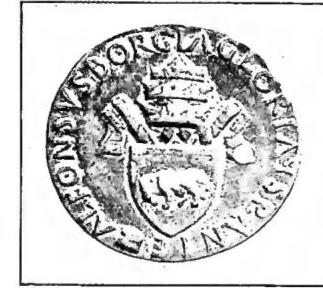
The authentic papal series begins in the mid-15th century and even for the 16th century it is not rich in pieces. These products then do not bear famous signatures, though they reveal the work of engravers and medallists such as Guazzalotti, Lysippus, Vittor Camelio, Fioravante, Caradosso, Cellini, Leone Leoni, and Federico Parmense, to name only the most famous.
It has also been rightly recognized that in Rome there was lacking a true and proper school of medallists, identifiable by a distinctive style; and that the artists who worked there, from Nicholas V throughout the 16th century, were immigrants from various Italian cities and their schools. Finally, their production is much better represented by non-Roman medals: even for Cellini it can be asserted that the characteristics of his precious art are far more evident and appreciable in every other product of his chisel than in the coins and medals of Rome. Yet it must also be borne in mind that in Rome their production assumed an individual physiognomy from the environment, due to the dependence and relations of the artists with the papal court, and therefore from the obligations inherent in their official production, restricted to the subjects assigned to them and which they were obliged to treat and repeat for subsequent issues.
The medals of the true papal series, i.e., contemporary with the popes whose name and portrait they bear, begin with a few cast pieces of Nicholas V, Callistus III, and Pius II. The medal of Nicholas is posthumous and, signed by Guazzalotti of Prato, depicts the Pope seated in a boat inscribed ECCLESIA;
(Int. Enc. Catt.)
PAPA — Reverse of a medal of Pius II with the pelican feeding its young (the obverse is almost identical to that in pl. LIX, 3). Attributed to Guazzalotti — Vatican Medagliere.
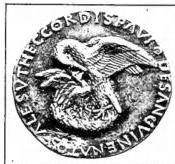
Pieces of Paul II are more numerous, all cast and largely anonymous; their types commemorate the building activity of the pope, already begun as a cardinal (cf. the pieces: HAS AEDES CONDIDIT... HANC ARCEM CONDIDIT, for the Palazzo S. Marco, etc.). Other anonymous pieces are attributed to Cristoforo di Geremia and depict the house of the physician Gottifredo, the tribune of St. Peter’s, etc. To the same artist are attributed the fine oval medals dedicated PAULI VENETO PAPE II ITALICE PACIS FUNDATORI, with a magnificent portrait. A single piece (LETITIA SCOLASTICA) bears the signature of Aristide Fioravanti of Bologna (A. BO.).
In the series of Paul II a special place is occupied by the large medal of the Consistory of 1466, 78 mm in diameter, of unknown author (among the names suggested are Andrea Niccolò da Viterbo, Pier Matteo Orfini and also the Bolognese Fioravanti). The piece has types of minimal relief but with a clear design in the details of the two scenes. These depict, one, the Consistory presided over by the pope enthroned, surrounded by his court [SACRUM PUBLICUM CONCISTORIUM PAULUS VENETUS P(A)P(A) II]; the other, in the upper field, Christ seated in glory at the centre of
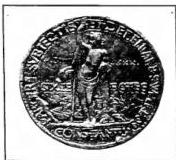
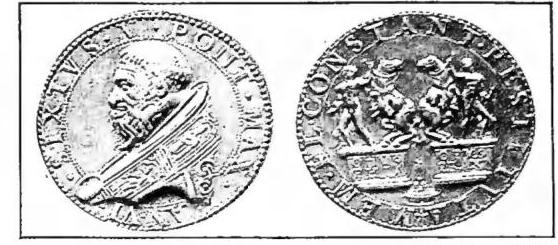
PAPA - Reverse of the medal of Sixtus IV with the motto: Parcere subiectis et debellare superbos (for the obverse see pl. LIX, 2). Attributed to Guazzalotti - Vatican Medals Collection.
An oval surmounted by countless angels, with nimbed saints at the sides, and in the lower field, flanking an altar topped by the Crucifix and flanked by the Virgin and St. John, a scene of the Last Judgment. An infinity of seated and standing figures fill the two scenes in a symmetrical arrangement that, for the variety of attitudes, does not engender monotony or annoyance. Two known specimens in gold, each worth 20 ducats, were struck, and bronze casts reproducing the gold are fairly common.
A certain number of anonymous pieces of Sixtus IV are attributed to Guazzalotti and to Lysippus; only one piece is signed by Vittor Camelio. The first is attributed the medal for the liberation of Otranto from the Turks by Alfonso, Duke of Calabria, commander of the papal army (PARCERE SUBIECTIS ET DEBELLARE SUPERBOS SIXTE POTES-CONSTANTIA-MCCCLXXXI), where the figure of Constantia repeats that of the medal of Dottori of Padua attributed to Geremia; and the specimen with the reverse known from the medal of Geremia himself for Constantine. Two anonymous medals are attributed to Lysippus, one with the Ponte Sisto (CUBA, RERUM PUBLICARUM) and the other with the coronation of the Pope. Vittor Camelio signed only one cast medal with the depiction of the papal audience [OP(US) VICTORIS CAMELI VE(NETI) at the foot of the reverse], which truly has something of the characteristic strength of the 15th century.
The four known medals of Alexander VI are attributed by style to the Milanese Caradosso; they are cast,
(photo: Enc. Catt.)
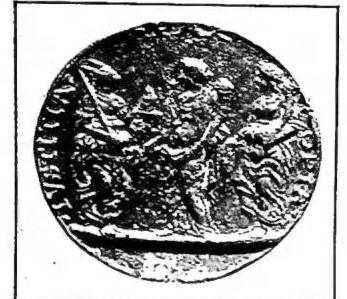
PAPA – Reverse of the medal of Innocent VIII with the motto: Justitia Pax Copia (for the obverse see pl. LIX. 6). Author unknown – Vatican Medals.
TIAM CUM FORTUNA CONIUNCT(AM).
For Leo X no signed medals are known, and the few specimens bearing his name are most uncertainly attributed to contemporary engravers.
From this point onward, the technique of striking proper to coinage is also adopted for the medal: hence a decline in artistic value and an ever closer adherence between the two products of the same Roman mint.
The medals by Cellini for Clement VII are two: the signed one (CLAUDUNTUS BELLI PORTAE), which commemorates the peace between the Pope and the Emperor, and the other anonymous (UT BIBAT POPULUS) with Moses making water gush from the rock, for the execution of the well at Orvieto. For the other medals of Clement VII the names of Giovanni Bernardi of Castel Bolognese and of Francesco Ortensi, son of Girolamo Dal Prato, are still put forward; to the first is attributed the magnificent specimen EGO SUM IOSEPH FRATER VESTER, which some prefer to consider as by Cellini’s hand; to the second the finely cast piece (POST MULTA PLURIMA RESTANT) with Christ bound to the column, a type alluding to the sufferings endured by the Pope at the sack of Rome.
Si attribuiscono a Leone Leoni alcune medaglie di Paolo III con cavalieri che fuggono sotto una pioggia di pietre (DOMINUS CUSTODIT TE - DOMINUS PROTECTIO TUA) allusivo alla fuga del corsaro Barbarossa; e SECURITAS TEMPORUM (con la firma LEO) con tre cavalli al pascolo; infine la Roma seduta presso la lupa ed il Tevere. Alessandro Cesati, detto il Grechetto, ha firmato una sola medaglia di Paolo III (OMNES REGES SERVIENT EI) con Alessandro in ginocchio davanti al gran sacerdote, tipo già di concezione ampollosa, che denunzia lo stile e le forme esagerate del tardo '500. Gli si attribuiscono altre sei o sette medaglie, ma solo per tradizione o su testimonianze discutibili: fra le altre l'esemplare con la facciata di S. Pietro, quella di ispirazione classica SECURITAS P(OPULI) R(OMANI), e l'altra, di effetto melodrammatico ma di ispirazione originale, con Ganimede che innaffia il giglio farnese presso l'aquila imperiale. A Fe-
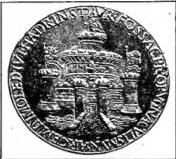
la prima con la scena della incoronazione (CORONAT); la seconda, in due varianti, con Castel S. Angelo ed il ponte omonimo (ARCEM IN MOLE DIVI HADR(IANI) INSTAUR(AVIT) FOSS(IS) AC PROPUGNACULIS MONS(VIT), e MOLEM HADRIANI VALLIS FOSSIS PROPUGNACULIS CORRIDORISQUE CINXIT); l'ultima col toro dei Borgia incoronato da un angelo: OR SAPIEN-
Dal Cavino, celebre falsario dell'epoca, è firmata la medaglia ANGLIA RESURGENS - UT NUNN NOVISSIMO DIE, in occasione del matrimonio di Maria Tudor con Filippo II nel 1554; alquanti pezzi dell'Anno Santo sono firmati dal Cesati insieme con l'esemplare KPATOUMAI. Ma il maggior numero sono anonime e non attribuibili.
Una medaglia di Marcello II, che regna 23 giorni, è firmata da G. B. De Rossi, milanese, che sostituì il Cesati alla zecca di Roma ed incise numerosi pezzi di Paolo IV, Pio V e Gregorio XIII. Di Paolo IV firmò il pezzo con il Calvario e quello con HAERESI RESTITUTA per l'istituzione del tribunale dell'Inquisizione; altri esemplari del medesimo papa (DOMUS MEA DOMUS ORATIONIS E BEATI QUI CUSTODIUNT VIAS MEAS) sono del Parmense.
The numerous medals of Pius IV are signed, in addition to De Rossi and the Parmense, by the new artists Marco Argo, pupil of Cesati, and Simone Pallante. Of the latter is the exemplar PIETATI PONTIFICIE with classical inspiration; of Marco Argo the pieces TUI SECTATOR, with a bishop on horseback pursuing and whipping a fleeing enemy, a transparent allusion to Cardinal Ippolito d'Este, legate in France to fight the Huguenots; finally, the piece with the Pope emerging with the Court from the Porta Flaminia. Notable among those of the Parmense are the pieces TU AUTEM IDEM IPSE ES E VIRGO TUA GLORIA PARTUS.
A rich group of pieces by Federico Parmense, some examples by G. A. Rossi together with some anonymous pieces, constitute the group of Pius V, among which notable by the Parmense is DEXTERA TUA DOMINE PERCUSSIT INIMICUM, recalling the Battle of Lepanto.
The numerous medals of Gregory XIII, in addition to the two previous artists, were signed by Domenico Poggini, G. Melone, L. Fragni, Niccolò De Bonis, Lodovico Leoni, Domenico Argentario and Bernardino Passero (and also by an F. C. and an R. C. not further identified). Argentario and Passero worked together around 1582 on the five large medals executed for the tenth year of the reign, which were to be placed in the foundations of the Jesuit College. The best pieces by the Parmense are UGONOTTORUM STRAGES E IN FLUCTIBUS EMERGENS - RESTAURAVIT with the bridge over the Tiber. By D. Poggini is IN NOM(INE) JESU SURGE ET AMBULA, with the healing of the paralytic. By L. Fragni Parmense are SUPER HANC PETRAM with the façade of St. Peter’s Basilica according to Michelangelo’s design and VIATORUM SALUTI - PELIA, with the bridge over the Paglia near Acquapendente; by Niccolò De Bonis is the medal commemorating the establishment of the German College, desired by Julius III and completed by Gregory XIII.
Numerous are the pieces in the name of Sixtus V signed by the engravers mentioned above. By now the papal medallic series is uniform in technique and systems that repeat and rework in the heavy style of the period, but it no longer presents much interest, except for the new types of architectural character.
The few medals of Urban VII, who reigned only 12 days, are posthumous. Of Innocent IX, who reigned two months, there are no coins but some medals
PAPA - Reverse of the medal of Alexander VI with Castel Sant'Angelo and the bridge (for the obverse V. pl. LIX. 7). Attributed to Caradosso - Vatican Coin Collection.
(photo: Enc. Catt.)
PAPA - Medal of Sixtus V, on the reverse the two colossi of the Quirinal. By E. De Bonis - Vatican Medals Collection.
Made by Niccolò and Emilio De Bonis, who also worked on the dies of Gregory XIV. Anonymous are the pieces in memory of Leo XI, who reigned only 27 days (1605).
The medals of Alexander VII are, except for a few exceptions, signed by Moroni and present in greater number architectural types and works of art of the epoch, in perspective figurations of great effect. Those of Clement IX and of Clement X by the Hamerani, by Lucenti, by Travani; for Innocent X is added the Guglielmata and for Alexander VIII G. Ortolani and Ferdinando di S. Urbano; with Innocent XII and then with Clement XI again the Hamerani, Paolo Borner, A. Pilaia; Ermenegildo Hamerani signs the obverse of the piece of Clement XI FACTUS EST PRINCIPATUS SUPER HUMERUM EIUS with Jesus fallen under the weight of the Cross, and also the fine portrait of the Pope himself in three-quarter view to the left. From the time of Benedict XIII until the end of the century the medals are signed by the Hamerani, by Cropanese; from Pius VII onwards are found the signatures of Mercandetti, Brandt, Pasinati, Passamonti, Cerbara, Caputi, Girometti; finally for Pius IX those of Cerbara, of Girometti and also of the two Bianchi.
The number of papal medals produced from the beginning of the 16th century (Julius II) onwards is enormous, but not determinable; the sources are incomplete and insufficient. Bonanni has described a good number, but stops at Innocent XIV (1700); Mazio limits himself to describing the dies collected and existing in his time at the Roman mint (and everyone knows how and when such a collection was made), and includes also the Palladian dies existing there; Martinori triples the number, but inserts, besides the Palladian inventions, also a good number of hybrid pieces, spurious, rejects of minting, repetitions, and finally numerous devotional medals of no official character. The question of the number remains unresolved, and can be calculated only approximately at several thousand pieces.
The first and greatest interest of this series is the iconographic one: it is a complete gallery of portraits of all the popes who succeeded one another for more than four and a half centuries; the engravers devoted the greatest care to these portraits, and beneath each one numerous artists of all ages affixed their signatures. The iconographic value is all the greater because on papal coins the portrait, which first appeared with Julius II, was used exclusively on the larger denominations of gold and silver from his time onward; these issues become rare and even extremely rare with Innocent XI, because few pieces survive; moreover, some popes never placed their portrait on the coinage, such as Paul IV, Gregory XV, Alexander VII, Clement IX, Benedict XIII, and Clement XIV. Only with Leo XII does the portrait reappear more frequently, of which Pius IX adorned the greatest number of his numerous issues.
In the second place, one must consider the typological interest, which makes this series a precious historical-religious documentation, especially for the representations on the reverse.
The typological development, like the artistic execution of the medal, parallels and is analogous to that of the coins, but the larger diameter of the medal allows for a more extensive development of the types. These types are never repeated identically in the two series, but appear on the medals as variants of a similar theme proposed to the artist by the same authority, illustrating the same concepts and events. Only a few groups will be treated here, which will make it possible to draw some observations of considerable importance regarding the working methods in the mint of Rome: namely, the systematic repetition of the same types, often even with identical dies, without prejudice to the so-called right of authorship; it should also be noted that the artist-engraver’s signature never appears on the reverse; the types are religious and include sacred and profane personifications.
The type of Christ delivering the keys to St. Peter (CLAVES REGNI CŒLORUM) appears already with Julius III, recurs with Marcellus II, and continues to Gregory XIII; it is a monetary type recurring in the 15th and 16th centuries from Julius II onward (cf. ACCIPE CLAVES REGNI CŒLORUM). One of the last editions is that of Clement X: TU ES PETRUS ET SUPER HANC PETRAM ÆDIFICABO ECCLESIAM MEAM, with a representation in the emphatic style of the period. The type of Christ driving the money-changers from the Temple (DOMUS MEA DOMUS ORATIONIS) appears in the same period with Paul IV and persists until Sixtus V.
The nimbed bust of Christ (BEATI QUI CUSTODIUNT VIAS MEAS) appears with Paul III and continues with his successors at least until Gregory XV. It is always the same type: severe, hieratic, with long hair falling over the shoulders, reappearing again with Alexander VII. A similar type appears on coins from Julius III to at least Sixtus V. Note the half-length frontal figure of the Eternal Father holding a cruciferous orb in the specimen of Julius III, with the legend EGO SUM VIA VERITAS ET VITA, more typical of the well-known medals with the effigy of the Saviour, attributed to De Rossi and Leone Leoni (cf. also similar pieces with EGO SUM LUX MUNDI). Another edition of the bust, rejuvenated and beautified, is found with Urban VIII (1623-1644): DOMINE QUIS SIMILIS TIBI.
Christ washing the feet of the Apostle (TU DOMINUS ET MAGISTER - EXEMPLUM DEDI VOBIS) appears from Leo X, once or more for each pope, up to Pius IX included, who presents numerous specimens. With Alexander VII the aforementioned formula is replaced by FORMAM SERVI ACCIPIENS; but then the old wording returns, which with Gregory XVI changes to EGO DOMINUS ET MAGISTER. The type also undergoes variations from Alexander VII onwards, since it no longer involves just one disciple, but five, six, and even ten, giving movement to the scene which previously unfolded calmly between Christ and a single attendant.
The type of Christ preaching to the multitudes (NE DETERIUS VOBIS CONTINGAT) seems to have been introduced by Paul IV and lasts throughout the 16th century. Christ disputing in the Temple with the Doctors (TU AUTEM IDEM IPSE ES) is peculiar to Paul III and Pius IV; it should be considered a variant of the testons of Paul III.
The type of the Apostles in the storm-tossed ship that ri
PAPA - Medal of Clement XI, on the reverse the motto: Factus est principatus super humerum eius. By E. Hamerani - Vatican Medals.
"Save us, O Lord" (SALVA NOS DOMINE), found with Clement VIII and Urban VIII, is from the same die. A variant of this type, with Jesus seated at the stern of the ship and the Apostles begging Him to calm the storm (IMPERA DOMINE ET FAC TRANQUILLITATEM), appears with Pius V and returns with Paul V. St. Peter half-submerged in the stormy sea, saved by Jesus walking on the water (SALVA NOS DOMINE), a magnificent die of Innocent XI, derives from the much more complex type of the three gold multiples of Paul II, Sixtus IV, and Alexander VI, and from the silver of Clement VII: Quare trepidasti.
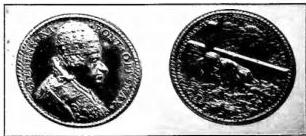
The type of St. Peter drawing the net (IN VERBO TUO) is found with Clement VIII and Urban VIII, a variant of the ducat monetary type from Sixtus IV onward. "Feed my sheep" (GREGEM NE DESERAS), a shepherd invoking heavenly aid for his flock, is a die of Gregory XIV repeated by Clement VIII. Jesus fallen under the weight of the Cross (FACTUS EST PRINCIPATUS SUPER HUMERUM EIUS) appears with Clement XI, and is repeated, from the same die, by Clement XIV and Pius VI.
The depiction of the Mother of God recurs in several variants of the monetary type and is often repeated from the same dies: Virgo tua gloria partus, from Julius II to Gregory XIII; Causa nostrae laetitiae of Gregory XV; Virgo potens ora pro nobis of Clement XI and Sub tuum praesidium of Innocent XII (1699) are two variants from the painting by Maratta. More complex compositions include that of Alexander VIII (Victricem manum tuam laudemus) for the Venetian victory over the Turks in 1690, and Auxilium Christianorum with the Madonna of the Rosary by Clement XI. Finally, the two types of the Immaculate Conception by Clement X, Cum me laudarent simul astra matutina, from the testone of the same.
The reverse DEXTERA DOMINI FACIAT VIRTUTEM (1591), with the Pope handing the banner for war, appears identical, and from a single die, for Sixtus V, Urban VII, Gregory XIV, and Innocent IX. It is thought to allude to the expedition of the Pope’s nephew against the Huguenots in France; if so, this is a clear example of hybrid pieces, though present in all collections.
For the Jubilee Years from 1500 onward, numerous medals were struck depicting the Holy Door open and closed, and the various related ceremonies; all types recur with minor variants in each period and for all ceremonies, as in coinage.
The same applies to sacred and profane allegorical personifications, these being of distinctly classical inspiration and preceding the former: the Annona pontificia of Paul III, which was repeated throughout the 16th century and often by the same dies; Roma resurgens of Paul IV; the Poe of Pius IV, the Hilaritas pontificia, a type of Paladino for Paul II and his immediate successors, which reappears under Sixtus V; the Securitas from Paul III onward and the Liberalitas of Leo X and Clement XIII, which are two analogous types.
From 1600 onward, there appear those personifications of religious concepts that are known from the monumental statuary art of the period: Religio, Fides, and Chiesa; Charitas, Iustitia, Clementia, Providentia, Fortitudo, etc. In this sphere, a detailed examination can reveal identical dies for various popes; it will suffice to recall that the group IUSTITIA ET CLEMENTIA COMPLEXAE SUNT of Urban VII and Innocent X derive from the same die.
How many hybrid and posthumous adaptations may and must be recognized in this rich papal series and for each period can never be fully stated or even verified; the pieces have gained a right to existence because they are present in all collections, manuals, and catalogues. It will suffice to consider the Paladino phenomenon, whose posthumously recognized production is found everywhere and for which an attempt has been made even in our own day to justify it under the name of «restitutions».
In one sphere alone did the phenomenon of the repeated use of dies across different periods not occur, nor could it occur: that of architectural types. These types bear witness to each pope’s specific merits in the field of sacred and profane construction, of which every pope was justly proud, so that no confusion or abusive repetition of dies was possible.
Particularly illustrated are: with Julius II the Vatican Basilica with the dome and the two bell towers according to Bramante’s design [TEMPLI PETRI INSTAURACIO - VATICANUS MONIS], the Basilica of Loreto, the port and fortress of Civitavecchia, etc.; with Paul III, the Palazzo Farnese, a view of Frascati with the Villa Rufina; a magnificent bird’s-eye view of Rome, etc.; with Julius III: the Vatican Basilica according to Sangallo’s design, Villa Giulia, etc.; with Pius IV: Castel Sant’Angelo and the church of Santa Caterina; with Pius V: the church of Santa Croce in Bosco; with Gregory XIII: the design of the Vatican Basilica according to Michelangelo and the Sistine Chapel of the same basilica, the bridge over the Paglia at Acquapendente, the Palazzo Capitolino with its tower, the Madonna dei Monti and the German College, etc.; with Sixtus V: the Trajan and Antonine columns with statues of Saints Peter and Paul, the colossi of the Quirinal, the four obelisks (CRUCI FELICIUS CONSECRATA), etc.; with Clement VIII: the city of Ferrara (FERRARIA RECUPERATA), the bridge and the waterfall of the Velino (VELLINO EMISSO MDC), etc.; with Paul V: the Borghese Chapel of Santa Maria Maggiore, San Carlo al Corso, the column of the Temple of Peace erected before the Liberian Basilica surmounted by a statue of the Madonna (PRO IUI NOMINIS GLORIA), the Quirinal Palace and the door of the Pauline Chapel, that of the Vatican beneath the clock, the bridge over the Liri near Ceprano, the artificial port of Fano, etc.; with Urban VIII: the Vatican Confession, Castel Sant’Angelo, the port of Civitavecchia, the churches of Santa Bibbiana, of San Caio near the Baths of Diocletian, the Lateran Baptistery, the granaries of Termini and the bastion of the Quirinal, the walls of Rome, the Porta San Pancrazio, the papal palace of Castel Gandolfo, the ironworks of Monte Leone, etc.; with Innocent X: the interior of the Lateran Basilica and of Saint Peter’s, the Palazzo del Museo Capitolino, Piazza Navona with its fountains and obelisk and the adjacent church of Sant’Agnese, etc.; with Alexander VII: the churches of Santa Maria della Pace, of Santa Maria in Campitelli, of Santa Maria in Via Lata, of Sant’Andrea della Valle, the Chair of Saint Peter in the Vatican, the Scala Regia, the courtyard of the Roman Archigymnasium, the Quirinal Palace for the papal family, Porta del Popolo from the outside and inside, the Hospital of Santo Spirito, the Bridge of Saint Angelo with its Bernini statues, etc.; with Clement X: the Palazzo Altieri, the port of Civitavecchia, the tribune of the Liberian Basilica, etc.; with Clement XI: the basilica of the Twelve Apostles and the private chapel of the Albani family, the church and porticoes of the basilica of San Clemente, the granaries of Termini, the church and baths of Nocera, the port and aqueduct of Civitavecchia, the Institute of Bologna, etc.; with Clement XII: the Arch of Constantine [OB MEMOR(IAM) CHRISTIAN(AE) SECURIT(ATIS) REST(AURATAE)], the large medallions with Saint John Lateran including the portico and the Corsini chapel, the Trevi Fountain (PONTE AQUAE VIRGINIS ORNATO), the Palazzo della Consulta, etc.; with Benedict XIV: Santa Maria Maggiore, the tomb of Maria Sobieski in the Vatican, the apse of the Leonine triclinium, in front of the Lateran Basilica, the interior of the Pantheon, the city walls (SECURITAS PUBLICA - MOENIA URBIS RESTAURATA); with Clement XIII: the granaries of Termini, the two black marble centaurs from Hadrian’s Villa in the Capitoline (CURA PRINCIPIS AUCTO MUSEO CAPITOLINO CELBERRIMIS ADRIANAE VILLAE ORNAMENTIS), Civitavecchia (CENTUMCELLIS AMPLIATA CIVITAS MDCCLXIV), etc.; with Clement XIV: the basilica of the Holy Twelve Apostles and the Clementine Museum with the Barberini candelabra; with Pius VI: the Vatican sacristy, the Pio Conservatory beneath San Pietro in Montorio, San Lorenzo alle Grotte, Civitavecchia and its furnaces, the orphanage in Foligno, the hospital in Città di Castello, the prisons and the Academy of Treia, the Conservatory of Fabriano, etc.; with Pius VII:
The Vatican Basilica, Piazza del Popolo, Ponte Molle, the group of the Laocoön and the Braccio Nuovo of the Vatican Museum; under Leo XII: the Basilica Ostiense after the fire, the baptismal font of S. Maria Maggiore, etc.; under Gregory XVI: the temple of Antoninus and Faustina, the Vatican Egyptian Museum, Porta Maggiore and the Claudian monument, the bridge and canal of Terracina, the hospital of S. Giacomo in Augusta, the Galloro bridge, the fortress of Ancona; and on the large monumental medals the entrance and exit of the Aniene from the tunnels near Tivoli, etc.; under Pius IX: the internal perspective of the Lateran Basilica, the Via Appia with S. Sebastiano, the Lateran Museum, Porta Pia viewed from inside and outside, Porta S. Pancrazio, S. Paolo rebuilt, the basilica of S. Lorenzo, Piazza del Quirinale, the Galleria Piana in the papal palace, the bridge connecting Albano to Ariccia, the temple of the B. Vergine known as S. Luca in Bologna, S. Lorenzo al Verano, etc.
Some temples and monuments recur more than once due to successive restorations, embellishments, and additions they underwent, such as S. Pietro, S. Paolo, and S. Giovanni in Laterano; with the Roman monuments, various temples, monuments, and constructions from individual cities, large and small, of the Papal State, also frequently recur, demonstrating that papal care extended to all, for all needs. Even after 1870, the annual minting of medals continued to this day, bearing on the obverse the bust of the Pope and on the reverse the depiction of the most salient event of the year. - See plates LVIII-LXV.