
PIRROTTI, POMPHILUS MARIA, Saint: *v.* POMPHILUS M. PIRROTTI.
PISA, ARCHDIOCESE OF. — City and archdiocese of Tuscany. Its suffragan dioceses are those of Apuania, Livorno, Pescia, Pontremoli, and Volterra. The extent of the diocese has varied from one age to another, especially due to competition with Lucca; until the beginning of the 19th century it included Livorno and part of the present diocese. It now covers an area of 847 sq. km., with approximately 251,000 inhabitants, of whom 248,000 are Catholic; it has 154 parishes, most of which form a compact nucleus around the city, without extending throughout the province of Pisa, but including centers in the province of Livorno; the others constitute the two detached nuclei of the Barghigiano and the Versilia in the province of Lucca. The clergy consists of 232 diocesan priests and 90 religious; in the archdiocese there are 21 male religious communities and 100 female ones; it also has a major and a minor seminary.
An ancient tradition, which seems to be supported by the results of recent excavations, links the Christian origins of Pisa to a landing of St. Peter *ad gradus Arnenses*, where the basilica of San Piero a Grado still stands. There is also a very ancient cult of St. Torpè, who is said to have been a Pisan, baptized and martyred under Nero. It can be said with certainty only that Christianity was already widespread in Pisa by the 3rd century; the first bishop of whom there is certain knowledge is Gualenzio, who attended a Roman synod in 313 (Lanzoni, I, p. 584). Gregory VII, on 1 September 1077, appointed Landolfo, a vicar in Corsica, as bishop of Pisa for spiritual interests; and on the 16th of the same month he informed the Corsicans that he had also entrusted him with the task of receiving and governing the island as a domain of St. Peter; the dual appointment was confirmed on 30 November 1078. Urban II granted Corsica in lease to Bishop Daiberto on 28 June 1091; and on 21 April 1092, in reward for the loyalty shown by the “glorious city” of Pisa to the Papacy, he elevated the Church of Pisa to an archbishopric, as metropolitan of Corsica. Somewhat later documents state that he also conferred legatine authority in Sardinia upon the archbishop. Rights over Corsica appear to have been exercised by the metropolitan of Pisa at the beginning of the 12th century; but they led to fierce conflicts with Genoa. The papal grant was annulled; then renewed by Honorius II on 21 July 1126. Innocent II, who stayed long in Pisa and held a council there in 1135, divided Corsica between the metropolitans of Pisa and Genoa, assigning to the former the bishops of Aleria, Ajaccio, and Sagona; but he also subjected to him as suffragans the Sardinian bishops of Galtelli (Nuoro) and Civita (Tempio), and that of Populonia (later Massa Marittima), and granted him primacy over the province of Torres (Sassari): the grant, probably made in 1133, was confirmed by a bull of that Pope on 22 April 1138, and confirmed by his successors; Alexander III (1 April 1176) added primacy over the other two Sardinian provinces of Cagliari and Arborea (Oristano).
Although the primacy over Sardinia was contested by the archbishop of Cagliari and the Sardinian bishops showed impatience, there are records in the 12th and 13th centuries of synods convened and acts of jurisdiction exercised by the archbishop of Pisa in the island: a solemn visit made in 1263 by Federico Visconti remained memorable. A bull of Clement VI, dated 1342, shows that the archbishop still had the right and duty to oversee the bishopric of Ajaccio. But the subjection of Corsica to Genoa and the Aragonese conquest of Sardinia progressively reduced the primacy of the Pisan archbishop to a mere title, although it was still claimed as late as 1639 before the Sacred Rota, without obtaining a decision. The archbishop of Pisa still styles himself today “Primate of the Islands of Corsica and Sardinia and Apostolic Legate therein.”
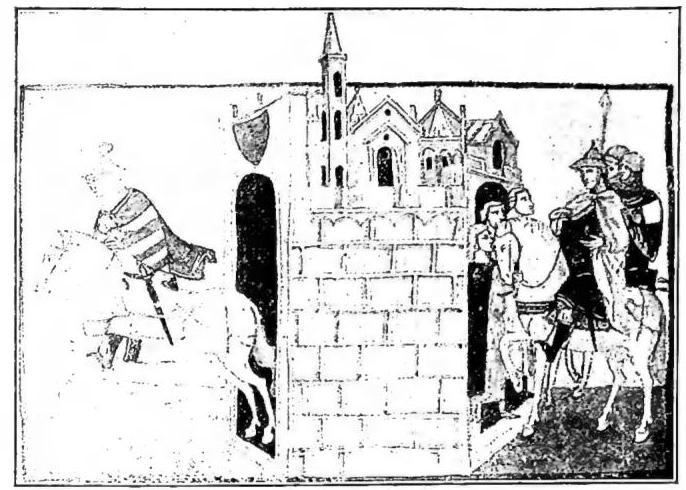
The diocese of Massa Marittima was subjected in 1459 to the metropolitan of Siena; Pisa, however, gained full control over the dioceses of Pontremoli and Livorno from their foundation (1797 and 1806), over Apuania, with an interval, from 1823, over Volterra from 1855, and over Pescia from 1855. The archbishop also has jurisdiction over the parish of San Piero a Grado. The religious activity of the Pisan bishops is clearly attested by the long series of synods and pastoral visits, of which there is certain knowledge from the second half of the 13th century; but which undoubtedly go back to a much earlier age.
Indications of political authority are found from the end of the 8th century, since it is known that a bishop was forced by Charlemagne in 774 to abandon his see, perhaps because he was suspected of hostility to Frankish rule; and in 796 the bishop was granted some rights of jurisdiction, which later seem to have been limited. He does not appear ever to have held the authority of a count, nor, except in isolated cases, that of a *missus*. Nevertheless, at the end of the 11th and in the 12th century, he took an active part in public affairs, together with the magistrates of the rising Commune; he represented the city in external relations; he participated in expeditions against the infidels: Daiberto (c. 1089–1105) was the leader of the Pisan enterprise in the Holy Land, a papal legate in the crusader army, and Patriarch of Jerusalem (1099); Peter Moriconi (1105–1119) was with the Pisans in the Balearic War; Ubaldo Lanfranchi (1175–1208) again led an expedition to Palestine and it is said that he brought back earth for the Pisan cemetery. Meanwhile, the possessions and political rights of the Pisan Church were expanding; particularly intense was the work of several archbishops in the first decades of the 12th century, among whom Baldwin (1137–1145), a disciple of St. Bernard, acquired a reputation for holiness; by the middle of the century the temporal authority of the Church extended to most of the Pisan countryside and even as far as distant Piombino; Conrad III on 19 July 1139 granted and confirmed feudal rights from Vada and Livorno to Buti and Bientina. The loyalty of Archbishop Villano (1146–1155) to Alexander III, who had been a canon of Pisa, brought him into conflict with Barbarossa, promoter of the schism, and with the consular government itself, which had sided with the Emperor: the archbishop had to leave the city (1167); the see was occupied by an intruder. But as the star of Barbarossa waned, Villano returned (1170?) and obtained from the Emperor confirmation of Conrad’s diploma (9 March 1178). In the East, Christian princes granted houses, lands, and privileges. In the 13th century, Federico Visconti (1254–1277) distinguished himself by singular activity in both the spiritual and temporal spheres; he held synods (1260, 1262, 1263), increased the possessions of the Church, and wrote *Sermones*, which have come down to us.
The temporal rights of the archbishop, as well as the primacy and legatine authority in Sardinia and Corsica, had been used by the Commune to extend, under the pretext of protection, its authority over the countryside and the islands. But, as it grew stronger, already from the end of the 12th and more in the 13th century, it entered into conflict with the archbishop and wrested from him, bit by bit, his dominion. For a few months, between 1288 and 1289, Archbishop Ruggeri
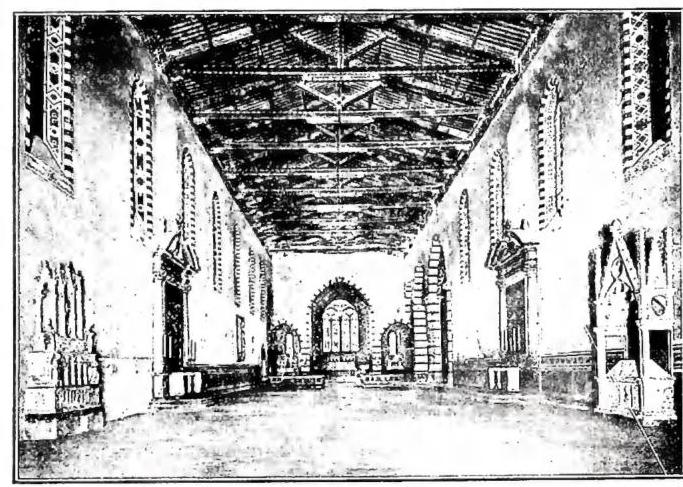
Pisa, archdiocese of — Interior of the church of St. Catherine (13th century).
Golino, was both podestà and captain of the people. But the struggle resumed and intensified: the archbishop Oddone de Sala (1312–1323), a most learned Dominican, who had nevertheless obtained from Henry VII confirmation of the privileges of the Pisan Church (19 May 1313), was forced to abandon the city, to excommunicate the regents, and to resign his see. Relations improved under the Pisan government with Simone Saltarelli (1323–1325), although he too had to leave the city temporarily when the Bavarian entered it; he was able to rebuild the palace at his own expense, received a splendid tomb in S. Caterina, and public veneration. The archiepiscopal see gained new distinction when Clement VI (4 Sept. 1343), elevating the already ancient Pisan school to a Studium generale, granted the archbishop the faculty to confer doctorates. Yet his political authority was now in decline. The lords, whether internal or external to the city, sought to reduce the archbishop to an instrument of government: Pietro Gambacorti, in 1381, secured the see for his nephew Lotto, whose arrogance and greed were not the least cause of the catastrophe of 1392. Later, the Florentines, masters of Pisa, wished to install some of their own citizens; Francesco Salviati, elected in 1474 by Sixtus IV against the wishes of the Medici, never took possession and, entangled in the Pazzi conspiracy, lost his life (1478); two Riario cardinals, Raffaele (1479–99) and Cesare (1499–1518), ruled the diocese from afar through vicars. Thereafter, Florentine archbishops or those devoted to the Medici were appointed, sometimes even members of their family, such as Cardinal Giovanni di Cosimo (1560–62), whose premature death gave rise to a legend of fratricide.
The archbishops, when not distracted by duties assigned them by the Grand Duke outside Pisa, attended to spiritual care, the implementation of Catholic Reform, the protection of studies, and the splendor of worship. Angelo Niccolini (1564–67) published (1564) the decrees of Trent; Cardinal Giovanni Ricci (1567–73) founded a college for eight young men from his native Montepulciano (1568); Carlo Antonio del Pozzo, a native of Biella (1582–1607), restored the Cathedral after the fire of 1595 and established (1604) the Collegio Puteano for students from his lands. Raffaello Roncioni, canon and archpriest of the Primaziale (d. 1618), spent these years writing his Istorie pisane and reorganizing the parchments of the archiepiscopal archive. Archbishop Giuliano de’ Medici (1620–35) distinguished himself by his pastoral activity, his beneficent work during the plague, and the completion of the Seminary near the archiepiscopal palace (1626); his vicar was Paolo Tronci (d. 1649), an investigator and writer of Pisan history. Two Pannocchieschi of the counts of Elci, Cardinals Scipione (1636–63) and Francesco (1663–1702), left a reputation for outstanding charity. Francesco Frosini (1702–33) held three synods and published their constitutions, combated Jansenism, donated to the Seminary, and richly endowed the Library; Francesco Guidi (1734–78) restored the palace and presented the Primaziale with its high altar; Angelo Franceschi (1778–1806), a staunch defender of Roman Church authority against Jansenist tendencies and French pretensions, gave the Seminary a new home in the restored convent of S. Caterina (1789).
The canons of the cathedral of S. Maria, whose existence already appears ancient from a document of 958, exercised great influence in the administration of the diocese and in the civic life of the city, especially in the medieval age, despite frequent conflicts with the archbishop and the communal government. The Popes granted them singular privileges, such as the dignity of domestic prelates and the use of purple vestments. Another college of Canons Regular was founded in 1073 at S. Pietro ad Vincula (S. Pierino), where the Olivetans took up residence from 1488.
Among the oldest monasteries, those of S. Michele in Borgo are recorded from the 11th century; first Benedictine (1018), then from the early 12th century a Camaldolese abbey, renowned alike for the learning and virtue of its monks and for its wealth, illustrated by the most learned Fr. Guido Grandi (1671–1742); that of S. Zenone, also originally Benedictine, then (15th century) Camaldolese; the Benedictine nuns of S. Matteo, the Camaldolese of S. Frediano. At least from the 12th century date the monastery of the Benedictines at S. Michele degli Scalzi, given in the 15th century to the Canons Regular; that of the Benedictines and later the Vallombrosans at S. Paolo a Ripa d’Arno; that of the Canons Regular at S. Martino, which became in the 14th century a convent of Clarisses. Almost all these monasteries were later given in commendam and suppressed by the end of the 18th century. Near the city stood the Benedictine nuns at the ancient abbey of S. Donnino, which from 1569 became and remains a Capuchin convent. Further away, on the small hill of Montone, there arose at the beginning of the 12th century the abbey of S. Savino, originally Benedictine, then Camaldolese; the church and remains of the monastery still stand.
From the 13th century the Franciscans had their home at S. Francesco, where the Conventuals still reside; the Dominicans at S. Caterina, which became a center of learning and piety, illuminated by the blessed Giordano, called da Rivalto (d. 1311), by Alessandro della Spina, inventor and disseminator of eyeglasses, by Cavalca, by Bartolomeo da S. Concordio, by Guglielmo da Pisa, and later by the blessed Lorenzo da Ripafratta (d. 1457). In the second half of that century the Canons Regular were already at S. Jacopo in Orticaia; by the end of the century the Augustinians came to S. Nicola; outside the city a monastery of Canons Regular was founded in 1264 at Nicosia, which passed in the 18th century to the Reformed Franciscans. In the 14th century the Carmelites settled at the Carmine, among whom was Guido da Pisa; in 1366 the Certosa of Calci was founded, to which in 1425 was joined the ancient monastery of the Gorgona. From the 15th century the Observant Franciscans were at S. Croce, the Servites at S. Antonio; from the 16th to the 18th century Pisa was the seat of the equestrian Order of the Knights of St. Stephen. In 1817 the Scalzi Carmelites came to the ancient monastery of S. Topre, in 1897 the Salesians to S. Eufrasia, in 1906 the Oblates to S. Jacopo.
Among the many charitable institutions may be mentioned: the Misericordia, which is traced back to 1053 and certainly existed at the beginning of the 14th century; the new Hospital of S. Chiara, dating from 1257 and uniting most of the many hospitals recorded in that century; the Monte Pio of the 15th century; the Hospital of the Innocents, which gathered older hospices in the same century; the Hospice of the Compagnia della Carità (16th century), from which two orphanages originated; the Hospice for the poor (1861); and the Cottolengo. In 1852 Frédéric Ozanam founded in Pisa the conference of St. Vincent de Paul.
The Cathedral of Pisa is dedicated to the Assumption and has as co-patron St. Reparata; there is greatly venerated the ancient image of the Madonna beneath the organs. The principal patron of the city is St. Ranieri (1118–61; feast 17 June), a Pisan nobleman who embraced a life of austere penance.
In our own age, Giuseppe Toniolo (1845–1918), professor at the University, was a distinguished master of Christian social science and justice, and led a life of goodness, piety, and toil; Ludovico Coccapani (1849–1931) distinguished himself by his zeal for Vincentian charity.
Giovanni Battista Picotti
COUNCIL OF PISA – The Council of 1409 was convoked by the cardinals delegated by Gregory XII and by Benedict XIII to put an end to the Western Schism. Gregory XII had been elected in Rome in 1406 with the explicit commitment to resolve the conflict dividing the Church. After various attempts at a meeting with the compelling Benedict XIII, to whom the French national council had confirmed obedience, the cardinals of the Roman Pope went to Pisa to negotiate with the French.
While the efforts made by the two Popes to convoke two separate councils failed, and the position of both appeared weakened—since France, a supporter of Benedict XIII, had now declared itself neutral, and the same had been done by the Diet of the Empire at Frankfurt regarding Gregory XII—the delegated cardinals decided to convene at Pisa an ecumenical council that would gather representatives from both obediences. The Council, summoned for 25 March, in order to legitimize its action declared on 5 June that the two Popes were schismatic and deposed them, transferring their jurisdiction to the cardinals, who thus, sede vacante, could elect another Pontiff, namely Peter of Candia: Alexander V. He confirmed the decrees of the Council and closed it on 7 August. But with this the schism was not concluded, because the Council of Pisa, even if with the immediate aim of restoring the unity of the Church, had applied that doctrine of the superiority of the Council over the Pope which until then had been only theoretically upheld by the theologians of the University of Paris (a doctrine contrary to the customs of the Church). Therefore the two deposed Popes refused the competence of the Council, and thus instead of resolving, the schism worsened. Alexander V was not recognized by all states. At his death John XXIII was elected, who, carrying out the commitment taken by his predecessor, convoked the Council of Constance of 1414, where Martin V was elected who put an end to the schism.
PISAN COUNCILLET OF 1511 – During the conflict between Julius II and the Duke of Ferrara, the Pope launched an interdict against the allies of the Este. Louis XII, who was among these, sought to counter it even in the spiritual realm, repeating the attempt to which, after the Councils of Constance and Basel, the states in conflict with the Church had repeatedly resorted: he procured the gathering at Tours of an assembly of bishops, who decided that one could disobey the Pope and appealed to a Council.
Having obtained the adhesion of Maximilian, on 16 May 1511 some cardinals convoked from Milan a council, which was held at Pisa in November. Only four cardinals and eighteen bishops and abbots attended, almost all French, who confirmed the Gallican theory of the superiority of the Council over the Pope; then, transferred to Milan, they declared the Pope suspended and assumed his authority for the Council. They then moved to Asti and from there to Lyon, where they dissolved. Julius II had responded by deposing and excommunicating the rebel cardinals, concluding the Holy League and convoking
the Fifth Lateran Council for the reform of the Church. The gathering at Pisa had the effect of arousing in Julius II an irreconcilable hostility toward Florence, which had allowed the rebels to make use of that city.
ART. — Excluding the so-called “Nero’s Bath” (11th cent. AD), which constitutes a notable testimony of Roman architecture, no artistic manifestations are encountered in Pisa before the Romanesque period, when the city acquired political importance. At that time, in the Maritime Republic of Pisa, Lombard, classical, Armenian, and Muslim influences converged and fused into an architectural style that, while sharing affinities with the Florentine style due to the common classical component, possessed its own original character and spread with great success in Tuscany, Sardinia, and Corsica. An architect, Buschetto—probably the same who built the Vatican obelisk in Rome—began in 1063 the construction of the Duomo, which was consecrated, even before its completion, in 1118. The architect Buschetto was succeeded by Rinaldo, who attended to the arrangement of the façade, completed in the 13th century. However, the essential lines of the building and even the general scheme of the decoration certainly go back to Buschetto’s original design. Eastern and Muslim influences are evident in the elliptical dome, the blind arcades, the inscribed lozenges, the tall piers of the arches, and in almost all the decorative elements that, harmoniously fused, animate the exterior, while the Lombard motif of the loggias, repeated on the façade, determines its soaring and lightness. The interior, of classical inspiration, is spacious and luminous, with five naves, a three-part transept, and matronea. The columns and capitals were largely replaced after the fire of 1595. Closely related to the forms of the Duomo are the Camposanto, begun by Bonanno in 1173, which due to ground subsidence has taken on its characteristic tilt, and the Baptistery, complex in plan, with two domes nested one within the other, begun in 1153 by Diotisalvi and completed in the 14th century in its external decoration. The church of San Sepolcro is also attributed to the architect Diotisalvi, octagonal in shape, with a segmented dome set on a high drum, and similar in design to the Baptistery. Moreover, dependent on the Duomo are San Matteo, San Niccolò, San Paolo a Ripa d’Arno, and San Michele degli Scalzi. Other churches, such as the pieve of Vicopisano and San Cassiano (in which a type of façade with hanging arches and a bifora recurs), may give an idea of what the original façade of the Duomo must have looked like. Characteristics of the civil architecture of this period are the so-called “casetori,” for which, given the poor compactness of the terrain, a framework of stone arches was devised, within which the rooms were created (houses in via Santa Maria and in via della Sapienza).
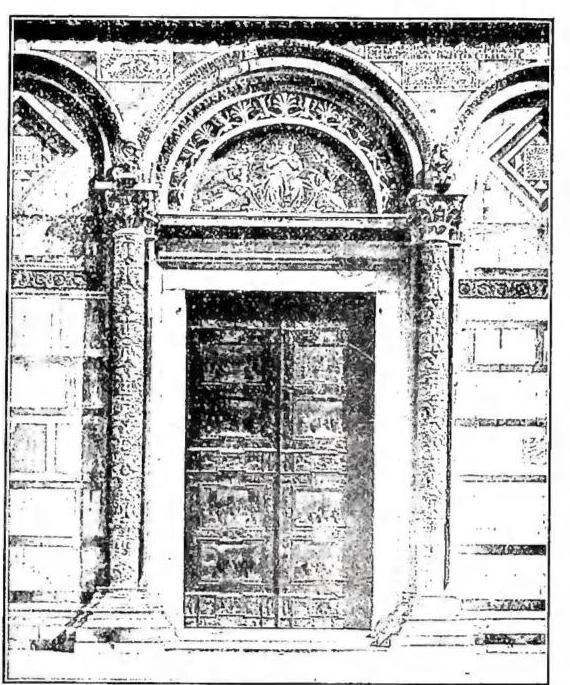
The numerous Etruscan reliefs preserved in the city directed the Pisan sculptors of the Romanesque period toward a decisive plastic search. They were also influenced by Lombard, Provençal, and Eastern classical styles. The fusion of these elements can be seen in the pulpit of the Cathedral (later transferred to the cathedral of Cagliari), carved by Guglielmo in 1162. Guglielmo is also attributed the *David playing the cithara* on the exterior of the Cathedral. A number of sculptors gravitated around Guglielmo, some of whose names are known: Filippo, Graziano, and Biduino. Around 1180, Bonanno da Pisa carved the main door, later destroyed, and the minor doors of the Cathedral, refining the plastic form into an unrealistic suggestion of pictorial impressions, in which he blended elements of his vast culture. At the beginning of the 13th century, traces of Byzantine neo-Hellenism appear in Pisa, in the portals of the Baptistery and in the portal of S. Michele degli Scalzi. The plastic tradition of the Lombards then returns in the city’s baptismal font, executed in 1246 by Guido Bigarelli da Como. Meanwhile, around the mid-century, Nicola da Apulia arrives in Pisa and, in the pulpit of the Baptistery (1260), inaugurates the great current of Pisan sculpture.
The painting of the 12th century is widely represented in Pisa by a considerable number of monumental painted crosses preserved in the Civic Museum and in the churches of the diocese. In the years 1229, 1241, and 1254, the presence in the city of Giunta Pisano is documented; he was the most notable personality in Tuscany at the beginning of the 13th century. The churches of S. Ranierino and S. Paolo a Ripa d’Arno preserve two of the four crucifixes attributed to Giunta (q.v.). The influence of Giunta’s art is also evident in Cimabue, who was in Pisa in 1301 to paint a *Maestà* for the church of S. Chiara, and in 1302, when he executed the figure of St. John the Evangelist in the apse museum of the Cathedral.
In the architecture of the Trecento, alongside the clear and simple forms of Florentine Gothic, which asserts itself in the churches of S. Caterina and S. Francesco, complex Gothic forms develop in Pisa, with a florid taste for decoration, exemplified by the exterior of the Baptistery. This decorative taste connects with the local Romanesque tradition, and an example of harmonious fusion between Romanesque and Gothic forms is the monumental Camposanto, begun in 1278 by the architect Giovanni di Simone and completed in the 14th century. In sculpture, Giovanni, son of Nicola, adopts the language of the Gothic world, purifying it of every ornamental inflection, and disrupts the composed forms of his father with a vehement luminous style that highlights the dramatic accents of the representation. Pisan sculpture now spreads throughout Italy through the followers of Nicola and Giovanni, including Arnolfo, Fra Guglielmo, Tino di Camaino, and Giovanni di Balduccio. This school concludes with Andrea Pisano and his son, Nino.
In the field of painting, however, Pisa lacks in the Trecento a school that can rival those of Siena and Florence. Nevertheless, artists of notable quality operate there, among whom Francesco Traini stands out; Pisa preserves his two sole surviving panels in the Civic Museum and in S. Caterina.
A personality of great importance is also that of the “Master of the Triumph of Death,” who executed the celebrated frescoes in the Camposanto, though it cannot be established with certainty whether he was a Pisan. Other minor artists generally follow the Sienese, such as Giovanni di Nicola, Cecco di Pietro, and Jacopo di Michele called il Gera; some instead follow the Florentines, such as Bernaldo Nello di Giovanni Falconi and the two Turino Vanni. Artists from all over Italy flock to Pisa, and the presence in the city of Simone Martini, Lippo Memmi, Taddeo Gaddi, Andrea Bonaiuti, Antonio Veneziano, Spinello Aretino, and Barnaba da Modena is documented by works executed there.
During the Renaissance, the political decline greatly reduced the quality and quantity of artistic production, and it was Florentine architects, especially in the orbit of Vasari and Buontalenti, who erected buildings in Pisa and gave it the face it still retains today (Palazzo and church of the Cavalieri, Palazzo della Canonica, Palazzo dell’Orologio). Even in sculpture, Florentines predominated in Pisa, first from the school of Donatello and then from that of Cividali. A notable work introducing the Seicento is the bronze doors of the Cathedral, with Stories of Christ and Mary, carved after 1595 by followers of Giambologna, such as Pietro Tacca, Pietro Francavilla, Gaspare Mola, and Gregorio Pagani. Cosimo Pagliani, who built the Palazzo Lanfraducci called “alla Giornata” and the market loggia, represents the Baroque in this city, while in the 18th century the architect Mattia Tarocchi is to be remembered for executing the façade of S. Apollonia. — See pls. CVI–CVII.