
Portuguese. - The earliest Portuguese versions of which we have records are rather paraphrases and historical summaries. The Epistles and Gospels for the entire liturgical year were translated by Gonzalo García de S. María (Saragossa 1485), and the Acts and Catholic Letters by Bernardo de Brivega (Lisbon 1505). Complete translations included a Protestant one begun by João Ferreira de Almeida and completed by others (New Testament, Amsterdam 1681; Old Testament, Tranquebar 1710-53), and a Catholic one by António Pereira de Figueiredo (Lisbon 1778-90), the latter of which was recently republished with a new commentary by Santos Farinha (1902-1904). Other modern versions are paraphrastic or limited to the New Testament; new translations of the entire Bible have been initiated both in Portugal and in Brazil.
English. - As early as the 8th century, partial versions of the Bible in Anglo-Saxon emerged in the British Isles, though almost all have been lost. In the 14th century, translations resumed in the new English language, with early examples being the Psalms translated by William of Shoreham and those by Richard of Hanpole; around 1380, J. Wyclif translated the New Testament, and shortly thereafter, with the collaboration of Nicholas of Hereford, the Old Testament as well. This translation, revised by John Purvey (1388), enjoyed wide circulation.
The first printed translation was the New Testament by William Tyndale (Cologne-Worms 1525), followed by the Pentateuch by the same author (Starburg 1531). Shortly afterward (1535), the entire Bible appeared, translated by Miles Coverdale based on Luther’s German version and the Latin of the Vulgate and Sante Pagnini. A fusion of Tyndale’s and Coverdale’s translations is the Matthew’s Bible edited by John Rogers (Antwerp 1537), which, with various revisions, gave rise to the edition curated by Richard Taverner,
Amendments and improvements, demanded by the times and the progress of scholarship, were proposed repeatedly for the Authorized Version. Finally, in 1870, a joint Anglo-American commission was appointed, which published the results of its work for the New Testament in 1881, for the Old Testament in 1885, and for the deuterocanonical books in 1895. This new revision was called the Revised Version.
In contrast to all these Anglican versions, English Catholics produced the ancient translation prepared by exiles in France and based on the Vulgate, of which the New Testament appeared in Reims (1582) and the Old Testament in Douai (1609-10).
(fol. Enc. Catt.)
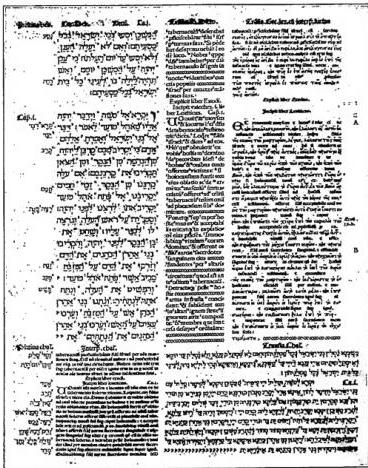
BIBLE - Complutensian Polyglot or of Alcalá (1514). Ex. 40, 34-36; Lev. 1, 1-80. Verse numbering is absent as it was then unknown. Specimen from the Biblical Institute - Rome.
has its literary merits and received several revised editions. A new excellent Catholic translation from the original texts (Westminster Version) is nearing completion.
Among the English translations by Israelites, the most recent and important is The Holy Scriptures according to the Masoretic Text (Philadelphia 1917), edited by a commission of Israelite scholars primarily for synagogue worship.
Numerous other English translations exist, almost all Protestant, prepared for either popular or scholarly purposes; the latter, accompanied by more or less extensive commentaries, form special series.
German. - Fragments of translations in the ancient Germanic, or Theotisc, language date back to the 9th century and derive from partial versions. From the 14th century onward, attempts expanded and multiplied: thus, numerous translations of the entire Bible emerged, by various authors and conducted with different methods and in various dialects, but always from the Latin of the Vulgate. The first printed edition, edited by G. Mentel (Strasbourg 1466), reproduced one of these complete translations
and was reprinted many times during the incunabula period; several editions also featured another complete Bible in a different dialect, along with other partial translations.
With the rise of Protestantism, of which Luther’s Bible was a powerful vehicle, German Catholics hastened to publish their own vernacular translations, based on the Vulgate but inspired by Luther’s translation and also considering earlier versions; thus appeared the New Testament by J. Beringer (Speyer 1526) and that by G. Emser (Dresden 1527), the complete Bible by J. Dietenberg (Mainz 1534), that by J. Eck (Ingolstadt 1537), and later that by C. Ulenberg (Cologne 1630), which saw several reprints with modifications. Other new Catholic translations were published toward the end of the 18th century, among which that by the Benedictine H. Braun (Augsburg 1788-97) met with great favor, later revised by M. Feder (1803), J. Fr. Allioli (1830-39), and H. Arndt (1899-1901); notable diffusion was also achieved by that of V. Loeh and W. K. Reischl (Regensburg 1851-66), reprinted even recently (1914-15). Many Catholic translations from the original texts were completed in the 20th century: that by N. Schlögl (Vienna 1920-22) was placed on the Index; furthermore, P. Riessler and R. Storr (Mainz 1924-34), E. Henne and C. Rösch (1934-40), and the series of scientific commentaries on the Old Testament (Nikel-Schultz, at Münster) or the New (Fr. Tillmann) or both (Feldmann-Herkenne, at Bonn).
Among Protestant translations, Luther’s held capital importance in every respect. As early as 1521, Luther began work on the New Testament, publishing it in 1522; from then on, for twelve years, he tenaciously labored on the rest of the Bible, which he published in its first complete edition by Lufft in Wittenberg in 1534: Biblia, d. i. de gantze heilige Schrift, Deutsch. Luth. (Wittenberg, MDXXXIV). Even after this edition, Luther continued to refine his translation, improving it through 9 subsequent editions, up to the final one of 1545, which remained definitive.
The success was enormous: from the Lotther press in Wittenberg alone, between 1534 and 1584, no fewer than 100,000 copies of Luther’s Bible were issued, not counting those from other presses. For followers of the Reformation, the German Bible of 1534 was “the greatest gift” Luther gave to the German people. Indeed, the merits of this translation were singular in linguistic and literary terms, for with it Luther forged from a great variety of local dialects the unified language that later became that of the German nation. Quite different, however, is the judgment to be passed on the scientific and theological value of the work: Luther translated from the original texts, assisted by Melanchthon, Aurogallus (v. MANSER, GALLUS) and others, keeping in view the Septuagint, the Vulgate, especially the translation of Sante Pagnini and the Postillae of Nicholas of Lyra (so much so that it was said Nisi Lyra lyrasset, Lutherus non saltasset); but his knowledge of Hebrew, of which he boasted so much, was not very great, and often compelled him to seek the opinion of rabbis. Moreover, his work aimed primarily at spreading his theological ideas, which led him to be tendentious in certain passages to attribute his own ideas to the biblical text: the case of Rom. 3, 28 is well known, where he translates that man “is justified by faith alone,” whereas the original text does not include “alone.” Though it became the classic book of Protestantism and the German nation, Luther’s translation appeared increasingly in need of emendations over time; these were in fact made in the countless editions that followed, with the drawback, however, that the Lutheran text was modified arbitrarily by individuals: a semi-official authoritative edition appeared in 1883, but though it amended the Lutheran text in many places, it proved inadequate to Protestant scholars, who therefore compiled lists of other passages deserving emendation.
Great importance was held, outside Germany, by the “Zurich Bible” (1530), prepared by Swiss Protestants and subjected over time to various revisions and updates: it remains popular today. Instead, numerous other translations prepared by various factions of early Protestantism (Antitrinitarians, 1527; Calvinists, 1579; Socinians, 1630) or by subsequent philosophical currents (Pietists, 1726-42; “Rationalists,” 1735) have fallen out of use.
In the 19th century, large series of commentaries with philological-critical character began and found good reception: among the most recent, we recall for the Old Testament those by W. Nowack (Handkommentar, Göttingen 1803 ff.), E. Sellin (Kommentar, Leipzig 1913 ff.), and O. Eissfeldt; for the New Testament, those by Th. Zahn (Kommentar, ibid. 1903 ff.) and H. Lietzmann (Handbuch, Tübingen 1911).
Dutch-Flemish. — The regions of Flemish language had various paraphrases of the Gospels or the history of the Old Testament, which retain only philological value. Catholic is the translation made from the Vulgate by Nicola van Winghe (Louvain 1548) and revised by Moerentorf (Moretus; Antwerp 1599). The translation begun by Th. Beelen (Louvain 1859) and left unfinished by him was completed by various continuators and published in Bruges (1894-96) under the auspices of the Belgian episcopate. A new Catholic translation by various collaborators began in 1894; another dates from 1935 onward.
Many Protestant translations appeared, the first of which, limited to the New Testament, was published in Antwerp in 1522. The first complete Bible was issued in 1526 by the publisher Liesveld (“Liesveld Bible”), reprinted many times with improvements. In 1558 appeared that called, from its place of publication, the “Emden Bible.” All were surpassed by the Statenbijbel, so named because its preparation, ordered by the Synod of Dort in 1619, was approved by the States General in 1637; it appeared in that year in Leiden and was reprinted very frequently. Other complete versions appeared at the beginning of the 19th century; the version called “synodal,” because ordered by the Synod of 1848, had among its collaborators the radical critic A. Kuenen. There is also a translation prepared by Israelites (1826 onward).
Other versions. — A brief mention will suffice for versions in other languages.
In Russian, the oldest versions are in Old Church Slavonic: editions of individual books date from the early 16th century, and the complete edition of Ostrog from 1581; subsequently, other versions increasingly approached spoken Russian; from the 19th century onward, new complete translations appeared, promoted by the Russian Bible Society and the British and Foreign Bible Society.
In Polish, the first attempts at translations are contained in codices from the 14th-15th centuries; the first complete version is that of Giovanni da Leopoli (Cracow 1561), followed by the superior one of Jakob Wujek (ibid. 1593-99), frequently reprinted even with modifications; the Protestants had the "Bible of Danzig" (ibid. 1632), by various authors and often reprinted.
In Hungarian, the earliest attempts date back to the 14th century; with the introduction of printing, editions of parts of the New Testament began; the complete version of Gaspare Karolyi (Visoly 1590, revised in 1608) is used by Protestants, while that of Giorgio Káldi (Vienna 1625, revised in 1862 and often reprinted) is used by Catholics.
In Bohemian (Czech), numerous partial versions existed in the 14th-15th centuries, from which the first complete edition emerged (Prague 1488); of singular linguistic importance is the "Bible of Kralice" (ibid. 1579-93), the work of the "Bohemian Brethren" used by Protestants, from which the Catholic "Bible of St. Wenceslaus" (Prague 1677-1715) and that of Prochaska (1778-80) partly depend.
In Swedish, versions circulated already in the time of St. Bridget of Sweden; the first complete translation is the "Bible of Gustav Vasa," prepared by Laurentius and Olaus Petri based on Luther's German version; the "Bible of Charles XII," prepared according to the same model, was the official text until 1917, when it was replaced by a new translation prepared by various commissions of scholars.
In Danish, the first complete translation is the "Bible of Christian III" of 1550, which later underwent several revisions.
In Norwegian, partial versions existed as early as the 13th century; subsequently, Danish translations were used in Norway.
The Ground Truth image displays a single, solid horizontal line. According to Rule 2 (UNDERSCORE & LINE RULES), this is a stylistic or background line, not a placeholder underscore. Therefore, the OCR result must ignore it and output nothing or only meaningful text. The provided OCR content is "____", which consists of four underscores. This is an incorrect interpretation of the line as a placeholder, violating the rule that stylistic lines must be ignored. The OCR has hallucinated underscores where none should exist based on the GT's visual context. Hence, the OCR result is inconsistent with the Ground Truth.
(due to political dependence on Denmark), so it was only in the 19th century that Norwegian translations were published.
In Irish, various types of paraphrastic versions must have circulated in the Middle Ages, of which only fragments have reached us; Anglican is the New Testament translation by W. O' Donnell (Dublin 1630); the Old Testament was translated by Bedell (London 1686), and partially by the Catholic Mac Hale (Tuam 1861).
PORTOGHESI
The earliest Portuguese versions of which we have records are rather...
VII. B. POLYGLOTS. - The abundance of biblical texts, both in the original languages and in ancient versions, soon made it evident how useful it would be to have these various texts arranged for each passage on a single page, so that their points of agreement and disagreement could be perceived at a glance. This desire was already met in antiquity by Origen (v.) with his monumental work, the Hexapla (v.). Other, far more modest attempts were made in the late Middle Ages, from which some manuscripts of the Psalms have survived, where the text is arranged in several parallel columns, each corresponding to a different language. The first printed example was the Psalterium octaplum (Genoa, 1516) by the Dominican Agostino Giustiniani, containing in eight columns the Hebrew text and its version, the Vulgate, the Septuagint, the Arabic, the Targum and its version, and annotations. After this partial attempt, the great polyglot editions of the entire Bible began.
The first was financed by Cardinal Ximenes de Cisneros and printed in 1514-17 in Spain at Alcalá de Henares (Lat. Complutum), known as the Complutensian: it was edited by Andrea di Creta, assisted by other scholars. It consists of 6 volumes and contains the Old Testament in Hebrew (on the left), the Vulgate (in the center), and the Septuagint with a Latin translation (on the right); for the Pentateuch, it adds the Targum of Onkelos with a Latin translation. For the New Testament, it offers the Greek and the Vulgate. Volume VI contains a Hebrew (and Aramaic)-Latin vocabulary, a Hebrew grammar, and indices. Only 600 copies were printed, at the cost of 50,000 scudi.
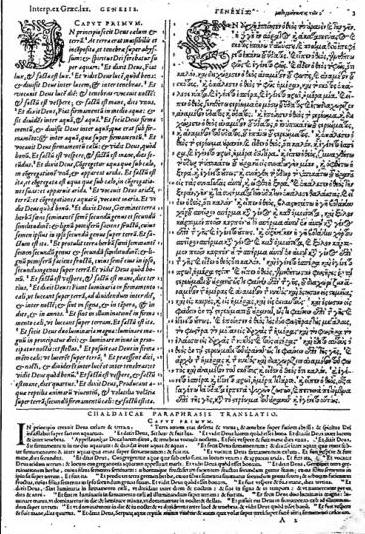
The second is the Polyglot printed by Christopher Plantin in Antwerp in 1569-72, also called the Regia because it was sponsored by Philip II; it was edited by Arias Montano, in 8 volumes. For the Old Testament, it offers the texts of the Complutensian, adding the Targum for the books following the Pentateuch. For the New Testament, it provides the Greek, Latin, and Syriac texts. Volume VI also contains the complete Bible translation by Sante Pagnini; volumes VII-VIII contain vocabularies, grammars, and various treatises.
The third polyglot, the most sumptuous of all, was published in Paris between 1629 and 1645, financed by Le Jay (Jaius) and edited by the Maronites Gabriele Sionita and Abramo Ecchelense, along with Jean Morin and others. It consists of 10 volumes; in addition to the texts of the Antwerp Polyglot, it includes the Samaritan Pentateuch and paraphrase, and the Syriac and Arabic versions (with Latin translations) of the protocanonical books of the Old Testament. Despite its typographical magnificence, the Paris Polyglot, though not without its merits, is the least useful for scientific purposes.
The fourth polyglot, of greater scientific value than all its predecessors, is the London Polyglot, published in 1654-57 and edited by the Anglican bishop B. Walton, assisted by other scholars. It consists of 6 volumes. In addition to the texts of the Paris Polyglot, it includes the Pentateuch and the Gospels in Persian, and the Psalms, the Canticle, and the New Testament in Ethiopic. Volume I contains useful prolegomena by Walton, and Volume VI contains the critical apparatus. This edition is accompanied by the Lexicon heptaglottum of E. Castellus, a remarkable monument of scholarship and expertise that retains its value even today.
Subsequent polyglots of lesser scope include: that of S. Bagster, which also includes versions in modern languages (2 vols., London 1831; 2nd ed., 1874); that of R. Stier and W. Theile (4 vols., Bielefeld 1847-55; 5th ed., 1900); that of Ed. de Levante (London 1890); all Protestant. The Catholic one is that of F. Vigouroux, La Sainte Bible polyglotte (8 vols., Paris 1898-1909), which offers the Hebrew, Septuagint, Vulgate, and French texts, with introductions and notes.
A. VACCARI
VIII. INTERPRETATION OF THE BIBLE
The Bible is a collection of inspired books, that is, books whose principal author is God, and which are destined for man: for this reason, some Fathers called the Bible a "letter from God to man." Man is therefore the recipient of this letter, which he must read and understand. However, understanding this letter is not easy for many reasons, which arise both from its divine element (the sublimity of revealed truths) and from its human element (the various authors with their particular mentalities, customs, etc.; the vicissitudes of textual transmission, etc.). The Bible, as an inspired writing, is part of divine Revelation, and in it God has revealed mysteries, included prophecies, and imparted norms of faith and morals; moreover, it was written in different languages and epochs, among peoples whose customs differ greatly from today's, in circumstances that vary from book to book, alluding to historical facts and situations of which clear knowledge is often lacking today. Furthermore, individual books often depend on older writings that have since disappeared or have undergone various modifications over the centuries. All these factors must be kept in mind when reading the Bible to avoid the danger of attributing to it meanings it does not actually possess, that is, of making God say what He never said.The set of interpretive rules, both theological and philological-historical, constitutes a distinct discipline called hermeneutics (v. HERMENEUTICS), or "interpretive (art)." The interpretation or exegesis (v. EXEGESIS) of the Bible has had many distinguished scholars, some of whom gave rise to trends and "schools" of considerable importance.
IX. READING OF THE BIBLE
The practice of reading the individual books of the Bible, even before they were gathered together, is ancient both in Judaism and in Christianity. Among the Jews, Greek and Aramaic versions arose precisely to make the Hebrew text of the Bible intelligible (see above: Ancient Versions). Synagogal reading led to a division of the biblical text into as many parts, each of which was to be read on a Sabbath or feast day: initially, the Pentateuch, the principal object of reading, was divided into 167 orders (sēdhārīm), corresponding to the readings of a triennium; later, it was divided into 54 sections (pārālōth), corresponding to the reading of a single year. Subsequently, alongside the passage from the Pentateuch, a passage (haphṭārāh) from the "Prophets" began to be read; still later, the reading of the Five Scrolls or Mēghillōth was reserved for certain feasts, namely the Song of Songs at Passover, Ruth at Pentecost, Lamentations on the anniversary of the destruction of Jerusalem (Aug.), Ecclesiastes at Tabernacles, and Esther at the feast of Pūrīm. From the usage of the synagogues, the reading of passages from the Old Testament was transmitted to the first Christian assemblies, where they were chosen especially from the prophetic books, as those which most clearly had foretold the future Messiah; soon, to these prophetic passages were added readings from the Gospels and the Epistles. However, no stable and uniform norm existed for the quality and quantity of biblical passages to be read in Christian assemblies, this depending on regional customs as well as on the judgment of individual bishops who presided over those gatherings; nevertheless, later on, especially from the 6th century onward, customs and laws began to take shape, whose further development and fixation merge with the history of the various Eastern and Western Christian liturgies.Private reading of the Bible was also widely diffused, both in Judaism and in Christianity. The rabbis, whose teachings are preserved in the Mišnāh, the Talmud, and other Jewish writings, concentrated their efforts and those of their schools on the study of the Tōrāh (Law), understanding by this term especially the oral tradition, though linked to the written law, primarily the Pentateuch; among others, a rabbinic norm teaches that "a man must not withdraw from the house of study (of the Law) nor distance himself from the word of the Tōrāh, even at the hour of death" (Šabbāth, 83 b), because "the study of the Tōrāh is greater than the building of the Temple" (Mēghillāh, 16 b). There were, however, in the Judaism of the common era, certain prudential restrictions, which were prompted either by abuses that were spreading or by particular exegetical difficulties encountered in the reading of certain books; thus, we know that the Song of Songs, and some passages of Genesis and Ezekiel, could not be read by a Jew who had not reached the priestly age, that is, 30 years (Jerome, Praef. libr. I in Ezech.: PL 25, 17), indeed, that even the public reading of the Song of Songs was not yet permitted at the beginning of the 5th century (Theodore of Mopsuestia, in Mansi, IX, 227; cf. Origen: PG 13, 63).
Among Christians, too, private reading of the Bible, much recommended and widely diffused, became a field of abuses. As early as the beginning of the 5th century, John Chrysostom recommended to his faithful not to limit themselves to listening to the reading of the sacred books in church, but to reread them at home to meditate again on what had been fleetingly heard and to deepen its meaning (PG 51, 90); on the other hand, Jerome complains of the irreverent and plebeian character that discussions on Holy Scripture had taken in his time, when it "is what the chattering old woman, the doddering old man, the wordy quibbler, and in short everyone, arrogates to themselves, tearing it apart, teaching it before having learned it" (Ep. 53, Ad Paulin.). But, despite such abuses, there are no traces of
(Ist. Enc. Cutt.)
BIBLE - Antwerp Polyglot (1558). Gen. 1. 1-
20. Hebrew text and Vulgate; below, the text of the Targum
Rome, copy from the Pontifical Biblical Institute.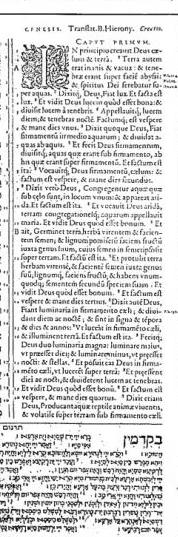
However, the religious revolution of Protestantism provoked, by reaction, restrictive measures on the reading of the Bible among Catholics. After local prescriptions issued in England, the Netherlands, France, and elsewhere, the Roman See intervened for the first time in 1559, when the Index of Paul IV prohibited printing and possessing Bibles in the vernacular without the permission of the Holy Office; the granting of this permission was later delegated to local bishops by the Index of Pius IV in 1564 (rules 3 and 4), but was subsequently revoked again by the Holy See. It seems, however, that permission was granted with considerable leniency. Once the danger of Protestantism had become remote, the Congregation of the Index in 1757 permitted vernacular versions of the Bible approved by the Roman See or published under the supervision of bishops with annotations drawn from Catholic authors; and the substance of this provision remains in force, incorporated into the Codex Iuris Canonici, can. 1391. The decree of 30 April 1934 of the Pontifical Biblical Commission prescribes that vernacular versions of the Epistles and Gospels to be read in churches for the people should be made not from the original Hebrew and Greek texts, but from the texts approved for the liturgy of the Church; thus, for the Roman rite, from the Latin Vulgate.
The frequent use of the Bible gave rise to various customs, often praiseworthy, sometimes strange, not infrequently reprehensible. Due to the very material volume of Holy Scripture, Jews and Christians have always held it in particular veneration: just as in synagogues the scroll of the Law was and is kept in a special area, so in Christian liturgy it is treated with special honors: in the Byzantine rite, the honors paid to the book of the Gospels are equal to those for the Eucharist.
Likewise, out of respect, biblical volumes worn by use were not destroyed by the Jews, but deposited in an underground place near the synagogue, the so-called gēniẓāh, where they remained unused for centuries. In Christian councils, already from the 5th century, it was customary to place the volume of the Bible at the center, as on a seat of honor; the same was done in courts, especially with the volume of the Gospels. A devotional practice among the Jews was that of the tefillin (v.), with certain passages of the Bible (Ex. 13, 1-16; Deut. 6, 4-9), applied during prayer on the forehead and left arm (cf. Deut. 6, 8); other similar parchments were buried under the thresholds of Jewish houses (māzūzōth).
Among Christians, it was customary to wear around the neck a small scroll containing passages from the Gospels: this practice is already attested in the 4th century, and finds its counterpart among Muslims in the passages of the Quran worn on the person for devotion. It was also customary to place the volume of the Gospels near the bedside of the sick, or to recite near them Jn. 1, 1-14; this prologue was also recited in important life circumstances or in grave dangers: for example, it is said that Christopher Columbus recited it when caught in severe storms at sea. Other passages of the Bible, especially from the Psalms, were considered appropriate for various joyful or sorrowful circumstances of life. The Bible was also consulted to make important decisions, to know the future, discover hidden things, and similar purposes: to practice these sortes divinatoriae, a whole formulary gradually developed regarding how to open the biblical volume, read it, and draw conclusions, etc. In addition to these superstitious abuses, there were also those of irreverence: among the ancient Jews, it is attested that the Song of Songs was sung at symposia as a profane ditty (Tāsephthā, Sanhedrin, XII, 10); among Christians, especially during the Renaissance, the custom of using biblical passages to compose jokes, parodies, pasquinades, and similar irreverent and often obscene things became widespread: against which the Council of Trent opposed (Sess. IV, De edit. et usu ss. librorum). But even later, no less incongruous oddities could still be heard from certain preachers, who twisted words and sentences of the Bible to apply them at their own whim: as is told of
that preacher contemporary with Galileo who, wishing to impugn the latter’s astronomical research, applied to him the passage Viri Galilei, quid statis aspicientes in caelum? (Act. 1, 11).
X. THE BIBLE IN LITERATURE
The influence exerted by the Bible on various literatures and the visual arts surpasses that of any other book. Among the Jews, in reality, this influence was quite limited for particular reasons: in the literary sphere, Jewish production after Christianity and up to the Middle Ages was largely juridical-traditional, and from this perspective, it may perhaps appear as an extensive work of biblical exegesis according to Pharisaic norms, but it offers none of those inventive elements that constitute artistic literature; in the realm of the visual arts, moreover, a most serious obstacle for the Jews was alwaysBIBLE - Antwerp Polyglot (1568). Gen. 1, 1-20.
Latin version and Greek text of the Septuagint; below, Latin version of the Targum.
Rome, copy from the Pontifical Biblical Institute.
the ancient prohibition against producing images of living beings, whether human or animal (Ex. 20:4; Deut. 4:15-19), which prevented Orthodox Judaism from cultivating sculpture and painting, except for secondary ornamental purposes. This prohibition was often violated, and recent excavations have brought to light ruins of synagogues built in Palestine and abroad (Dura Europa) in the early centuries of the Common Era, in which paintings of biblical figures appear; but such cases always represent exceptions, which, under the influence of the surrounding Greco-Roman culture, may have been more or less tolerated but were never approved by Orthodox Judaism.
With the rise and formation of the various vernacular literatures in Europe, more or less dependent on classical forms and the Christian tradition, the Bible immediately emerged as their principal animating force: directly inspired by the Bible are the Anglo-Saxon poet Caedmon (8th century) in his works, the Heliand and other compositions of early German (9th century) and French (10th century) poetry. Biblical subjects were frequently treated in those "mysteries" and sacred representations from which modern theater in various nations traces its origins. Then comes Dante in Italy, whose Comedy depends on the Bible for concepts and expressions far more than modern commentators usually acknowledge. During the Renaissance, the Bible continued to exert a broad influence, though its derivations were often distorted, clothed in foreign classical expressions, or paired with pagan concepts. Protestantism, by virtue of its principles, returned to a total adherence to the Bible even in poetic compositions, which seemed all the more faithful to the new doctrine the more they appeared filled with biblical material in both thought and word: Luther’s religious poems and Milton’s Paradise Lost are typical productions of this tendency, among many other German, English, and French works. The Catholic Counter-Reformation opposed Protestantism in this field as well, but in a piecemeal and occasional manner, drawing from the Bible forms and concepts (used especially in contemporary epic poetry) without producing works of particular representative significance. The Latin Catholic poems De partu virginis (1526) by Sannazzaro and the Christias (1535) by M. G. Vida stand apart. Later, the best works of Klopstock were biblical, not only in the Messiah (1772) but also in his dramas; contemporary with him in Italy was Alfonso Varano, whose biblical Visions were highly appreciated in his time, especially by Monti. Regarding the Bible as a literary work, Monti expressed this judgment: "I therefore love David more than the other poets, and I believe no one will condemn this partiality of mine. Homer, Pindar, Virgil are great and majestic: but David (without speaking of the Prophets, especially Isaiah) David is something more. Whoever does not perceive the difference between him and them, so much the worse for him. This is a matter of sentiment, and he who is not convinced by himself will find it useless to seek the reasons of others." Romanticism, by its very spirit, drew abundantly from the Bible, in Italy and abroad; biblical in inspiration, and in part also in expression, are Manzoni’s Sacred Hymns, which, in Carducci’s judgment, mark the highest level of Italian lyric poetry in the nineteenth century.
BIBL.:
PERIODICALS. — The Expositor, London 1875 ff.; Zeitschrift für die alttestamentliche Wissenschaft, Giessen 1881 ff. (with Beihefte from 1896); The Expository Times, Edinburgh 1889 ff.; Revue biblique, Paris 1892 ff.; Zeitschrift für die neutestamentliche Wissenschaft, Giessen 1900 ff. (with Beihefte from 1923); Biblische Zeitschrift, Freiburg im Br., 1902-39; Biblica, Rome 1920 ff.; Estudios bíblicos, Madrid 1929-33, 1942 ff.
SPECIAL ENCYCLOPEDIAS AND DICTIONARIES. — DB, 5 vols.; DBs, vols. I-IV to date. — T. K. Cheyne and J. Sutherland Black, Encyclopaedia biblica, 4 vols., London-New York 1899-1903; H. Gotthe, Kurzes Bibelwörterbuch, Tübingen 1903; C. Piercy, Murray's illustrated Bible Dictionary, London 1908; J. Hastings, Dictionary of the Bible, 4 vols. with an extra volume, Edinburgh 1910; id., Dictionary of Christ and the Gospel, 2 vols., ibid. 1906; id., Dictionary of the Apostolic Church, 2 vols., ibid. 1918; J. Orr, The International Standard Bible Encyclopaedia, 5 vols., Chicago 1915; G. Kittel, Theologisches Wörterbuch zum Neuen Testament, 4 vols. to date, Stuttgart 1933-41; K. Galling, Biblisches Reallexikon, Tübingen 1937; E. Kalt, Biblisches Reallexikon, 2nd ed., 2 vols., Paderborn 1938.
CATHOLIC COLLECTIONS. — Biblische Studien, Freiburg im Breisgau 1896-1930; Etudes bibliques, Paris 1903 ff.; Biblische Zeitfragen, Münster in W. 1908-22; Alttestamentliche Abhandlungen, ibid. 1908 ff.; Neustestamentliche Abhandlungen, ibid. 1908 ff. — PROTESTANT COLLECTIONS. — Forschungen zur Religion und Literatur des A. und des N. T., Göttingen 1903 ff.; Biblische Zeit- und Streitfragen, Berlin 1905-25; Beiträge zur Wissenschaft vom A. T., Leipzig 1908 ff.
CATHOLIC INTRODUCTIONS. — R. Cornely, Historica et critica Introductio in utriusque Testamenti sacros libros, 2nd ed., 4 vols., Paris 1894; U. Fracassini, Che cosa è la B., Rome 1910; F. Kaulen - G. Hoberg, Einleitung in die Heilige Schrift, 5th ed., 3 vols., Freiburg im Br. 1911-13; J. Goettberger, Einleitung in das A. T., ibid. 1928; J. Renié, Manuel d'Écriture Sainte, 6 vols., Lyon 1930-38; H. Lusseau-M. Collomb, Manuel d'Études bibliques, 7 vols., Paris 1930 ff.; L. Gramatica and G. Castoldi, Manuale della B., 2nd ed., Milan 1932; R. Cornely-A. Mork, Compendium Introductionis, 11th ed., 2 vols., Paris 1934; H. Höpfl-B. Gut, Introductionis in sacros utriusque Testamenti Compendium, 4th ed., 3 vols., Rome 1935-40; Institutiones biblicae, I, 5th ed., ibid. 1937 (Pontifical Biblical Institute); H. Simon-J. Prado, Propaedeuticos biblicos sive Introductio in universum Scriptorum, 3rd ed., 3 vols., Turin 1938; K. T. Schäfer, Grundriss der Einleitung in das N. T., Bonn 1938; A. Robert - A. Tricot, Initiation biblique. Introduction à l'étude des Saintes Écritures, Paris 1939 (new ed. 1948); G. Boson, L'Antico Testamento, Casale Monferrato 1939; P. Cheminant, Introduzione alla B., Italian trans., 2 vols., Turin 1941; Le Clément de Saint Marcq, La Bible et son architecture mentale, Brussels 1941; G. M. Perrella, Introduzione generale, Turin 1948.
PROTESTANT INTRODUCTIONS. — H. L. Strack, Einleitung in das Alte Testament, 6th ed., Munich 1906; M. Goguel, Introduction au N. T., 4 vols., Paris 1922-27; G. F. Moore, I libri del Vecchio Testamento, Italian trans., Bari 1924; A. H. Mc Neile, An Introduction to the Study of the N. T., Oxford 1927; A. Jülicher - E. Fischer, Einleitung in das Alte Testament, 7th ed., Tübingen 1931; E. Sellin, Einleitung in das A. Testament, 7th ed., Leipzig 1935.