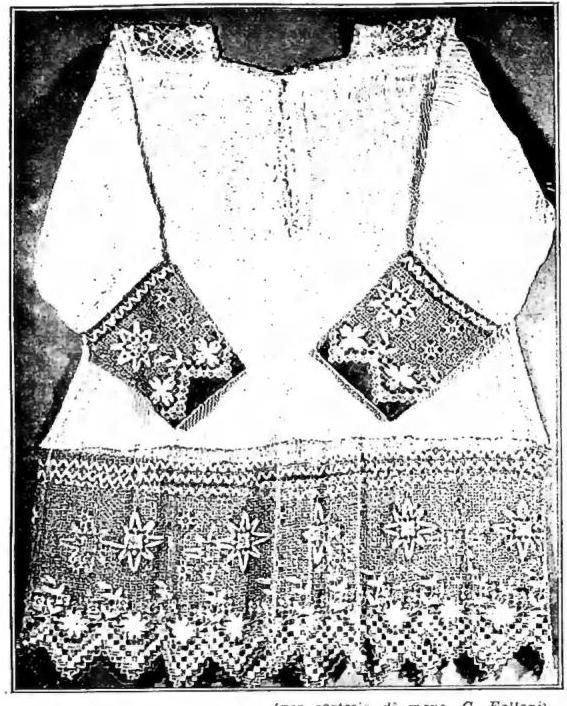
**ROCCHETTO** (camisia, alba romana, succa, saroth, sarcotium, sancos, rocchettum, diminutive of Late Latin *roccus* "garment"). — It is a white linen vestment worn by the pope, cardinals, bishops, and prelates as a distinctive sign of their dignity.
It is a shortened form of the alb with long, narrow sleeves adorned with lace over white, red, or purple silk, unlike the surplice, which has wide, short sleeves. The rocchetto is not worn alone but with the mozzetta, mantelletta, or cappa during choir services, processions, sermons, etc. For the celebration of Mass and the administration of the Sacraments, the rocchetto must be covered by the alb or surplice.
The first mention of a "camice et cingulum," worn before the proper alb, is found in the *Ordo Romanus VIII*, I, 1 and II, 2.4 from the 9th century (M. Andrieu, *Les Ordines Romani*, II, Louvain 1948, pp. 310-371). Among the Franks, a secular garment ("une sorte d'écran") was worn between profane and sacred vestments; already in the 7th century, the pseudo-Germanus (Ep., II) refers to the "manicae" of the Gallican liturgy "ne apparent vile vestimentum" (M. Andrieu, loc. cit., 313 n. 1). The Gallican or Frankish usage spread everywhere; in England (can. 46), under St. Dunstan (d. 988), it was sanctioned in the Synods of Trier (1238) and Cologne (1260) (can. 7). This tunic was worn by all clerics, even sacristans. At Rome, the rocchetto came into use with the adoption of the German Missal and Pontifical but soon became a prerogative of the higher clergy; already the Fourth Lateran Council (1215) recommended that secular bishops wear "superindumenta linea" even outside the church; the newly elected pope (cf. *Ordo Gregorii X* [1271-76]: M. Andrieu, *Le Pontifical*, II, Vatican City 1940, p. 527; *Ordo Romanus* XIII, 3 and XIV, 10: PL 78, 1106 and 1127) wore this garment. The rocchetto is bestowed upon the newly elected
Perfuis ludouricis Maldu ra 3n etiam fanti Dochi
Contra Petlem Epidimic Zpud vim digniti
mi intercefforio Cinaci cudem Dffico.
---
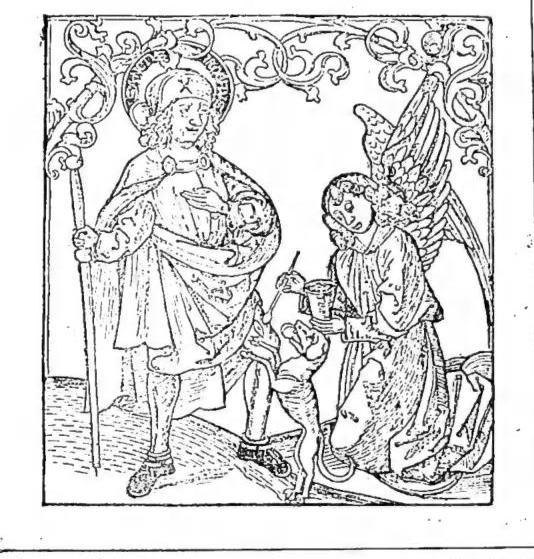
ROCHUS, ST. — Title page of the *Vita S. Rochi* by Francesco Dieci, despite the printed title (cf. *Gesamtkatalog*, VII, no. 8332; *Indice generale degli Incunaboli*, II, no. 3427), printed in Mainz by Peter von Friedberg, 1494-95. Copy from the Vatican Library.
He spent three years dedicating himself to the poor and the sick; then, for the same charitable motives, he went to Rimini, Novara, and then Piacenza, where, afflicted by the same disease, he left the city and lived for some time in a wooded place. After recovering, he resumed his journey homeward but was arrested in Angera on suspicion of espionage and died in prison after five years of confinement. His identity was recognized after death, and he was buried with honor. The site of his tomb is not recorded.
CULT. — The biographer Jean Pin speaks of a canonization, but to this day no confirmation exists; if it occurred, it must have been by the antipopes Clement VII or Benedict XIII. It is certain that in 1590 Sixtus V intended to canonize him "in order to remove him from the number of the saints," as attested by a dispatch from the Venetian ambassador Alberto Badoer (cf. P. Paschini, art. cit., p. 249). In 1629, the Sacred Congregation of Rites granted an Office and Mass of St. Roch for churches dedicated in his honor.
At Montpellier, Roch was not the object of cult before 1410, since in that year, during a pestilence, only St. Sebastian was invoked; however, in 1421 a chapel in his honor is recorded there, and in 1440 the celebration of his feast on August 16 is attested. In Avignon in 1437, the painter Pierre de la Barre was commissioned to paint an altarpiece in which St. Roch ("yamago S. Roqui") was to appear. In France, Missals and Psalters of the 15th century (the oldest being a Psalter-Hymnal from Maguelone, early or mid-15th century: the Calendar, in a first hand, records on August 16 "sancce Roc [sic]": V. JALABERT, LOUIS, *Les psautiers*, I, p. 278) first list his feast as an addition and later include it in the text; his name also appears in Books of Hours, though not in Breviaries. In Germany, wooden statues of Roch from the 15th century survive, including one from Obersimonswald in the Black Forest dated 1450 (cf. K. Künstle, op. cit. in bibl., II, p. 515). In Italy, the cult of Roch experienced extraordinary development in the second half of the 15th century, particularly during severe pestilences: 1476 in Gemona (cf. G. Marchetti, op. cit. in bibl., p. 3); 1477 in Venice; 1478-79 in Brescia. In 1485, the mysterious translation of his relics took place in Venice; from that moment, the city of St. Mark, with its church of St. Roch and the sumptuous Scuola di S. Rocco (16th century), a center of artistic and charitable activity in the spirit of the saint, became the radiating focus of the cult of the great thaumaturge, spreading wherever Venetian influence extended. Numerous confraternities, hospitals, chapels, and churches were erected in his honor throughout Europe, and August 16 became in many places a votive feast celebrated with solemn popular festivities. In Rome, the church of St. Roch near the Ripetta port dates to the early 16th century. As for the procession in honor of Roch said by Diedo to have taken place in Constance in 1414 during the Council, historical reasons suggest it should be referred to the Council of Ferrara (January 1439). The feast of Roch on August 16 appears in various editions of the *Missale Romanum* prior to the reform of St. Pius V, beginning with the Venice edition of 1505 (cf. R. Lippe, *Missale Romanum Mediolani* 1474, II, London 1907 [H. Bradshaw Society, 33], pp. 225-26; A. Ebner, *Iter Italicum*, Freiburg in Br. 1896, p. 231, records only one manuscript missal [16th century] with the saint’s feast).
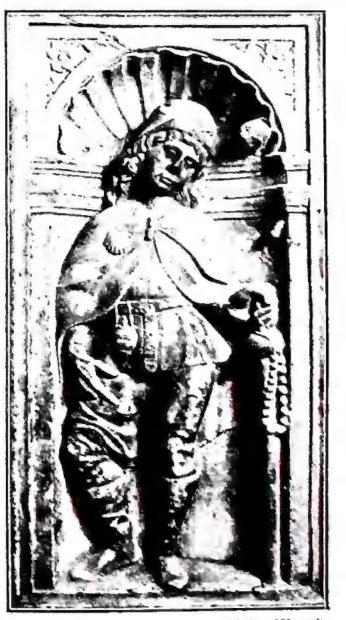
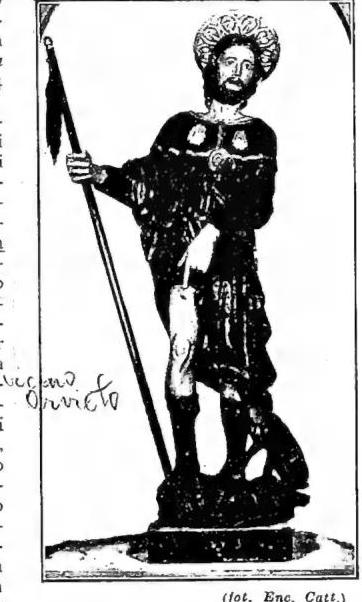
**III. ICONOGRAPHY.** — Further evidence of Roch’s popular cult is the rich iconographic material concerning him. Roch is depicted as a pilgrim, of youthful appearance, with his left leg (less often the right) bared, bearing a swollen bubo and sometimes a purulent sore, which the saint points to with his right hand. Beside him stands a dog with a loaf of bread in its mouth, alluding to the bread which, according to the *Acta*, the dog of the nobleman Gotthard brought him daily while he lay ill near Piacenza. Often he is accompanied by an angel who, according to the *Acta*, appeared to the saint to announce his healing and then his death, and by other saints, including St. Sebastian, the protector against pestilence since the 7th century and one of the *quinque famosi santi contra pestem* along with St. Roch, St. Anthony, St. Adrian, and St. Christopher (cf. *Anal. Boll.*, 60 [1942], p. 239). Besides the statues preserved in the Grenoble Museum (early 15th century), at Acquapendente (15th century), and Obersimonswald (c. 1450), among the many works that could be cited, listed by Künstle, Ceroni (*S. R.*, Rome 1927), Fliche (*Sr.-R.*, Paris 1930), and Bessodes (*S. R.*, Turin 1931), only the following pictorial or sculptural works by the following artists are noted: for the 15th century: Crivelli (Venice), Ghirlandaio (Pisa), Bergognone (Milan), the Rodari brothers (Como); for the 16th century: Pordenone, Titian, Tintoretto (Venice); for the 17th century: Van Dyck (Senlis), Guido Reni (Bologna), Rubens (Aalst), Fetti, Baciccia (Rome); for the 18th century: Tiepolo, Marchiori (Venice); for the 19th century: Mariani (Rome), Baussan, Marsal (Montpellier). — See pl. LVII.