
ROCCOÒ. – A term that came into use in France in the 1700s to denote, along with the other term “rocaille,” a particular kind of decoration—shell incrustations, rock imitations, whimsical arabesques—with which rustic constructions (baths, grottoes, fountains) and furnishings were adorned, especially under Louis XIV and above all under Louis XV. Today, in a broader sense, the term r. refers to the figurative culture of the 1700s, which, developing from the Baroque, accentuates its whimsy and curvilinear dynamism in a search for grace, lightness, and decorative effects. More than architecture—which often repeats the forms of the previous century—it is painting, sculpture, and above all the so-called minor arts that contribute to this, particularly in the minute details of furnishings, entrusted to skilled artists and refined to harmonize with the setting.
I. ARCHITECTURE
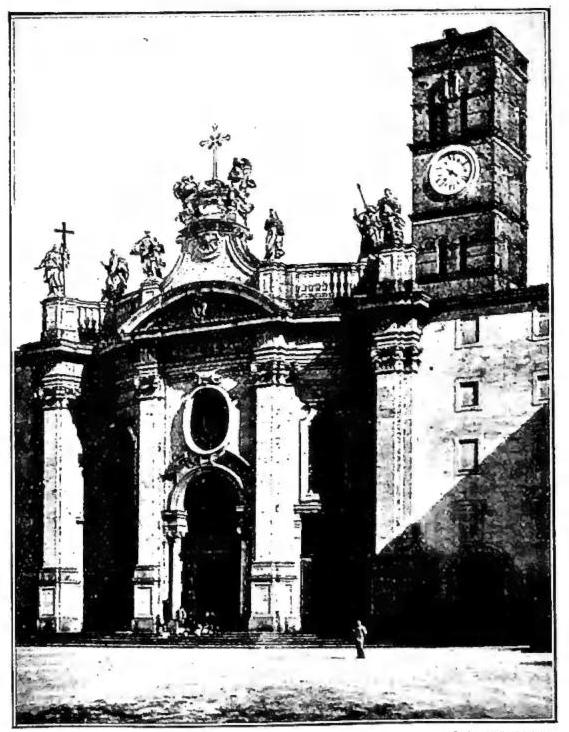
Rococo forms were realized as early as the third decade of the 1600s by Borromini (1599–1667), active in Rome in rivalry with Bernini. His style spread throughout Italy and abroad, returning enriched by French (Piedmont, Liguria, Lombardy) and Spanish elements (southern Italy).A very active center of the rococo was Piedmont, where the Modenese Theatine father Guarino Guarini (1624–1683), a follower of Borromini, the Messinese F. Juvara (1676–1736), B. Alfieri, and G. B. Planteri were active. In Rome and Naples, the rococo shared the field with the resurgent giant classical forms (represented by A. Galilei, L. Vanvitelli, and in part by F. Fuga) and often fused with them, as in the façade of S. Croce in Gerusalemme (D. Gregorini, P. Passalacqua), classical in the single order of monumental Corinthian pilasters but rococo in its curvilinear movement and lively crowning ornamentation. The rococo assumed particular characteristics in Sicily and Apulia; here, on the one hand, the trite “plateresque” decoration (from the Spanish *platero*, silversmith), fed by Spanish influences, flourished from the 1600s onward, with its center in Lecce, where the local stone provided a suitable material; on the other hand, brilliant architects such as G. B. Vaccarini, who rebuilt Catania after the 1693 earthquake, and P. Picarale (Syracuse, Cathedral) asserted a sense of grace and measure. The structural forms remained those of the Baroque: especially in church façades, with curvilinear movement and superimposed orders (usually two: Rome, church of the Maddalena by G. Sardi [1680–1753], Madonna della Quercia).

(Rococo – Adoration of the Magi. Wood carving from 1747. Wilhering, abbey church.)
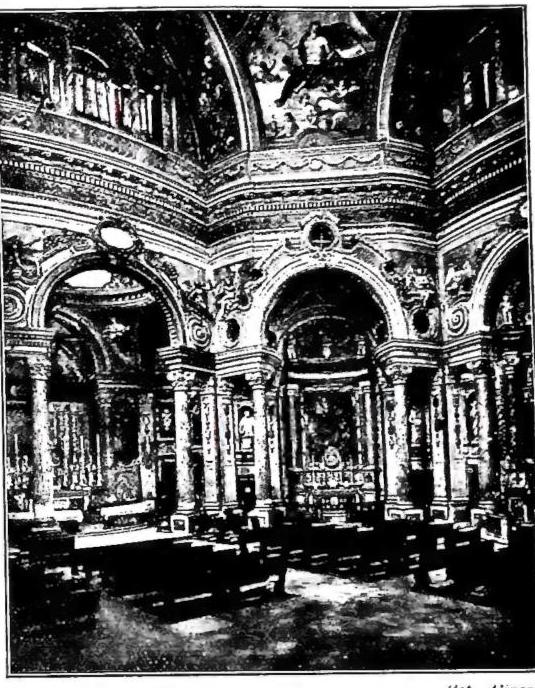
by F. Raguzzini; three superimposed orders in Sicily and southern Italy: Ragusa, S. Giorgio; Catania, Cathedral) of which the upper one is sometimes connected to the lower by volutes; and often it is only the decorative revetment (in which stucco is used with great frequency) that imparts the rococo character. Inside churches, a single circular (Turin, Chapel of the Holy Shroud by Guarini) or elliptical or semicircular hall (Carignano, Cathedral by B. Alfieri) replaced the traditional nave arrangement, already partly abandoned in the 1600s: chapels and niches animate the contours with a function often serving to connect to an external quadrangular perimeter (Turin, S. Lorenzo dei Teatini, by Guarini), creating effects of movement and picturesque scenography to which the abundance of colored marbles, sculptures, stuccoes, and bronzes contributes. The role of sculptors is often predominant, as in the Chapel of the Monte della Pietà in Rome, entirely clad in reliefs, and in the Palermitan oratories where Serpotta lavished the grace of his stuccoes.
In civil architecture, the use of inexpensive stucco decorations allowed even multi-family dwellings to adopt a rococo character. Adapting to the needs of a more practical and intimate life, even noble palaces were articulated into apartments, replacing the solemn 1600s salons with small, numerous rooms, to which the façades responded with a denser arrangement of openings; this, combined with the sinuous movement of the wall curtains and the varied, delicate design of the moldings, lent a graceful and light appearance. In Rome, examples of rococo architecture include Palazzo Doria Pamphilj (G. Valvassori), Piazza S. Ignazio arranged like a stage set (F. Raguzzini), and the staircase of Trinità dei Monti (F. De Sanctis). In Piedmont, mention should be made of Palazzo Carignano in Turin (Guarini), with its broad sinuous façade, and the Palazzina di caccia at Stupinigi (Juvara), with its mansard roof like French castles and four wings radiating from a central oval body. In southern Italy, palaces often have a cheerful and brilliant aspect, not without French influences: the most elegant example is the courtyard of Palazzo Bonagia in Palermo.
In France, the rococo found expression more through interior decoration and arrangement—especially in civil architecture—than through architecture itself (in which the disciples of Mansart—Robert de Cotte, Boffrand, Jacques Gabriel—repeated the measured and solemn forms of the Grand Siècle). In the *hôtels*, which became less monumental, more comfortable, and brighter, with the collaboration of sculptors of genius such as J. B. Lemoine, the Adams, the Slodtz, and Guibert, environments of exquisite elegance were created, such as the oval salon of the Hôtel Soubise in Paris or the interiors of the Petit Trianon at Versailles, where—executed in stucco—flexuous motifs of ribbons and garlands, herbs and flowers, cupids and nymphs unfurl.
Rococo architecture flourished abundantly in the Germanic countries, particularly in Vienna, Dresden, and Potsdam. In religious architecture, Italian models were followed, whereas in civil architecture, French influences predominated, brought by R. de Cotte, F. Cuvilliés, and other French architects and artists who had fled as a result of the religious wars. After being renewed following liberation from the Turkish threat (1685), Vienna—which had already absorbed Italian influences since the 1600s—imprinted its rococo with the style, sober in exteriors and most elegant in interiors, of L. von Hildebrandt (born in Genoa and a pupil of Carlo Fontana), author of the Palais Kinsky and the Belvedere Palace; but it also felt the impact of French taste introduced by J. N. Jadot, who built the Palace of the Academy of Sciences. In Dresden, a destination for French and Italian architects, the rococo expressed itself in the pompous forms of the Zwinger pavilion (M. D. Pöppelmann), the heavy forms of the Frauenkirche, and the whimsical scenography of the Hofkirche (G. Chiaveri). Finally, in Potsdam, the pavilion of Sanssouci, erected by Frederick the Great to his own designs (arch. G. W. von Knobelsdorff), was inspired by the Grand Trianon. A special mention should be made of castles: the grandest, that of Würzburg (arch. B. Neumann, frescoed by Tiepolo), is a typical example of lavish German rococo.
In Spain, after the extravagances of the “Churrigueresque” style—partly attributable to J. de Churriguera, who died in 1725—as seen in the portal of the Hospice in Madrid and the Palace of S. Telmo in Seville, a return to measure was marked by the advent of F. Juvara, to whom Philip V entrusted the construction of the Royal Palace in Madrid (completed by G. B. Sacchetti). On this stylistic path worked, among others, Ventura Rodríguez.
Decoration and Furnishing. Alongside stucco and marble, one of the most widely used materials for decoration is ceramics, whose working was perfected by the discovery of hard paste (at the beginning of the 18th century in Meissen, Saxony), and spread to Venice, to Doccia (Ginori), to Capodimonte (Naples), while it intensified in Delft and Sèvres (under the direction of the sculptor Falconet), for the manufacture not only of figurines and tableware, but also of panels and furnishings, as in the Japanese Palace in Dresden which Augustus II had imagined entirely decorated with Dutch ceramics, or in the first Trianon (now destroyed), known as the Porcelain Trianon. The art of tapestry also received a great impetus, especially in France, a model for all Europe with the tapestries of Beauvais and Gobelins based on compositions by Boucher, Fragonard, and Coypel. In Italy, the Medici manufactories gained renown, as did that of Turin, which collaborated with the painters of the House of Savoy (the Venetian G. B. Crosato, the Neapolitan F. De Mura, the French Pécheux, the Piedmontese Beaumont), and the manufactory of Naples, which often used French models.
In the field of decoration and furnishing, France leads with the decorator J. A. Meissonnier, from Turin, “dessinateur... du Roi”; with C. Cressent, cabinetmaker, sculptor, chaser, creator of exquisite pieces of furniture
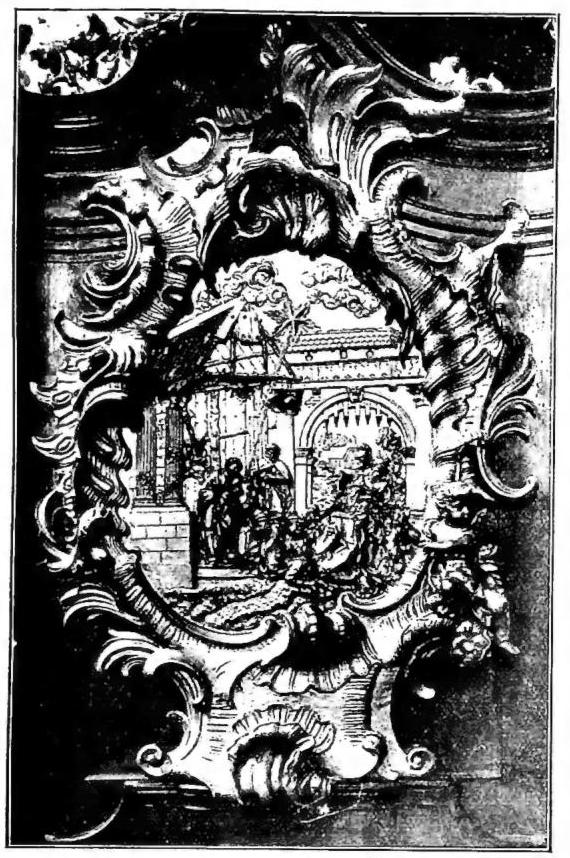
Rococo – Adoration of the Magi. Wood carving from 1747. Wilhering. Abbey church.
ROCCO – RHODESIA
Stuttgart 1924; G. Morazzoni, Il Settecento ital., Milan 1932; G. De Logu, La scultura ital. del '600 e del '700, Florence 1932; id., L'archit. ital. del '600 e del '700, ibid. 1935; A. De Ridolis, L'arte in Roma dal '600 al '900, Bologna 1948; V. Golzio, Il Seicento e il Settecento, Turin 1950. Annalia Mezzetti