
RÒPOLO, GIOVANNI. — Byzantine humanist, born in Constantinople around 1415, died in Rome on June 26, 1487; he was one of the principal architects of the Italian Renaissance of the 15th century. According to the historian Dukas (Historia byzantina: PG 157, 1010), he was part of the entourage of Emperor John VII Palaiologos during his stay in Florence (1437–39). Perhaps from this time dates his full adherence to the Roman Church, which is irrefutably attested in a letter addressed to Pope Nicholas V in 1448, published by S. Lampros (Αρχιποπούλεια, Athens 1910, pp. 136–37).
Like many of his Greek contemporaries, Giovanni led a very active life. After returning to the East following the Council of Florence, he came back to Italy, to Padua, where he studied and taught at the same time for three years (1441–44); he taught in Constantinople between 1444 and 1452; he made a brief stay in Rome in 1448, and, without doubt on this occasion, composed his small Treatise on the Procession of the Holy Spirit (cf. L. Allatius, Graeciae orthodoxae script., I, Rome 1652, pp. 400–18 and PG 158, 992–1008). After the fall of Constantinople to the Turks between 1453 and 1457, he traveled through Greece, Italy, France, and even England. Finally, in 1457, he was appointed professor of philosophy at the Studium in Florence, where he translated into Latin and commented on the works of Aristotle. He avoided directly intervening in the dispute between Platonists and Aristotelians and praised both great Greek philosophers equally. In 1471, he left Florence for Rome, relying certainly on the favor of his former pupil from Padua, Francesco della Rovere, who would later become Pope Sixtus IV. The Pope gave him a warm welcome but did not enrich him or his Roman students. The death of Bessarion (1472) was a disaster for him; he wished to return to Florence, but the Florentines preferred Calcondyla. However, in 1477, he returned to the Florentine Studium for four years (1477–81), alongside Calcondyla. In 1481, he left Florence again for Rome, where he died a few years later, almost in poverty (cf. G. Mercati, Minuzie, in Bessarione, 24 (1910), pp. 145–46).
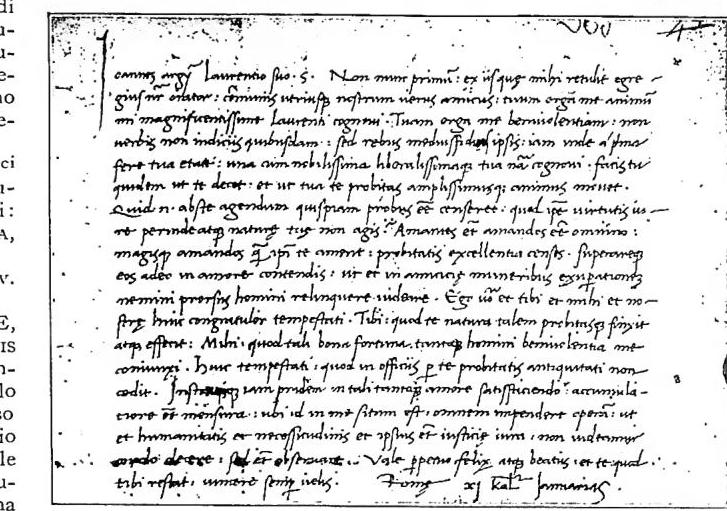
A. was above all a professor and wrote little: in addition to the treatise mentioned above, he left: 1) Latin translations of most of Aristotle’s works, which had numerous editions; the translation of Porphyry’s Isagoge and that of St. Basil’s Hexameron, also published several times; 2) various oratorical writings, recently published by S. Lampros (op. cit., pp. 1–67, 129–41); 3) four treatises, the first on various questions, the second on rhetorical exercises, the third on forms of syllogism, the fourth on dialectic; published by Lampros (op. cit., pp. 142–86), except the last, discovered by G. Cammelli; 4) prefaces and inaugural speeches (Prolusiones) to his Florentine verses; 5) seventeen letters, published by various authors in different collections.
As for his personality, his enemies described him as a lover of good food and claimed he died from a lemon indigestion. These judgments, like the hyperbolic praises of his admirers, should be treated with caution. His friend Filelfo speaks of his erratic and inconsistent character, a trait sufficiently attested by the vicissitudes of his life.