
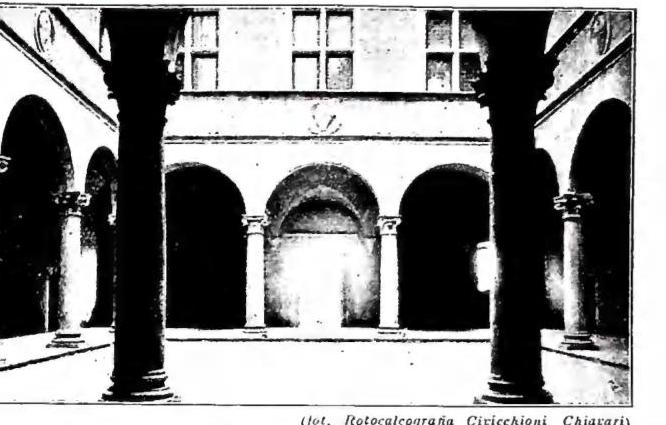
(1433) pierced and delicate, adorned, among other things, with a relief lunette that also represents his debut as a sculptor. Having gone to Rome, he carried out the restoration of S. Stefano Rotondo (renewing the pavement and constructing the entrance portal, that of the atrium, some biforas and the altar) and, in the capacity of engineer of the Palace, participated (1451–53) with Alberti in the works undertaken by Nicholas V in the Vatican Palaces and in St Peter’s, works in which, however, the respective contributions are very difficult to distinguish, while the intervention of R. in the Palazzo di Venezia and in the church of S. Marco remains uncertain. Sent by Pius II to Tuscany for the architectural renewal of Corsignano (later Pienza), he built the Piccolomini Palace, the Duomo, the Bishop’s Palace and renewed the Public Palace (1460–63), drawing on the light and serene forms of the early Alberti, especially in the Piccolomini Palace which repeats the façade of Alberti’s Palazzo Rucellai. Greater originality is shown by B. in the courtyard of the same Palace and above all in the façade facing the garden, entirely open to loggias, as well as in the Duomo which, Gothic inside at the Pope’s wish, has a Renaissance façade of broad sweep, rhythmically marked by large blind arches with full centres.
In his final years (1461–64) he attended to the completion of the lantern of the Florentine Duomo.
As regards his activity as a sculptor, while uncertain is his participation in the works for the chapel of Eugenius IV in the Vatican, for which documents mention among others a Magister Bernardus, certain works include, besides the aforementioned Arezzo lunette with the representation of the Madonna of Mercy, the Monument to Leonardo Bruni in S. Croce in Florence (1443–51); the Annunciate in S. Stefano in Empoli (1447); the tabernacle in S. Egidio in Florence (1450); the tombs, also in Florence, of B. Villana in S. Maria Novella (1452–53) and of Orlando de’ Medici at S. Anna Annunziata (1455), the sepulchre of Giovanni Chellini in the church of S. Miniato al Tedesco (1461), as well as the design for the monument of F. Lazzari in the Duomo of Pistoia (1462), executed after B.’s death by his brother Antonio. His style, more than the sensitive dynamism of Donatello, reflects the solid plasticity and the naïve and somewhat awkward classicism of Michelozzo, though occasionally refined by Gibertian curvilinear rhythms.
In Florentine sculpture of the 15th century, R.’s work is important for the example of a firm and organic connection between plastic and architectural elements, such as that which imprints with severe composure the Bruni sepulchre, a work more of an architect than a sculptor, which generally renews, with openly Renaissance spirit, the scheme of mural monuments. — See pl. LXXXV.