
SOUTHERN SOLOMON ISLANDS, APOSTOLIC VICARIATE OF
Mystic of the Dominican Order, born in Venice in 1231 to a patrician family, died in Forlì on 13 May 1314.
At the age of seventeen he entered the Dominican Friars at SS. Giovanni e Paolo after distributing his patrimony to the poor. He subsequently held the offices of prior or vicar in the convents of Ravenna, Faenza, and S. Severino. He carried out much of his religious activity in Forlì at the convent of S. Domenico, which earned him the title of Apostle of Forlì. According to an ancient tradition, the Blessed S. founded or reformed the confraternity of the “Battuti Bianchi,” which had the task of assisting poor children. His contemplative life was marked by charisms: ecstasies during Mass, the gift of tears, knowledge of hearts, and prophecy. A Venetian reform of the Dominican Order was named after him. In the current Dominican Missal (ed. Rome 1933), his feast is celebrated on 5 June.
SALÓN, MICHELE. Augustinian theologian, born in Valencia in 1539, died there on 25 January 1621. He took religious vows in 1558, studied in his native convent, where he became bachelor in 1563; he attended the Universities of Valencia, Alcalá, and Salamanca, obtaining the degree of master in theology in 1567; he taught until his death at the University of Valencia, where he expounded the Summa Theologica of Aquinas in the sense of traditional Thomism.
When asked for his opinion in the De auxiliis controversies, he wrote a lengthy dissertation, severely censuring many propositions Bañez (v.); against these he taught that, in the exposition of moral doctrine, account must be taken of canon and civil law, in which S. showed himself to be very well versed.
He also wrote: De iustitia et iure (2 vols., Valencia 1591 and 1598; 2nd ed. Venice 1592 and 1602; 3rd ed. ibid. 1608), an excellent commentary on St. Thomas; other expositions of the Summa of the Angelic Doctor remain unpublished (principal manuscripts in the Biblioteca Angelica, Rome).
SALONA. Today a small village in Dalmatia, Salona is in Yugoslavia near Split, with extremely rich ancient remains from the period when it flourished as an important Roman city.
Founded by the Greeks (from Issa, a colony of Syracuse) on the territory of the Dalmatians, probably in the 3rd century BC, Salona, an important port of the eastern Adriatic, enjoyed great development under Roman rule, becoming not only a colony (Martia Iulia S.) but also the administrative center of the new province (Illyricum, later Dalmatia). Seat of a legatus Augusti pro praetore and other high magistrates, Salona became in the 3rd century the seat of a bishop as well. A considerable Christian community had formed there among numerous Orientals, the first propagators of Christianity in the Dalmatian cities. Having survived the multiple incursions of the barbarian peoples who had temporarily taken possession of the entire territory of Dalmatia, Salona, like all Dalmatia, acknowledged Byzantine rule until its complete destruction by the Avaro-Slavic tribes around 615. The city never rose again, and social life shifted to nearby Spalato (Split), where the ecclesiastical organization was also transferred. However, in the vicinity of Salona a notable center of the emerging Croatian state developed in the early Middle Ages.
The ecclesiastical organization took shape in the 3rd century and is due to the bishops Venantius (who, as F. Bulić demonstrated, had a distinctly missionary function in the Illyrian territory) and Domnius, both of whom suffered martyrdom—Venantius, it is believed, under Aurelian, and Domnius under Diocletian. Salona had a considerable number of martyrs (among them Anastasius, Asterius, Telio the Antiochian, Gaianus, etc.), whose relics were partly transferred, at the behest of Pope John IV, a Dalmatian, to Rome in the baptistery of S. Giovanni in Laterano (the chapel of S. Venantius with the magnificent mosaic: cf. Wilpert, Mosaiken, p. 731 and pl. 111). Some relics are also preserved in the cathedral of Split.
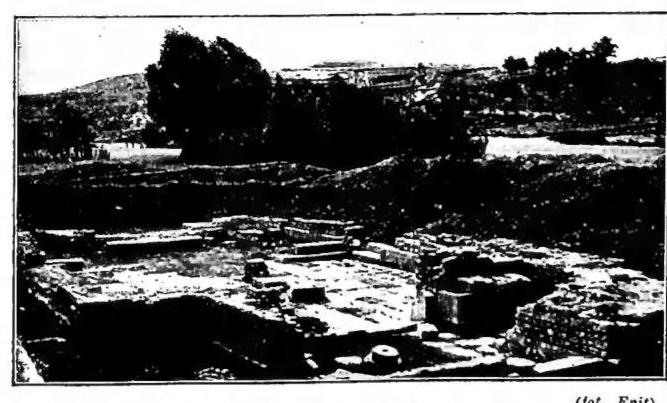
Salona became famous for its Christian monuments (it was the site of the first Congress of Christian Archaeology in 1894). Among the earliest and most important are the cemetery basilicas (five have so far been discovered:
(photo: Enis)
transferred thither are the relics of all the Salonian martyrs. Marusinac, instead, is of great importance for the development of Christian architecture. Apart from a rare example of a mausoleum (of St. Anastasius), with Orientalizing (Syrian) features, two basilicas have come to light, side by side, the first originally roofless (the “basilica discoperta”). Another notable Christian complex is represented by the Urban Basilica, a large three-aisled church (5th century, rebuilt in the 6th) with its baptistery and other adjacent buildings. By means of a broad narthex this Basilica is connected to another in the shape of a Greek cross, which shows several phases of construction. Salona had many other basilicas, most of which still leave traces visible today. Within the ancient city walls alone, fifteen have so far been recorded. Pope Zosimus (414) raised Salona to the dignity of an ecclesiastical metropolis of Dalmatia, a rank it retained until the city’s destruction. — See pl. CVI.