
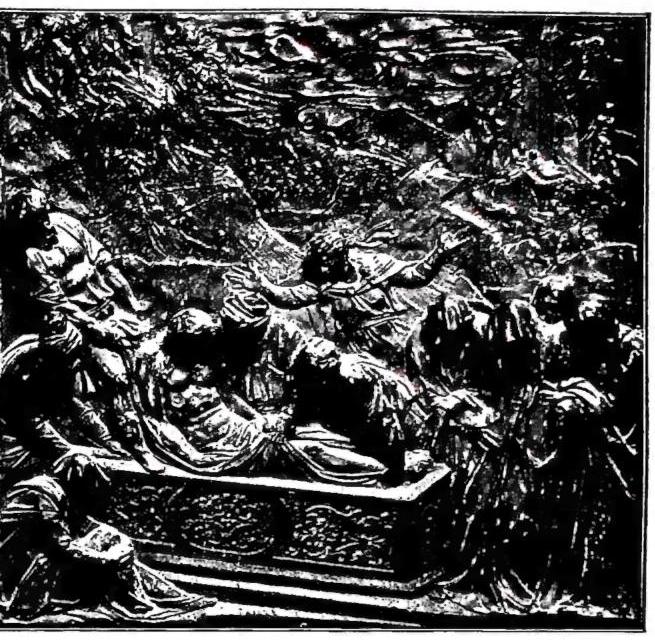
SAN SOVINO, ANDREA CONTUCCI known as il. — Architect and sculptor, b. at Monte S. Savino (from which his name derives) in 1460, d. probably there in 1529.
Having gone to Florence at a very young age, he was perhaps a pupil of Cronaca (q.v.) and certainly his collaborator in the atrium of the sacristy of S. Spirito, where some capitals are attributed to him; in the same church is his altar of the Sacrament erected for the Corbinelli family, still tied to the tradition of Benedetto da Maiano (1490-91). In the immediately following period one should place his sojourn in Portugal, recorded by Vasari, but now denied by most scholars. It is certain that in Portugal none of the works attributed to him can be considered truly his. Still later, after a brief stay in Florence, S. went to Rome, where he carried out great activity under the pontificates of Julius II and Leo X. To this period belong the monuments to Cardinal Manzi in S. Maria in Aracoeli (1504) and to Cardinal Sforza (1505) and Cardinal Basso (1507) in S. Maria del Popolo. In the first, despite the powerful plastic sense, S. is still tied to the models of Bregno in the simplicity of the architectural conception and in the minuteness of the ornamentation; but the tombs of S. Maria del Popolo, for the monumentality of the architecture, conceived as a triumphal arch, and for the classicism of the sculptures, reveal an inspiration from antiquity, first elaborated with cold intellectualism, then penetrated and relived. Classical culture is ever more evident in his later works, both as sculptor (statues of the Virgin with the Child above the doors of S. Giacomo in Augusta and of S. Maria dell’Anima, of 1509; group of the Virgin with the Child and St Anne in S. Agostino, of 1512) and as architect (among which is particularly to be remembered the portico of S. Maria in Dominica, erected between 1513 and 1514, previously attributed to Raphael or to Peruzzi). From Leo X he was sent after Bramante’s death to Loreto, where he played the principal part in the marble revetment of the Holy House, and continued the construction of the Apostolic Palace and of the Basilica, departing, it seems, from Bramante’s designs; so much so that in 1520, following the unfavourable judgment given by Antonio da Sangallo the Younger on his work, he was replaced in the post of architect by Cristoforo di Simone Ressa of Imola. The sculptural part, however, remained entrusted to him, which he attended to until his death. Other certain works of S. are the courtyard of the Palazzo comunale of Jesi, the staircase before the duomo of Arezzo and the house he built for himself in his native town; probable is also the attribution of the Palazzo erected in Rome in Piazza dei Caprettari for Giuliano de’ Medici and later passed to Lante. — See pl. CXVII.