
WISDOM. – A book of the Old Testament. In Latin it is called *Liber Sapientiae*, but in older authors the title *Sapientia Salomonis* is also attested, corresponding to that found in the best Greek manuscripts and writers (*σφάλα Σαλαμῶνος*).
---
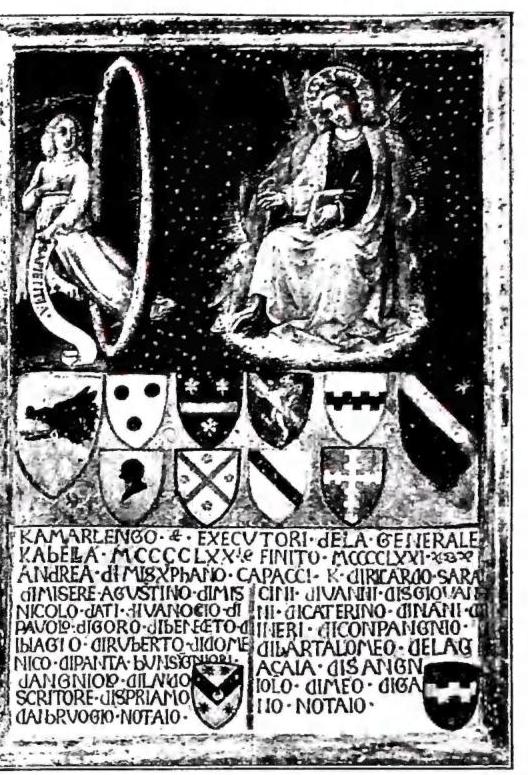
WISDOM (in the Bible) – Wisdom emanated by God. Biccherna panel painting by Sano di Pietro (1471) – Siena, State Archive.
The work is customarily divided into two major sections: a didactic one (1:1–9:18) and a historical one (10:1–19:22). It opens with a fervent invitation to the pursuit of wisdom, considered the source of all virtue and the means of drawing near to God. Only the foolish or the wicked neglect it, and they will be punished (1:1–2:24). Contrasted with their fate is the happiness of the just, both in this life and in the next (3:1–5:23). After a special exhortation to kings to appreciate and love wisdom (6:1–23), the most famous sage, Solomon, is presented, who extols the gift granted to him by a special grace of God. He praises the goods that wisdom brings to men, describing it not merely as a quality of the soul but in its objective beauty as an attribute and perfection of God, through which the Creator governs the world and exercises His providence (7:22–8:1). In certain verses (7:22–27), wisdom is presented as something intrinsically divine, yet at the same time distinct from Him from whom it proceeds, thereby manifesting the glory and greatness of the Almighty. It is the hypostatic wisdom.
In the historical section, the true benefits and privileges of the patriarchs are outlined in broad strokes as effects of wisdom (10:1–11:4). Then the punishments inflicted by God upon the Egyptians and Canaanites are contrasted, always highlighting the justice and clemency of God in His judgments (11:5–12:23). In 13:1–15:19, idolatry is condemned. The book concludes (16:1–19:22) with a new comparison between the Israelites and the Egyptians, summarizing the various episodes preceding and accompanying the liberation of the Hebrews from Egypt: these are signs of God’s predilection for His chosen people and of His justice against idolatrous oppressors.
The book holds great doctrinal and dogmatic value. Its unmistakable characteristic, shared in some way only with 2 Maccabees, is its insistence on a reward beyond death reserved for the just, who will live a blessed life with God (3:1–9; 4:7; 5:16), and thus on the immortality of the soul. This beatitude is the fruit of wisdom, since it is the primary source of justice (1:15; 3:15; 4:2; 5:16). In describing the fate of the wicked, the text emphasizes their unhappiness in this life (2:21; 3:10; 4:3–6), but it also clearly speaks of their future misery (1:16; 3:19; 4:19–5:14). Similarly, the work affirms the knowability of God through creation (13:4–9; cf. Rom. 1:20), the power and providence of God (12:12–15; 15:7; cf. Rom. 9:19–23), and the nature of idolatry and the corruption of paganism.
Often, especially among Protestants, serious errors are noted in the book, which is said to presuppose the pre-existence of souls (8:20) and the eternity of matter (11:18). In reality, in the first case, it is a firm affirmation of the superiority of the soul over the body; in the second, the term *δύναμις* (dynamis) should not be interpreted as amorphous matter, from which, according to Greek philosophers, the world would have originated, but rather as chaos, which is present in Gen. 1:2 as the first effect of God’s will.
Although there are notable stylistic similarities with the books of the Hebrew Bible, it is certain that the original language was Greek. The many compound words, certain paronomasias, the often elegant manner of joining various propositions, and the use of technical terms from Greek religion or philosophy are clear indications that the book was written in that language. Moreover, the ancients were already convinced of this (cf. St. Jerome, *Praefatio in libros Salomonis*: PL 28, 1307–1308). Since these characteristics extend throughout the entire book, the various hypotheses about an original, perhaps only partial, Hebrew text have not gained acceptance.
The fact that the author presents himself as the famous wise king (7:1ff.) presents no difficulty. This is a simple literary device and does not imply any special conclusion regarding inspiration. Already St. Augustine (*De doctrina christiana*, II, 8, 13; *De civitate Dei*, XVII, 20, 1) affirmed that learned men did not even entertain the doubt that the work was not composed by Solomon (*non autem esse ipsius, non dubitant doctiores*).
Intrinsic analysis shows that the author was a Jewish Egyptian and that he wrote for his coreligionists in that region to turn them away from idolatry and confirm them in the Mosaic religion, offering them comfort amid the persecutions they suffered (cf. 2:10–20; 15:14). The most recent research places this in the time of Ptolemy IV Philometor (221–204 BC) or Ptolemy VII Physcon (170–163 BC), both hostile to the Jews. Other indications make the latter date more plausible. However, a somewhat later period is not excluded. The idea, reported by St. Jerome (loc. cit.), that the book was written by Philo, can be deemed unlikely, although some modern scholars have revived II. The Book of Wisdom is not a philosophical work nor an attempt to reconcile Platonic concepts with moralism. Its rare allusions to Greek philosophy are explained by the cultural environment and the author’s concern to protect his coreligionists from the dangers inherent in false doctrine.
The Book of Wisdom belongs to the group of deuterocanonical books (v. BIBLE), as it was not accepted into the Hebrew canon, at least in Palestine. For this reason, it is also rejected by Protestants. In favor of its canonicity stands, first and foremost, the infallible authority of the Church and a venerable tradition of Fathers and ancient writers. St. Jerome excluded it as “pseudepigraphal”; for this reason, he did not translate II. The Church, therefore, still reads it in the tradition of the Vetus Latina. The book is never explicitly quoted in the New Testament, but there are allusions to it (Rom. 1:20; 9:19–23; etc.).