
GIROLAMO SAVONAROLA - The martyrdom of Savonarola in Piazza della Signoria (23 May 1498), painting by an unknown contemporary - Florence, Galleria Corsini.
On 25 March the Franciscan Francesco da Puglia, preaching, challenged to the ordeal by fire anyone who maintained that Savonarola’s excommunication was invalid. Fra’ Domenico promptly accepted the challenge, and the Signoria itself—now dominated by the Arrabbiati, who saw in it an excellent opportunity to rid themselves of Savonarola—ensured that neither side could back out by inviting them to subscribe, on 29 March, to the propositions to be tested by fire. These concerned, in sum, the need for the Church and Florence to be scourged and renewed, and the invalidity of Savonarola’s excommunication. The definitive agreement, stipulated on 6 April in the presence of the Signoria and the vicar of the archbishop, provided that the party which refused or merely hesitated would be deemed the loser. On the morning of 7 April, the ordeal was to take place. However, no other test was made than that of words and endless discussions. According to the terms of the agreement, since the opposing side had refused and hesitated, Savonarola seemed to many to be the loser simply because, against all odds, he had not performed the miracle expected of him. The multitude did not forgive him for this; and the Arrabbiati took advantage of it to deal him the final blow.
The next day, Palm Sunday, Savonarola delivered a brief sermon in which, foreshadowing his imminent end, he said he was content that the Lord, in the days of His Passion, wished to make him like unto Himself. That afternoon, as one of his friars was about to preach in the Duomo, a tumult arose. Suddenly, as had been prearranged, the place was filled with the common people and armed citizens, manipulated by the Arrabbiati, who rushed to San Marco. Savonarola wished to prevent any resistance and tried to surrender himself to the assailants, but his own followers barred his way. He went to pray in the choir, where he remained for six hours, while some citizens and a few friars defended the convent and church from the besiegers. When he rose from prayer and was given the order to present himself at the Palazzo, he surrendered, together with Fra’ Domenico, into the hands of his enemies.
Examined in the following days and cruelly tortured, he answered with steadfast courage until, in the end, his delicate frame gave way under the torment, dislocating a limb and lacerating his flesh; the torture was then continued. Thus, in two successive trials, it was possible—if not to make him say what they wanted—at least to force him to renounce his prophetic mission. When this was not enough, after the forced confession, certain clauses were interpolated at the end of the paragraphs and some marginal notes were added that distorted the context. These trials were read in public, but it was not deemed advisable to allow the presumed culprit to attend, as was customary.
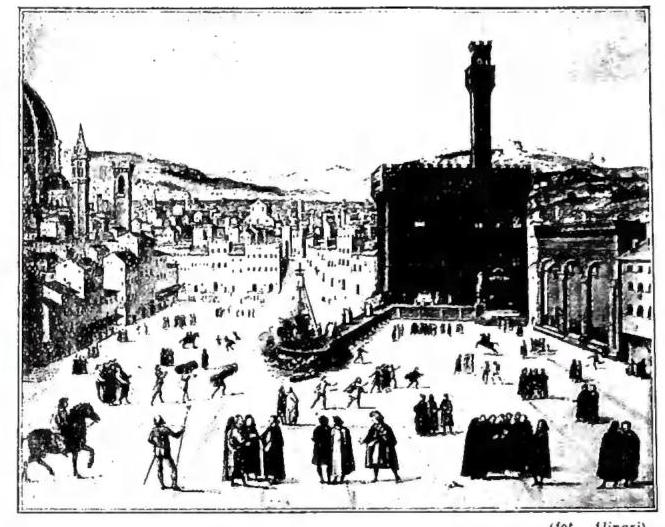
The sentence, pronounced on 22 May, was carried out the next day. The sentence itself, though it contained nothing contrary to Catholic doctrine, was not free from the taint of political passion. In this final hearing, a few things were indeed suspended, not because they contained error, but because they needed some clarification to be understood in a vulgar sense. In truth, such doctrine, steeped in Thomism, could not be more immaculately Catholic; and this is today acknowledged without dispute even by those Protestants who had at first, with manifest distortion, attempted to claim the great name of Savonarola for themselves. Nor could a greater injury be done to one who had lived and died for the Catholic faith. If there were conflicts between Savonarola and the Borgia, his position toward the Roman Pontiff was always devout and reverent; nor did he tire of professing this devotion and reverence until his last moments.
This is testified not only by his life, but also by his preaching and his works. The principal one is the Triumphus Crucis, which he wrote in Latin and immediately translated into the vernacular: a lucid and tightly reasoned apologetic treatise on the Christian faith, which remained in use until the end of the century, and in a book of propaganda Fide, at the behest of which it was reprinted in execution of the testament of Cardinal Antonio Barberini, brother of Urban VIII. Nor should the De simplicitate christianae vitae be overlooked, in five books, of which the first treats of Catholic doctrine, and the others of simplicity of heart and outward simplicity. Of his other works, some are exegetical in character, some ascetical: a clear mirror, framed in pure diction, of that spiritual perfection which he had known how to build within himself. Of his youthful songs it has already been said; his other poems are mostly lauds, which, by force of feeling and originality, stand among the best of the time. Humanistic prejudices branded Savonarola as an enemy of poetry; perhaps it is true instead that, feeling himself too drawn to it and deeming it useless, if not harmful, to the attainment of the ultimate end—as set forth in his Apologeticus de ratione poeticae artis—he sought to repress it in his heart, as he had rigorously repressed his family affections before. Clarity, simplicity, and efficacy were the principal qualities of Savonarola as a writer; and the same may be said of his preaching. His sermons contain passages of great power and beauty, even in the text that has come down to us—certainly very imperfect (cf. R. Ridolfi, Studi savonaroliani, Florence 1935)—even stripped of the charm of his voice and person, which was undoubtedly immense. Prejudices of the same sort that depicted him as an enemy of poetry sought to make him out as an enemy of art, which he held in noble esteem; yet neither the much too rhetorically condemned “bonfires of the vanities,” nor his strictures against certain pagan deviations, can erase the debt that art owes to one who inspired a Michelangelo, a Botticelli, and a Simone del Pollaiolo.
Editions. — Of Savonarola’s works, often reprinted in the 15th and 16th centuries but always separately (many ascetical pamphlets were collected in the Additiones of Quétif to G. F. Pico, Vita... H. Savonarolae, Paris 1674), there is no modern complete edition; the National Edition aims to remedy this, of which the first two volumes (Prediche sopra Ezechiele, edited by R. Ridolfi) are in press. Nor are there modern critical editions of the individual works, except for the Epistolario (Le Lettere di G. S., edited by R. Ridolfi, Florence 1933). In the collection, unfortunately poorly executed, Prediche italiane ai Fiorentini, Florence 1930–35, the sermons on Haggai (vol. I) and on the Psalms (vol. II), edited by Cognasso (with many errors), and the sermons on Amos, edited by Palmarocchi (vols. III–IV), were published. Of all the other sermons and works, only ancient editions exist, or modern ones that are entirely negligible.