
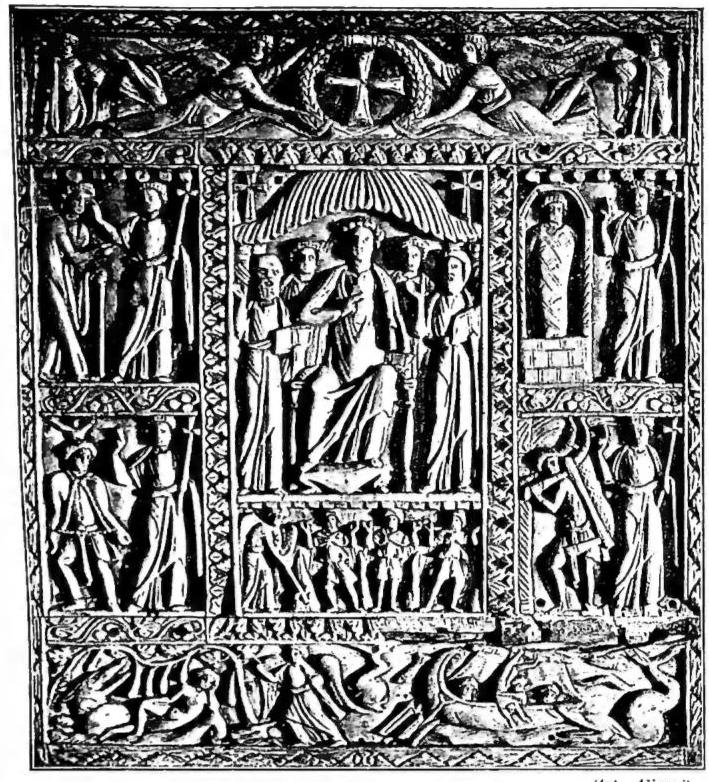
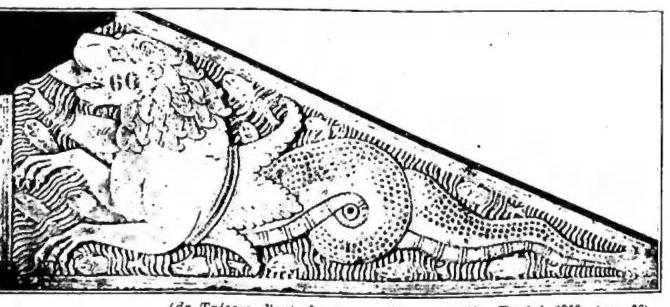
**CARVING – Ivory Diptych of the 6th Century**
In consular diptychs; in any case, they are extremely valuable for the study of post-catacomb Christian iconography. The chair of Maximian in Ravenna (6th century), of probable Alexandrian origin, entirely composed of small panels adorned with biblical scenes framed by decorative bands, is a rare testimony to the richness that this part of liturgical furnishings could achieve. Among reliquaries, the most famous are in the Lipsanotheca of Brescia and in that of Samagher (Pola). A fine example of an ivory pyx is that in Berlin, with the sacrifice of Isaac and the teaching Christ among the Apostles. Another, more recent and more Oriental in style, in the same city, depicts the Annunciation and the Nativity. Among Christian diptychs with biblical scenes, mention may be made of those in the Louvre with healings and in the British Museum with scenes of the Passion, the slabs with the Ascension in Munich and with the Resurrection in the Sforza Castle in Milan. More recent or of Oriental origin are the diptych in Murano preserved in Ravenna and that in the National Library in Paris (6th century). Magnificent is the Byzantine valve with an archangel in the British Museum. Finally, mention should be made of the rich series of consular diptychs.
A special case is constituted by Coptic art, which, both in the funerary field with its numerous steles and in the architectural and furnishing fields, offers a very rich collection of symbolic and figurative motifs (triumphal crosses supported by eagles, decorations, etc.), but above all ornamental ones, characterized by a special form of stylization in which the fusion of Hellenistic and Syriac art has received a very strong local imprint.
11. MEDIEVAL, RENAISSANCE, AND MODERN SCULPTURE
In early Christian sculpture, the stylistic modes that appear are closely linked to those of the preceding and contemporary pagan sculpture. But soon the new order of ideas that characterizes, between the 1st and 5th centuries, the evolution of thought both in the East and in the West, inevitably leads sculptors toward new forms of expression. Indeed, while during the period of classical art the reproduction of the perfect harmony of human limbs was considered the highest term of aesthetic perfection, now other concepts replace it, and carved images, like painted ones, tend rather to express the movements of the soul with forms that gradually accentuate, with ever greater efficacy, in an anti-academic and anti-classical direction. This continues until, around the 7th and 8th centuries, sculptors abandoned even the use of depicting human features, and the art of sculpture was reduced to the incision or piercing of marbles to represent elements of a limited decorative repertoire (cf. BARBARIC ART; BYZANTINE ART; ITALY, VI. Art in I.).
It was only during the Romanesque period (cf. ROMANESQUE ART) between the 11th and 13th centuries that the plastic faculties of Italians and other peoples participating in the culture of the Christian world manifested themselves with new and exceptional vitality, and from the throng of stonecutters engaged in the construction and decoration of the new churches emerged the first great personalities of sculptor artists such as Wiligelmus (cf.), Antelami (cf.), Nicola Pisano (cf.), who expressed with perfect harmony of forms the new fervor of life characteristic of that time.

Their intervention and vigilance are required. These should harmoniously merge into one, since there is only one subject to be instructed and educated as a citizen and as a religious (cf. EDUCATION); yet throughout history, there have been, and still are, untimely interferences, coercions, and distrusts that infringe upon the fundamental rights of the individual and the family.
A rapid glance at the various fates suffered by the school will help to better understand the value of the important problems that gather around the school question.
I. SCHOOL AMONG THE MOST ANCIENT PEOPLES
Setting aside the "primitives," for whom one cannot properly speak of true schools, although a rudimentary hint might perhaps be seen in the initiation rites (cf.) to which young men and women are subjected during the transition from childhood to adolescence, among other peoples a fine and varied flourishing of schools can be observed. A characteristic fact, almost universal, is that the education of youth is centered in the family, regarded as the hub of civil and social life, while the State, where it established schools, generally aims to integrate and develop family education, without in any way seeking to replace II. Among the Babylonians and Assyrians, even though precise information about their school organization is lacking, we do know what subjects were taught, which formed the culture of the "magi" or wise men. Almost every field of knowledge was included: history, geography, astronomy, astrology, mathematics, medicine, and theology. Study, even if reserved for people of high caste, priests, and magi, was not closed to any intelligent person, who could freely acquire the level of culture required for access to public offices. Women and the common people, however, were generally excluded from education. A center of particular cultural activity was Babylon, where the king maintained an advanced school of higher studies in his palace. Students were supported at state expense and, after a three-year course, were carefully examined by the sovereign (Daniel and his companions, exiled to Babylon in 606 BC, were precisely educated in this school in all the sciences of the time).
Among the Persians, state care took over from family education through its schools, for the period from ages 7 to 25. After the intellectual and religious part of the lower course came the upper course for military and civil training. Those who did not aspire to public office could freely educate themselves with private teachers. The Persian priests, called magi or wise men for their vast learning, must also have had great priestly schools.
The Egyptians, who always held knowledge in high esteem, had numerous and well-developed schools, but only the sons of priests and warriors— the two privileged classes to which alone the governance of the state was entrusted— were admitted. Instruction was imparted exclusively by priests, and schools were located in temples. Higher education was directed especially toward technical and professional fields (scribes, engineers, architects, physicians). Those who possessed the most profound and complete knowledge (literature, natural sciences, medicine, philosophy, and music) were the priests, who had their own schools and also studied theology deeply (famous theological schools in Ethiopia, Memphis, Hermopolis, and Thebes created various theogonies and elevated or lowered their deities according to their theories). Religion also encompassed magic, which was studied from earliest times, and divination, especially in the form of haruspicy (one may recall the episodes of Moses and of Joseph sold into Egypt).
Among the Chinese, more than among any other people, all social life was centered on the family, regarded as the foundation of the nation’s religious, moral, and civil life. They considered the school a continuation and perfection of domestic instruction in the traditions and customs of their ancestors. The state maintained an organized system of schools of various levels, founded, supported, and directed by the state, and open to all male citizens. Those who aspired to govern the people had to undergo, at the end of their higher studies, rigorous state examinations. Yet families and private individuals could also open and run schools; state schools were compulsory only for those preparing for public employment, and even those who had studied privately could take the state examination.
The Japanese received Chinese writing only in AD 207, introduced by a Chinese scholar; until then, most of them were entirely ignorant of II. King Mommu established in Tokyo in AD 701 a university and numerous national schools and colleges in every province, also issuing regulations for each level of schooling, thus creating a system of national education. Those who, after the elementary schools, wished to study particular disciplines (Chinese classics, political science, jurisprudence, etc.) had to move on to the university or employ private tutors. Likewise, the sons of merchants, farmers, and artisans— who could not attend the schools and colleges of the nobility— had to resort to private instruction.

The Indians did not have state schools for preparation for public office, as did the Chinese, Egyptians, and Persians; yet they did have lower and higher schools (practically all in the hands of the priestly caste of Brahmins, the highest of the four castes into which Indian society was divided), which fell into two categories: some were reserved for boys of the priestly caste, while others served the sons of the warrior and farmer or merchant castes; the latter had an essentially religious purpose (knowledge of sacred books). At first, higher education— well organized in numerous colleges that soon became something like universities— was the privilege of the Brahmins; but gradually, as literature, medicine, jurisprudence, astrology, and astronomy were added to religious subjects, members of the warrior and artisan castes could also attend the schools.
Among the Hebrews, a people distinctly set apart from others by their theocratic conception of the state, family education imparted by parents—or, in upper-class families, by pedagogues who remained in the household for life— long prevailed. Only after the return from the Babylonian captivity did the successors of Ezra establish schools in the principal cities, where literature, religion, and national laws were taught. The scribes or learned men formed a special class with a distinct profession and became the regular teachers in synagogues and in elementary schools opened alongside them. Hellenism increased the desire for ever greater learning, and schools multiplied. Little success attended the House of the Book, established in Jerusalem in 104 BC by Samuel ben Setah, head of the Great Sanhedrin, as a type of state elementary school; and only in AD 64 was there a decree for compulsory elementary education and an order to establish schools in every, even small, town. After the Dispersion, the Israelites built synagogues and schools wherever possible, and their Academies, during the Middle Ages (Toledo, Granada, Córdoba, etc.), enjoyed periods of true splendor.
In Greece, the Spartans maintained an absolute state monopoly over schooling. The school system, attributed to Lycurgus (d. 839 BC), aimed to produce valiant soldiers because, as a small aristocratic minority (the Spartiates) facing the other peoples of Laconia, the Spartans could preserve their dominance only through great military superiority. Thus the child belonged to the state: after seven years of severe family education, he passed into public educational institutions, maintained by the state and run by teachers and educators appointed and supervised by the state. Girls too belonged to the state, which provided their education to form strong and vigorous women and mothers.
Among the Athenians, by contrast, the political constitution of Solon (c. late 6th century BC) placed great importance on instruction and education but imposed neither official programs nor obligatory schools.
University with the two Constitutions of February and March 425 (ibid., 14, 9, 3; 15, 1, 53), by which private teachers were reduced to the simple role of domestic tutors ("inter privatos parietes"), while all were required instead to attend the university he had founded and which was provided with 8 rhetoricians, 20 grammarians, 2 jurists, and 1 philosopher. A century later, Justinian, in 529, concentrated all legal studies in the Empire in the three cities of Constantinople, Beirut, and Rome, centralizing all educational initiatives under his control and prohibiting any form of teaching "to those afflicted by the insomnia of paganism" (Code of Justinian, 1, 11, 2). But this reform, before it could consolidate, was swept away by the Lombard invasion.
At the same time, the Church, for a more solid preparation of pagans for Baptism, had established the "catechumenate," in which the priest imparted instruction about the faith throughout the year, but especially during Lent. Any place, especially in the early days—sanctuaries, crypts, cemeteries, private homes, etc.—became a center of teaching. Many catechumenates gradually transformed into "catechetical schools," which also admitted pagan students and aimed to provide general culture alongside religious instruction. Even more: some of these catechetical schools evolved into academies or higher schools, because Christians, confronted with heresy and the highest and most refined pagan science, realized that they had to make a final effort to give Christianity a philosophical, literary, and cultural foundation that could match any pagan teaching and serve to defeat the numerous enemies who attacked it in schools, books, and daily sarcasm. The most famous example of these higher schools is the Didascalium of Alexandria, founded, according to more recent studies, by Origen in 202 at the behest of Bishop Demetrius and which replaced the catechetical school of Pantaenus. There, professors taught, alongside sacred sciences, Platonic and Aristotelian philosophy, physics, astronomy, grammar, and rhetoric, drawing abundantly from classical pagan authors; the study of Sacred Scripture crowned the curriculum. Since in other cities there was an equal need for a scientific demonstration of the truth of the faith, the Church founded similar institutions; thus arose the Academies of Caesarea, Antioch, Jerusalem, Edessa, Smyrna, Nisibis, and Rome.
III. CHRISTIAN SCHOOLS IN THE EARLY MEDIEVAL PERIOD
The void left by the dissolution of the Roman Empire (476) caused the Church to assume full responsibility for public education. Various types of schools can be noted:1. Presbytery or parish schools
Where Christianity counted almost the entire population, or at least the majority, purely Christian schools had already been established for elementary studies, where children learned, in addition to religion and liturgical chant, reading, writing, and basic arithmetic. These schools naturally multiplied as pagan schools declined, until they remained in many places the sole beacon of education. A Council held in Italy in 443 ordered priests to gather children from the surrounding area in their homes to provide them with proper instruction. Before and after this Council, parish schools must have been numerous in Italy and yielding good results, since the Council of Vaison, Orange, and Valence in 529 established that priests in charge of souls should admit young readers without wives into their homes to instruct them as good fathers instruct their sons, "secundum consuetudinem, quam per totam Italiam satis salubriter teneri cognovimus" (Hefele-Leclercq, II, pp. 1111-12). Once freed, the young readers could either follow an ecclesiastical career or embrace the secular life, avoiding the disturbances that recent novelties brought to the ancient Roman way of life.Under the Empire, teachers enjoyed many privileges and immunities. Vespasian was the first to stipulate public salaries for some teachers; Hadrian generously provided such subsidies and also founded in Rome the first universities, the Athenaeum Romanum, a spacious school building in the shape of an amphitheater, where teachers, lacking their own school buildings, could gather students without expense; Marcus Aurelius founded in Athens a series of chairs in philosophy and rhetoric, with teachers paid by the State; Alexander Severus in Rome created new school buildings for private teachers, established new chairs in medicine and architecture, and allocated in-kind scholarships for poor students; Constantine founded a university in Constantinople, that is, an organic complex of schools and chairs for secondary and higher education. Municipalities throughout followed the example of the emperors by creating municipal schools with salaried teachers; indeed, Emperor Gratian, to prevent injustices, fixed by law the honoraria due from municipalities to grammarians and rhetoricians, listing them in the budget as mandatory expenses. If these municipal schools not infrequently became occasions for some more direct interference by the State, they always left room for private schools, founded and maintained by individuals and directed by more select personnel, and thus preferred by families.
II. CHRISTIAN SCHOOLS UP TO THE FALL OF THE EMPIRE
This full freedom of teaching also allowed Christians to pursue the career of teachers; indeed, there were teachers who suffered martyrdom, not condemned as private teachers, but for refusing to renounce their faith. St. Cassian, a martyr, was a teacher in Imola; Flavian, a martyr in Africa, was a grammarian; Origen began his career as a grammarian to support his family; and in the cemetery of St. Callistus, the epitaph of a magister primus or elementary schoolmaster was found.Julian the Apostate was the first to attempt to restrict the freedom of teaching for Christian teachers by issuing the Edict of 362, by which he prohibited them, if they persisted in Christian beliefs, from teaching any longer. Notable teachers then left their chairs, such as the rhetorician Victorinus in Rome and the sophist Prohaeresius in Athens. But already two years later, in 364, Valentinian repealed the law and restored to Christian teachers their freedom: "Whoever, by character and learning, is worthy to teach, shall have the right to open schools" (Theodosian Code, 13, 6, 3). This regime of freedom lasted in the West until the end of the Empire. In the East, however, Theodosius implemented the official monopoly of uni-

School — Teacher at a desk with disciples. Engraving from the Epigrammata of G. B. Cantalicio — Venice, printed by Matteo Capocasa, 1493, f. 2r.
2. Episcopal or cathedral schools
Parochial schools did not go beyond the subjects taught in elementary schools; but higher schools with a more suitable and deeper curriculum were also needed. Moreover, the training of the clergy required that studies be conducted in a manner worthy of their calling. Hence, alongside the bishop’s see there arose the so-called episcopal schools—large seminaries and universities—intended especially for candidates for the priesthood, though increasingly attended also by laymen. Already one such school had been founded by St. Augustine at Hippo; another existed at Imola, where St. Peter Chrysologus pursued his studies; others were at Paris, Poitiers, Clermont, and elsewhere. The Second Council of Toledo (531) prescribed their establishment, adding that when pupils reached the age of eighteen they were to be examined in the presence of the bishop and clergy to determine whether they preferred the priesthood or marriage (Mansi, VIII, p. 785). The bishop exercised control over the school, under whom stood the immediate superior, called the magister scholae. The school was divided into the schola minor (elementary) and the schola maior, which included only the courses of the trivium or else offered the full program of the trivium and quadrivium, crowned by the study of Holy Scripture and pastoral theology.3. Canonical schools
Where no cathedral existed, the canons of the local church themselves established their schools, patterned after the episcopal type; these thus took the name of collegiate and canonical schools and assumed a more secular than ecclesiastical character. Later they merged with the episcopal schools.4. Monastic schools
The greatest burden of public instruction, however, was borne by monastic schools, first in the East, where most of the Church Fathers and ecclesiastical writers received their education, and then in the West, especially through the work of the Benedictine monasteries, which spread rapidly across Europe. They maintained an “internal” school (schola claustri) for the religious and an “external” school (schola canonica or externa), separate from the first and situated within the monastery precincts to avoid unnecessary intercourse with the monks who were devoted in particular to study, prayer, and work. The head of the school was called magister scholae, capiscola, or proschola, and by the end of the ninth century, scholasticus. The curricula of the two schools were roughly the same: the trivium or quadrivium. Parallel to the male monasteries, the female houses were likewise to have their schools, and the English Council of Cloveshoe (747) ordered that not only bishops and abbots but also abbesses should take particular care to foster the study of letters within their religious communities (Hefele-Leclercq, III, p. 907).IV. Christian schools in the Carolingian era
Besides reorganizing the Palace School, intended especially for princes and nobles preparing for military service and the governance of the people, Charlemagne issued numerous ordinances aimed at promoting or reorganizing parochial, episcopal, and monastic schools. In the Epistola de colendis litteris, addressed between 780 and 800 to bishops and abbots, he urged them to provide literary instruction to all who were capable of learning according to their individual capacity; more explicitly, in the Capitular of March 23, 789, he ordered that in every bishopric and monastery schools be founded for boys and that well-corrected textbooks be used (cf. MGH, Capitularia, I, pp. 72 and 79). The bishops complied, and in the first half of the ninth century many councils in France, Germany, and Spain reminded parents of their duty to have their children educated. In Italy, the Roman Council of 846 prescribed that all bishoprics and dependent parishes have their own schools, since it had come to their attention that in some places teachers were lacking and the study of letters was being neglected.At this time state schools also appeared; indeed, in the first Capitular Ecclesiasticum of Lothar, issued in 825 at the great assembly of the Kingdom of Italy held in the fields of Olona (Pavia), lament was made over the neglect observed in many places, and those entrusted by the state with teaching were ordered to apply themselves with the utmost care so that pupils might acquire the learning required by the times. Moreover, the seats of the schools were specified, listing the cities that were to receive pupils: Pavia, Ivrea, Turin, Cremona, Florence, Fermo, Verona, Vicenza, and Cividale del Friuli (cf. MGH, Leges, I, p. 249). Indeed, the French episcopate, assembled at the Sixth Council of Paris (823), earnestly entreated Emperor Louis the Pious to follow his father’s example and establish by his own authority public schools in at least three suitable places within the Empire (Mansi, XIV, p. 599).
V. Schools from the ninth to the thirteenth century
From the second half of the ninth century to the end of the eleventh, there was a rather deep and ever-widening decline in the schools, owing to the severe political, social, and religious crisis that followed the collapse of the Carolingian Empire. But as soon as, toward the close of the eleventh century, social and religious conditions permitted, the Church took its rightful place in reviving and promoting the schools to their former vigor and splendor. Important were the educational provisions of the Third Lateran Council (1179): the Church, as “mother,” has the duty to care for the instruction of poor children; hence every cathedral was to set aside a suitable stipend for a teacher so that instruction might be open, free of charge, to both clergy and laity, provided they were poor; the wealthy could still avail themselves of private tutors or schools in monasteries; moreover, all persons were granted broad freedom to open schools, provided they were competent and had obtained the requisite license; teachers were exempt from taxes, and no fee was to be charged for granting the teaching license (Mansi, XXII, p. 227). The Fourth Lateran Council (1215) reaffirmed this prescription, adding that even in non-cathedral churches with sufficient income, the bishop was to appoint a competent teacher for free instruction (Mansi, XXII, p. 999).As a result of this papal school legislation, parochial and episcopal schools flourished and multiplied; monastic schools too, despite their decline,

School — Master with ferule and pupils with their primers. Engraving from the Summa perutilis in regulas distinctas totius artis grammatices et artis metrices — Rome, printed by Giovanni di Besicken and Sigismondo Mavr, 1494.