
SECKAU (SEKAU), DIOCESIS OF — Diocese and abbey in Styria (Austria).
I. THE DIOCESE
The present diocese of Seckau covers an area of 16,373 sq. km. with a population of 1,106,581, of whom 970,000 are Catholics; it has 360 parishes in 64 deaneries, nearly 1,000 priests, and nearly 2,000 religious sisters (statistics of 1952). There is a Faculty of Theology at the University, two seminaries, many educational and instructional institutes; almost all the major orders and congregations are represented.The diocese of Seckau owes its origin to Eberhard II, Archbishop of Salzburg, who, with the consent of Honorius III (22 July 1218) and Emperor Frederick II (17 Feb. 1219), established, with its seat in the abbey of Seckau, one of those suffragan bishoprics that are a unique peculiarity of the metropolitan see of Salzburg (v.). The diocese, of minimal extent, was established pro forma, since the bishop of Seckau was in fact merely the vicar general of the archbishop (1218–1786) for the entire vast Alpine region.
II. THE ABBEY
In 1140, Count Adalram of Waldeck established a small convent for the Augustinian Canons in the locality of the present-day St. Martin (Upper Styria, then in the archdiocese of Salzburg). Already in 1143 it was transferred to the site of the present Seckau, which was more suitable. The canonry soon flourished, enriched by many donations; a monastery of canonesses was added, which disappeared after the Turkish devastations at the end of the 15th century. From 1359 the provost (abbot) enjoyed the right to wear pontifical insignia. The prosperity of the abbey was cut short by Joseph II, who suppressed it in 1782. In 1883 the Benedictines of the Beuron Congregation acquired the remaining buildings and erected the present Benedictine abbey. Over the years they carried out extensive restorations and reconstructions, especially of the basilica, opened a public gymnasium with boarding school, and devoted themselves greatly to liturgical apostolate. Under Nazism there was a new suppression (1941–45); but recovery was certain, and Seckau has returned to being one of the most prominent centers of Austrian cultural life. Notable are the many publications, especially in philosophy, history, Catholic culture, and liturgy. Liturgical performances, especially at certain times of the year, enjoy international renown. The library is modern.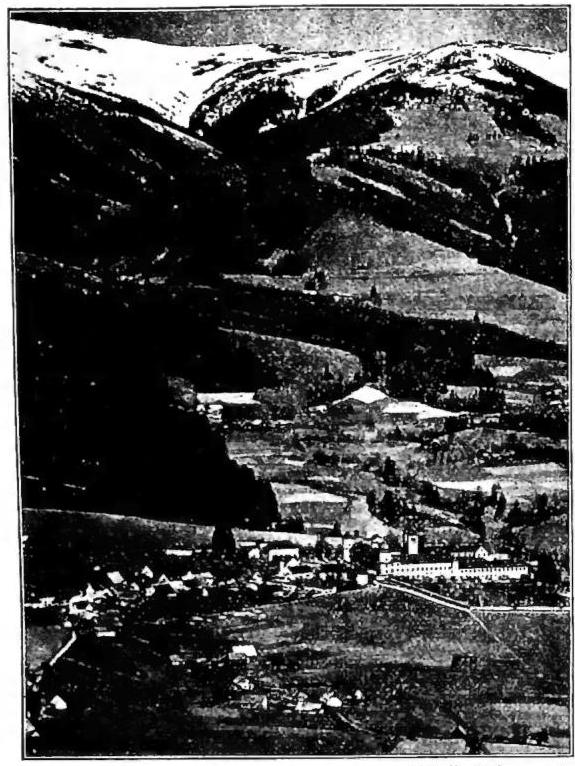
The church, a Romanesque basilica of Austro-Bavarian type but with elements of the Saxon school, is one of the most significant examples, almost intact, in the eastern Alpine territory. The first dedication dates to 1162. The reconstructions following fires, the transformation of the vaults (Gothic), and a radical modern restoration have not altered the general severe and imposing impression of the structure. Many Gothic and Renaissance tombstones have been preserved, as well as the celebrated altar of Provost Dirnberger (1507), in gilded and painted wood, with a strange representation of the Most Holy Trinity (three human figures with a single trunk) crowning the Virgin. Of extraordinary note is the grandiose mausoleum of Charles II of Styria (d. 1590), a work of late Renaissance and Italian masters (Carlone, Verga, Ghisi, and others), of extraordinary unity and richness: it includes the sarcophagus with Charles and his wife, figures of angels and various reliefs, stucco decorations, frescoes, marble and bronze balustrades, and a magnificent altar; the complex is set into the left apse of the basilica. The convent has been rebuilt over the centuries, especially in the 16th and 17th centuries, with a vast courtyard with Tuscan arcades and an inner cloister, partly still Romanesque and Gothic.
III. ART, ABBEYS, SANCTUARIES IN THE TERRITORY OF THE DIOCESE
Styria, inhabited since remote antiquity (the Erzberg, the iron mountain, was known to the Celts and Romans, as were the saltworks of Hall and Aussee, etc.), has churches dating from the period of the second missionary penetration of Salzburg after 950 (St. Michael).In Graz, noteworthy is the Cathedral (such since 1786) of St. Giles, originally the city’s parish church, rebuilt by Emperor Frederick III (1438–60), declared a court church, entrusted from 1577 to the care of the Society of Jesus; a late Gothic structure with very spacious naves and remains of frescoes; altars and sacred furnishings in Baroque style. Of great artistic interest in Graz are other Gothic or Baroque churches of various ancient Orders (Dominicans, Franciscans, Teutonic Order). Notable are the Landhaus, seat of the government and Diet, a work by D. Allio, with the most beautiful Renaissance courtyard outside Italy; the Zeughaus, with the most complete armory, a work by A. Solari (1643–45); the Mausoleum of Ferdinand II (1614–39); and the Folklore Museum (Faunneum), one of the earliest founded (1811).
In the diocese of Seckau are the greatest Austrian sanctuary, Mariazell (v.), and the abbey of St. SANKT LAMBRECHT (v.), the former Cistercian abbey of Neuburg, founded in 1327, as well as the more famous Admont.
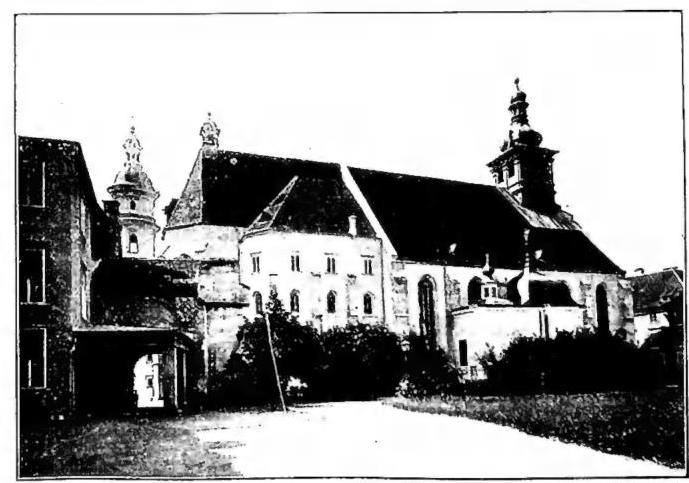
This last Benedictine abbey, in the Enns Valley, in a very picturesque setting, was founded in 1072 with the goods of St. EMMAUS (v.) by the Archbishop of Salzburg, Gebhard. The first dedication of the church took place in 1074. The monks came from the abbey of St. Peter in Salzburg. Soon the abbey affiliated with the Hirsau reform and enjoyed a golden age in the 13th–14th centuries, especially under Abbots Gottfried of Vemmingen (from 1138), Henry V (1275–97), and Engelbert (v.). As early as c. 1115 there was also a convent of Benedictine nuns, with a celebrated school, which disappeared in 1570. After a period of stagnation in the 17th century, a second flourishing began in the Baroque era, with extensive reconstructions. In 1664 a gymnasium was opened, supplemented in 1710 with two departments of philosophy and theology. Joseph II transferred the gymnasium to the city of Leoben, where the monks held chairs until the last years of the past century. A terrible fire in 1865 destroyed the church, monastery, and village, with the exception of the grand and celebrated library. The church was rebuilt in modern Gothic forms, the monastery in simple modern Baroque forms. The library, rich in about 80,000 volumes, many manuscripts and incunabula with an attached museum, is housed in a wing built by G. Hayberger, 70 m. in length, with frescoes by B. Altomonte and sculptures by J. Th. Stammel, rococo bookshelves in white and gold. The Nazi suppression (1939–45) inflicted no slight losses on the library and the monastery. The abbey cares for 29 incorporated parishes, which include the immense territory in which it exercised for many centuries an intense cultural activity of every kind. Noteworthy in the treasury, which includes the remains saved from the fire, are vestments, sculptures, and minor arts, from the Romanesque to the Baroque periods. Nearby, on a hill, stands the sanctuary of Frauenberg, a jewel of Baroque architecture. In many churches belonging to Admont Abbey, the wood sculptures of J. Th. Stammel, a native artist of the abbey (1609–1765), are admired. — See pl. XIV.