
FOUR CROWNED MARTYRS, Saints. - Venerated on 8 November. The names in the Gregorian Sacramentary (five, not four) are: Claudius, Nicostratus, Symphronianus (or Symphorianus), Castorius, Simplicius. The account of the martyrdom (BHL, 1836-37) was not written in Rome, the characters are not Roman but Pannonian, and they were not martyred in Rome. In the narrative one does not find the type of Diocletian as a ferocious persecutor thirsting for Christian blood, as he appears in other late and fanciful hagiographic tales. It is instead the historical Diocletian, a great builder, but weak of character, who yields to pressures and insinuations. The bishop of Antioch, Cyril, is also a historical figure. The legend-writer therefore knew at least the milieu (H. Delehaye, Etude sur le légendier romain, Brussels 1935, pp. 64-73).
Moreover there is a Roman mention that cannot be overlooked: the very ancient text of the Depositio martyrum has the insertion: VI idus nov. Clementis, Semproniani, Clavi
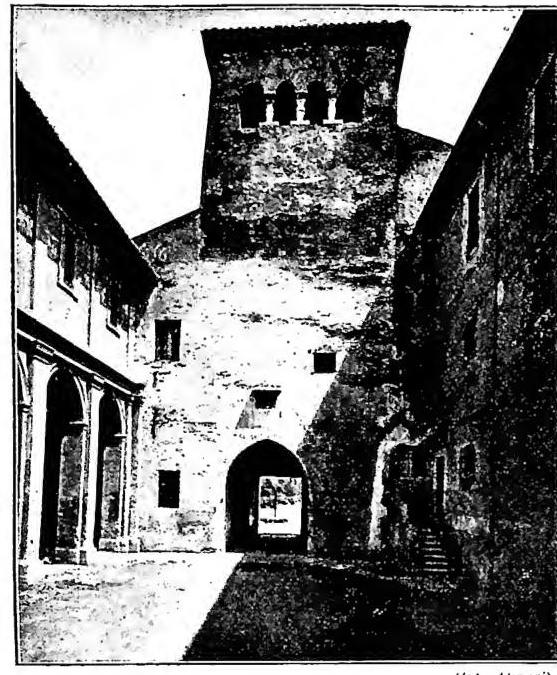
(phot. Alinari)
CORONATI, QUATTRO, saints - Detail of the interior of the church of the SS. Q. C. (12th cent.) - Rome.
(for Claudi), Nicostati in comitatum (the name of Simplicius is absent). And the in comitatum, believed by Delehaye to be the title of an imperial residence outside Rome, is instead a name of a Roman locality, since in the Depositio only places of Rome are mentioned, and when they are outside, express mention is made of it. The appellation fits well the area of the Labicana which was a possession of the crown and in which imperial troops were stationed and where there was also an imperial mausoleum (mausoleum of St. Helena). There is the catacomb of Sts. Marcellinus and Peter in which the group of the Depositio was venerated.
Nothing, therefore, seems to connect the Pannonian martyrs, marble-workers by trade, with the four Romans, who must have been soldiers. In turn this Roman group was, in the Middle Ages, confused with a group of soldiers from Albano (Secundus, Carpophorus, Victorinus and Severianus).
The basilica of the SS. Q. C. erected on the Caelian had to unite the cult of the Roman martyrs and of the Pannonian ones; but the relics of the latter must have arrived earlier. The compiler of the Jeronymian Martyrology names the Sts. Q. C. only in relation to the Basilica (the text is of the 7th cent.). This building must have replaced a very ancient title (Aemilianiae). In 595 there is mention of the title of the SS. Q. C.; the Basilica was destroyed by the Norman invasion of 1085 and rebuilt by Paschal II (1116) on a smaller scale. The vestiges of the earlier one, which had been rebuilt by Leo IV (847-55), are still recognizable. The crypt is of this pope. In the 12th cent. a monastery was attached to it. The cloister is from the first decades of the 13th cent. The chapel of St. Sylvester also has 13th-century paintings (with the legend of St. Sylvester and Constantine).