Machine translation of the 1948–1954 Italian original. The original text is authoritative.
MARIAZELL. – The oldest Austrian shrine, situated in a delightful location among the mountains of Upper Styria (870 m), in the Diocese of Seckau. The town has barely 2,000 inhabitants, but the pilgrims number more than 300,000 annually. The statue of the Madonna with the Child, made of limewood and painted, is a work of the thirteenth century.
M., founded as a simple “cella” by the Benedictine colonizers from St. Lambrecht around 1157, soon acquired a reputation as a shrine. An indication of its renown is provided by the visits of Enrico I Ladislao, margrave of Moravia (1198-
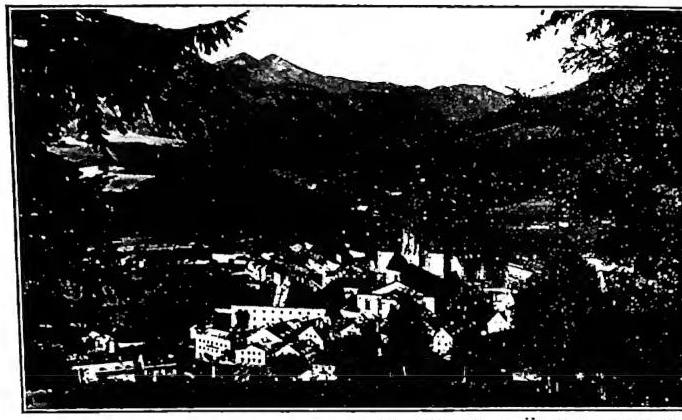
(phot. Bildarchiv d. Ö. Nationalbibliothek) MARIAZELL – View with the Sanctuary – Stiria.1212), and of Luigi il Grande, king of Hungary (1380–96). The latter, indeed, in order to thank Our Lady of M. for the victory won over the Bulgarians, had a large Gothic basilica, a «Hallenkirche», built there. From then on, M. became the central Sanctuary of the whole of Austria-Hungary, greatly favored by the imperial house. The traditional access routes were embellished with churches at the stopping points and with Marian shrines along the roads («Zellerwege»); Ferdinando III took an interest in the rebuilding of the church, in sumptuous Baroque forms, carried out by D. Sciassia (1644–83). The two smaller bell towers, added at that time to the central Gothic one, give the Sanctuary a singular appearance. In the middle of the central nave is preserved the primitive chapel, transformed by E. Fischer von Erlach into exuberant Baroque forms; the grandiose high altar is by J. B. Fischer V. Erlach (1693–1704). The prohibition of pilgrimages during the times of Giuseppe II (1782–96) and of the Nazis remained episodic. Highly valuable works of art are preserved in the Treasury. Care of the Sanctuary is entrusted to the Benedictines of St. Lambrecht, assisted by those of Vienna, known as the «Scots».
BIBL.: G. B. Rodler, Geschichte u. Beschreibung der Gnadenkirche M. in Steiermark, Mariszell 1907; A. Hoppe, Das Österreichers Wallfahrtsorte, Vienna 1913; A. Krause, Benedikt. Wallfahrtstätten, in Benedikt. Mönchstum in Österreich, Vienna 1949; Cottineau, II, 1523. Giuseppe Löw
Cite this article
“MARIAZELL.” Enciclopedia Cattolica, vol. VIII (1952), p. 119. Azione Romana digital edition, https://azioneromana.com/article/mariazell.