
Dominican theologian of the Order of Preachers.
*Adfællum concilium Fideiuntum*
*De natura gratia.*
Venice: Apud Iunctas, Anno Domini 1546.
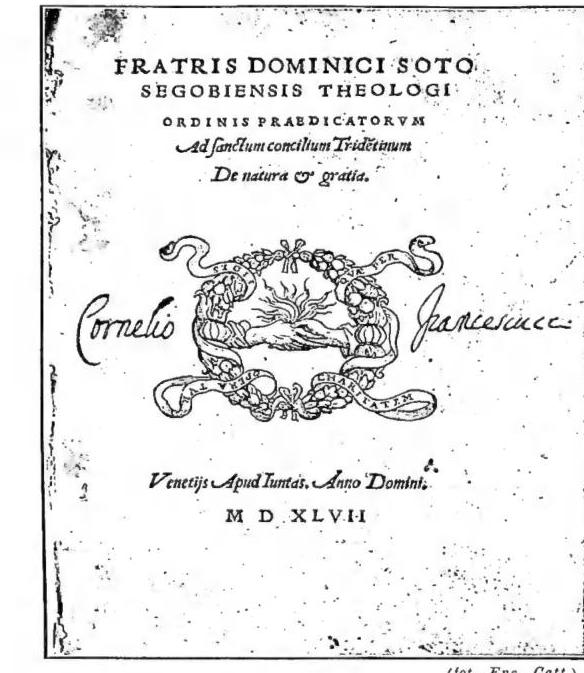
DOMINGO DE SOTO – Title page of *De Natura et Gratia*, Venice, Giunta, 1547 – Rome, copy held in the Biblioteca Nazionale.
He played a decisive role in defending the teaching of Scholastic theology against certain Fathers who wished to abolish or at least reduce II.
His interventions were of decisive importance in the discussion on justification (Session VI). Together with other theologians, he drafted the *Interim of Augsburg*. He served as confessor to the Emperor (1548–49), as well as counsellor to the State and the Holy Office. In 1550, at the request of Charles V, he took part in the debates between Sepúlveda and Las Casas concerning methods of colonization. He served twice as prior at Salamanca (1550–52, 1556–60), and in 1552 succeeded Melchior Cano in the first chair of theology at that university. He engaged in a lively controversy with Ambrogio Catarino (v. POLITICA, LANCELLOTTO) regarding the certainty of being in grace, justification, and original sin.
He left a course in philosophy in four volumes: *Summulae* (Burgos 1529; Salamanca 1539 and 1568); *In Aristotelis Isagogen Porphyrii, Aristotelis Categorias et De demonstratione commentarii* (Salamanca 1543, 1566, 1574); *In libros Physicorum commentaria et quaestiones* (ibid. 1545). All these works went through multiple editions and were frequently used as university textbooks. His commentary on the *De anima* remained unpublished and has been lost.
Among his many theological works are: *Relectiones de ratione tegendi et detegendi secretum* (Salamanca 1542); *De natura et gratia libri tres* (Venice 1547, Antwerp 1550), a work dedicated to the Fathers of the Council in opposition to Lutheran and Pelagian heresy, which occasioned his controversy with Catarino; *In Epistolam divi Pauli ad Romanos commentarii* (Antwerp 1550); *De iustitia et iure* (Salamanca 1556, a classic work issued 27 times); *In quartum Sententiarum commentarii* (I, ibid. 1557; II, ibid. 1560).