
SENS
Philip IV. The tower that stood above the portal collapsed in 1267; it was rebuilt in 1535. It contains ten statues representing the principal archbishops of Sens. At the opposite corner the bell tower rises to a height of 78 m. The left portal features bas-reliefs of Prodigality and Avarice, while the tympanum depicts episodes from the life of St John the Baptist. The transept portals are the work of M. Chambiges (1490–1513); the small statues each bear the name of a character from the Old and New Testaments. The interior, with its three naves, measures 113.50 m in length and 24.40 m in height; the central nave is 15.50 m wide with alternating paired piers and columns. Of great value are the stained-glass windows dating from the 12th to the 16th centuries: in the transept they depict episodes from the lives of Abraham and Joseph, patrons of the diocese, the Paradise, legends of St Stephen and St Nicholas, the Tree of Jesse, and the Last Judgement (16th century). In the choir, separated by an artistic railing donated by Cardinal de Luynes (1678), the stained glass represents scenes from the Passion, the life of the Blessed Virgin, and the martyrdom of St Stephen (13th century). In the apse chapel the stained glass depicts the Apostles St Peter, St Paul, and St John the Evangelist (13th century). The 12th-century stained glass in the ambulatory illustrates the story of St Thomas of Canterbury, the legend of St Eustace, and the parables of the Prodigal Son and the Good Samaritan.
The Cathedral Treasury preserves a precious series of silk fabrics, including: fragments of a silk fabric with scenes relating to the story of Joseph, with explanatory inscriptions in Greek (E. Chartraire – M. Prou, *Note sur un tissu byzantin à personnages et inscriptions du trésor de la cathédrale de S.*, in *Mémoires de la Société des antiquaires de France*, 58 [1897], pp. 258–70); a silk fabric with ducks and griffins dated around the year 500 (H. Peirce – R. Tylor, *L'art byzantin*, I, Paris 1932, p. 103, pl. 181); a silk fabric with busts, dating before the 6th century (ibid., pp. 102–103, pl. 180); a fragment of silk fabric with a buffalo head (ibid., pl. 162 b), and another fragment with a maenad, both from the 5th century (ibid., pl. 162 c); the Shroud known as that of St Columba and St Lupus, with seven superimposed zones each containing four medallions, with confronted lions and around them dogs, foxes, and trees (E. Chartraire, *Les tissus anciens du Trésor de la cathédrale de S.*, in *Revue de l'art chrétien*, 61 [1911], pp. 372–76); the Shroud known as that of St Potentiana, removed from relics in 1896 (ibid., p. 378); the Shroud known as that of the Holy Innocents, which is said to have contained relics brought by St Ursicinus; according to E. Chartraire it dates to the time of Bishop Ansegisus (879–83), who transferred these relics from the church of St Leo to the abbey of St Peter-le-Vif (ibid., pp. 376–78, no. 21 and fig. 21). Also preserved is a silk fabric with medallions, confronted horses and birds, a Persian work of the 9th century (L. Duthuit – F. Volbach, *L'art byzantin*, Paris [1932], p. 74, pl. 89 a); a damask silk fabric with griffins, known as the Shroud of St Viard, a Byzantine work of the 10th or 11th century (ibid., p. 77, pl. 97); a silk shroud known as that of St Victor, depicting a man throttling two lions, attributed to the 8th century (ibid., pp. 73–74, pl. 86–87); a silk-and-gold tapestry of the Adoration of the Magi, a work of the second half of the 15th century, donated by Cardinal Charles of Bourbon (1535–57); liturgical vestments of Archbishop P. de Charny (13th century), of St Thomas Becket who resided in the monastery of St Columba from 1166 to 1170; a Byzantine chasuble attributed to St Ebbon, archbishop of Sens (d. 750); an altar frontal known as the “des Trois Couronnements” of the 15th century, depicting the Blessed Virgin crowned by the Holy Trinity, Bathsheba crowned by Solomon, and Esther by Ahasuerus; an ivory casket known as the “Sainte Chasse” with episodes from the life of Joseph son of David; a liturgical comb and a bishop’s ring attributed to St Lupus (7th century). Also preserved are an ivory pyx of the 6th century with scenes of lion hunting (H. Peirce – R. Tylor, op. cit., I, Paris 1932, p. 94 and pl. 160 c); and an ivory diptych with scenes of the triumph of Dionysus and Selene, an Eastern work attributed to the mid-5th century (ibid., pp. 78–79, pl. 121).
In the chapel of the Madonna is the venerated statue of the Blessed Virgin, donated in 1334.
SENS, ARCHDIOCESE OF – Façade of the Cathedral (12th–13th centuries).
In 1791 the Revolution overthrew the ancient local religious organisation, imposing a new departmental arrangement. The Concordat of 1801, however, suppressed the diocesan jurisdiction of the Yonne, incorporating it into the diocese of Troyes. By a brief of Pope Pius VII dated 4 September 1821 the see of Sens was reconstituted with its present territory. The dioceses of Troyes, Nevers, and Moulins became suffragans of the restored metropolitan see; only the diocese of Auxerre was suppressed and its territory annexed. The same Pope Pius VII, by a brief of 3 June 1823, granted the archbishop of Sens the right to add to his title that of Bishop of Auxerre.
Illustrious figures of the archdiocese. – Among those remembered are St Lupus the wonder-worker, popularised by the *Legenda aurea*, who died in 623; Archbishop G. Cornut, who died in 1241; Cardinal Duprat, who died in 1536 and to whom is owed the Concordat of 1516; Cardinal L. de Bourbon, who died in 1557; Cardinal L. di Loredana, who died in 1562; Cardinal de Pellevé, who died in 1592; Cardinal J. Du Perron, who died in 1618; and Cardinal de La Fare, who died in 1828.
Renato Fourrey
II. Archaeology and Art
The Cathedral dedicated to St Stephen is a typical example of Gothic art; begun in 1130 under Archbishop Henri Sanglier, it was remodelled in the 13th and 14th centuries and completed between 1490 and 1520 with the transept, at the time of Archbishop Tristan de Salazar. The façade (12th century) features in the central portal the scene of the wise and foolish virgins; in the tympanum episodes from the life of St Stephen, whose statue stands on the central pier; above the great window are statues of Christ and two angels. The 70 statuettes of angels and saints adorning the framing were beheaded on 7 November 1793, as were the 22 statuettes of prophets and angels on the right portal, the four bas-reliefs depicting the death, burial, Assumption, and Coronation of the Virgin, and the statue of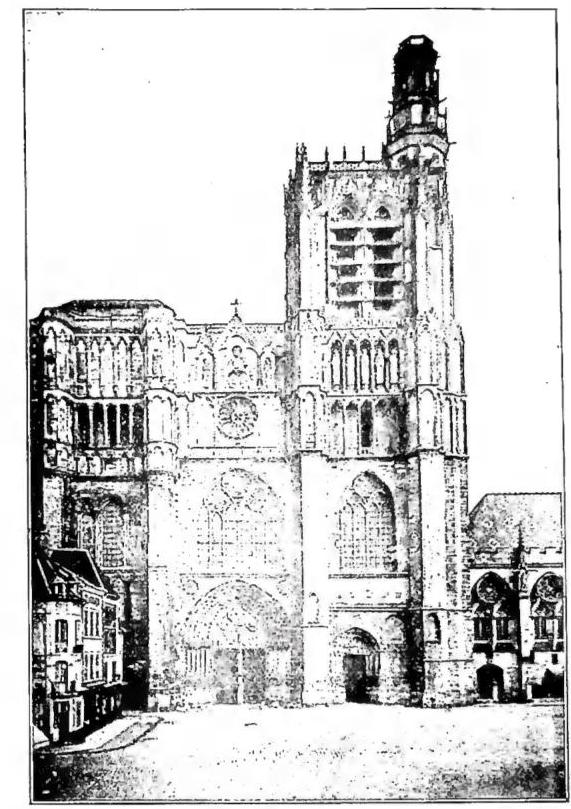
The Archbishop’s Palace was built between 1510 and 1565. In the Synodal Palace or the Official’s Palace of the 13th century, restored by Viollet-le-Duc, one may admire a large tapestry depicting the story of Judith and Holofernes, adorned with the arms of Cardinal Wolsey (1515–20); the mausoleum of Cardinal Archbishop Duprat (1525–35); medieval statues from the Renaissance period; and a series of Roman musical instruments. The Municipal Museum is rich in sculptures, stars, Gallo-Roman inscriptions, collections of paintings and furniture; it also houses the Municipal Library, which contains over 30,000 volumes and 300 manuscripts, including a Missal featuring the feast of the Circumcision with a distinctive prose composition attributed to Peter of Corbeil, Archbishop of Sens from 1191 to 1221. Bound within it is a diptych in ivory depicting the triumph of Diana and Bacchus.
The church of St-Pierre-le-Rond dates to the 13th century; the church of St-Saviniens (12th–13th century) preserves a crypt from the early 12th century. The abbey of St-Colomba was founded by Clotaire II in 620; its church was rebuilt in the 12th century and demolished in 1792. Of the ancient buildings, only the refectory from the 13th century remains, incorporated into the modern structures occupied by the Sisters of the Holy Childhood. Two stone reliquaries were discovered near the altar of the crypt of St-Savinian (J. Perrin, *Les châsses de pierre antiques des martyrs sénonais dans la crypte de St-Saviniens*, in *Bull. de la Société archéol. de S.*, 1927–28, p. 734). A museum piece depicting two stags facing a fountain was published by Martigny (*Mosaïque chrétienne trouvée à S.*, in *Gazette archéologique*, 3 [1877], pp. 189–94). In 1909, at the site of the former abbey church of St-Pierre-le-Vif, a tomb was discovered containing a Merovingian gold fibula (P. Deschamps, *Note sur une fibule d'or trouvée à S.*, in *Bull. archéol. du Comité*, 1913, pp. 17–20, pl. 2 and fig. 1). Since 1844, Sens has had an Archaeological Society.
Auxerre. — The ancient territory of the diocese of Auxerre corresponded to that of the two dioceses of Auxerre and Nevers before the Revolution. Around the end of the 18th century, following political divisions between the Frankish Kingdom and the Kingdom of Burgundy, the territory of the latter was used to establish the diocese of Nevers. Auxerre takes pride in St Germanus, who died at Ravenna in 448. During the Middle Ages, the history of the diocese was repeatedly disrupted by feudal bishops often eager to expand their domains. The region was plundered during the Hundred Years’ War and later by the Wars of Religion. The diocese was reorganized only in the 17th century. Unfortunately, in the following century it was harmed by Jansenism, and the Revolution sought its suppression.
Auxerre had 217 parishes; it was divided into two archdeaconries: Auxerre and Puisaye. The first was further divided into the archpriesthoods of Auxerre and Vergy, the second into those of Puisaye and St-Bris. It had a cathedral chapter composed of 59 canons; the diocese counted nine colleges, including Notre-Dame de la Cité in Auxerre itself. By the end of the 6th century, the church of Auxerre possessed a calendar that was later incorporated into the compilation of the *Martyrologium Hieronymianum*.
Two canons of Auxerre, Rainogala and Alagus, with the help of Henry, a monk of St Germanus, composed at the time of Bishop Wala, around 875, the *Liber episcopalis* of the diocese up to Crastianus, known under the title *Gesta pontificum Antisiadorum* (ed. Duru, in *Bibliothèque historique de l’Yonne*, 1), in the manner of the *Liber pontificalis* of Rome; it was later continued. The 12th-century Library of Auxerre contains biographies first from St Peregrinus up to Abbot Hugh of Pontigny (d. 1151), and then up to Érard of Lézinnes (d. 1278).
The first bishop, St Peregrinus, is listed as a martyr in the *Martyrologium Hieronymianum* on May 16; his *Passio* seems inspired by that of the SS. Andochius and Thyrsus of the diocese of Autun from the first half of the 6th century. His successor, Marcellianus, is also in the *Hieronymianum* on May 12, as is Valerian on May 6, attested in 346; Eladius on May 8, and Amator (d. 418) on May 10, whose life was written at the behest of Bishop Annacarius by the priest Stephen, of African origin (*Acta SS. Maii*, I, p. 53). Next comes St Germanus, who is commemorated in the *Sacramentarium Hieronymianum* on July 31; in 1429 he was sent by Pope Celestine to Brittany to combat the Pelagians. His life was written by Constantius, a priest of Lyon and friend of Sidonius Apollinaris, at the suggestion of Bishop Patient (*BHL*, I, p. 515).
Following are Eladius (in the *Hieronymianum* on September 28), Fraternus (in the *Hieronymianum* on September 29), Censurius (in the *Hieronymianum* on June 10; to him Sidonius Apollinaris wrote around 475: *Ep.*, VI, 10), Ursus (in the *Hieronymianum* on July 29), Theodisius (in the *Hieronymianum* on July 17), who was present at the Council of Orléans in 511, Gregory (in the *Hieronymianum* on December 19), Optatus (in the *Hieronymianum* on August 31 and May 2, where his translation is noted), then Drottoladus, Eleutherius (in the *Hieronymianum* on August 26), who attended the Councils of Orléans in 533, 538, 541, and 549; Romanus (in the *Hieronymianum* on October 6); Etherius (in the *Hieronymianum* on July 27).
Then comes Anacarius, whose ordination is noted in the *Hieronymianum* on July 31; he attended the Councils of Paris in 573, 581, and 585 at Mâcon; Pope Pelagius II wrote to him in 580 and 586 (*Jaffé-Wattenbach*, 1048, 1057); he convened a diocesan synod and died in 605; his biography was composed in the 9th century (*Acta SS. Iulii*, VII, p. 97). His successor, Desiderius, attended the Council of Paris in 614; Palladius attended that of Clichy in 627 and that of Chalon-sur-Saône in 650; Vigilius was assassinated around 684; Scopilius donated precious vessels to the Cathedral (684–92); Terricus (from 692 to around 767, the year of his assassination); then Floccald, Savaric, Aimaro, Quintilian, Cilian, Clement, Aigulf, Maurinus, Aaron, who accompanied Charlemagne to Rome in 800; Angelhelm, Eribert, Abbo, Christian, Wala in 872, who attended the Council of Pontigny in 876; Vivald, Erifrid in 909; then St Geran (909–14); St Betto (933–61); John (997–98); Humbert (1095–1114); Hugh of Montaigu (1116–36), friend of St Bernard; Hugh of Mâcon (1137–51), abbot of Pontigny; Alan (1152–67), author of the life of St Bernard; William of Toucy (1167–81); Hugh of Noyers (1183–1206); William of Seignelay (1207–20), later Archbishop of Paris; Bernard de Sully (1234–44); Guy de Mello (1247–70); Peter de Mornay (1296–1306), who served as Chancellor of France; Peter de Cros (1349–51), created cardinal in 1350; Philip de Lenoncourt (1506–62), later cardinal; Cardinal Philibert Babou de la Bourdaisière (1562–70); J. Amot (1571–93), a learned Hellenist; Charles de Caylus (1704–54); the last bishop (1761) was Mgr. J. B. Campion de Cicé. In 1802 the diocese was incorporated into that of Troyes, and in 1822 into that of Sens. Pope Pius VII, to preserve the memory of the Church of Auxerre, suppressed by the Concordat with a brief of June 3, 1823, decreed that thereafter the Archbishop of Sens should bear the title of Bishop of Auxerre.
The ancient cathedral of St Stephen was built over earlier structures, the earliest of which is attributed to St Amator. The present Gothic building was begun in 1215 by Bishop Guglielmo de Seignelay, continued by Monsignor Enrico De Villeneuve, and completed between 1520 and 1545; although the southern tower on the façade remains unfinished, the northern tower rises to 65 m, albeit damaged during the religious wars. The central portal features the Redeemer between angels, the Virgin and St John the Evangelist, the Last Judgement; on the jambs are the wise and foolish virgins; in the medallions the story of Joseph and the parable of the Prodigal Son. The portal on the right depicts scenes relating to St John the Baptist, the Creation and the Flood; further right, the story of David and Bathsheba and statuettes of the liberal arts; further still, a high relief of Solomon’s Judgement. The interior (98.50 m x 39 m) has three naves with side chapels, which preserve remains of frescoes and an inscription of 1573 commemorating the restoration carried out by Bishop J. Amyot after the devastation wrought by the Huguenots in 1567. The choir and ambulatory are in the pointed style (1215–45), with superb thirteenth-century medallion stained glass containing 353 subjects drawn from Holy Scripture and hagiography (R. Fourrey, Les verrières historiques de la Cathédrale d'Auxerre, Auxerre 1931). The sacristy contains paintings of the stoning of St Stephen (1543).
The basilica of St Germain was built in the first half of the sixth century by Queen Clotilde to receive the body of St Germanus, Bishop of Auxerre; the lower crypts were completed in 859 when, in the presence of Charles the Bald, the relics of St Germanus were deposited there.