
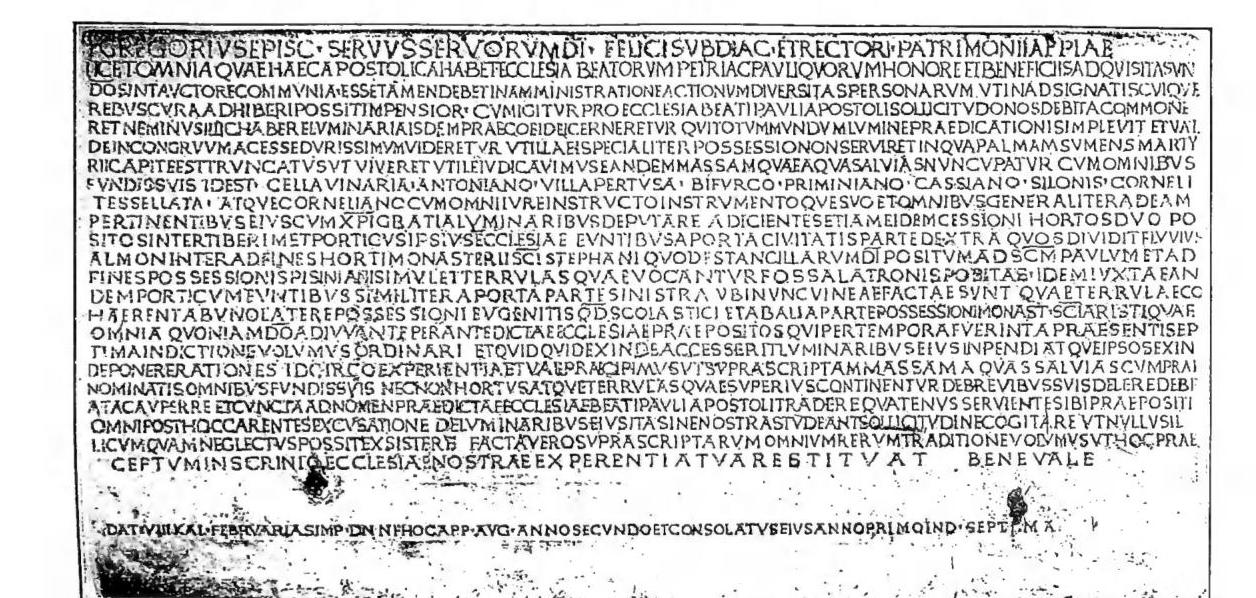
SERVANT OF THE SERVANTS OF GOD — Superscription with the subscription of the *Praeceptum* of St Gregory the Great to the subdeacon Felix, rector of the patrimony of Appia, by which he assigns the estate of Aquae Salviae to the basilica of St Paul (25 January 604) — Rome, lapidary gallery of the monastery of St Paul outside the Walls.
Some scholars compare the Servant of Yahweh with the Teacher of Righteousness of the Dead Sea Scrolls (Dupont-Sommer) or regard him as an allegory like that of the Prodigal Son.
Others interpret the Servant of Yahweh according to the context of the second part of Isaiah; some detach him from it, others give a certain fluidity to the meaning of the Servant of Yahweh. Some distinguish two servants: Israel in 41:29–42:4 and 41:1–4, 9 and 49:1–7, and then the Messiah in 52:13–53:12 (Kissane); or Jehoiachin for the first three songs and Zedekiah as a figure of the Messiah in the fourth (Coppens). For others the Servant of Yahweh is multivalent, that is, he indicates Israel as a servant who develops into the idea of an individual servant par excellence without abandoning the idea of an Israel still in servitude (H. H. Rowley), or he is an ideal personification of the Messiah with the traits of the prophet of Deut 18:15, the teacher and saviour drawn from Isa 9 and 11, from Jeremiah and Ezekiel.
The messianic interpretation remains the most solid. It is supported by Jewish tradition (Septuagint, Targum, Talmud), by the explicit testimony of the sacred writers of the New Testament, and by the Christian tradition unchallenged at least until the time of Grotius (cf. J. Knabenbauer, *Comment. in Is. prophet.*, pp. 347 ff.). For the New Testament writers it is enough to compare Matt 12:18–21 with Isa 42:1–4; Rom 15:21 with Isa 52:15; John 12:38 with Isa 52:1; Matt 8:17 with Isa 53:4; Acts 8:32–35 with Isa 53:7–8; Luke 22:37 with Isa 53:12. In these passages it is clear that what is said of the Servant of Yahweh is fulfilled in Christ (cf. also Luke 2:32, Isa 42:6; Matt 11:5–8, 42:7; Rev 19:13–15–Isa 49:2; Matt 26:67–Isa 50:6). Jesus applies Isa 53:12 to himself (Mark 1:18; 28; Luke 22:37). No one can doubt that the figure and mission of the Servant of Yahweh suit Christ perfectly, indeed suit him so clearly as to make Isaiah the evangelist of the passion. The objections (that the Servant of Yahweh must bring Israel back from exile [49:5]; that therefore he must have lived during the exile; that his passion is projected into the past and his glorification into the future; that the idea of a suffering Messiah is unknown in the Old Testament; that the word “servant” is used repeatedly of Israel) are easily resolved. None of the other hypotheses stands up to rigorous critical scrutiny.