
SERVANT OF THE SERVANTS OF GOD (δουλος τῶν δουλων τοῦ Θεοῦ). — A formula constantly used by the papal chancery in the “superscriptio” or “intitulatio” of documents issued by the Pope from the 9th century to the present day.
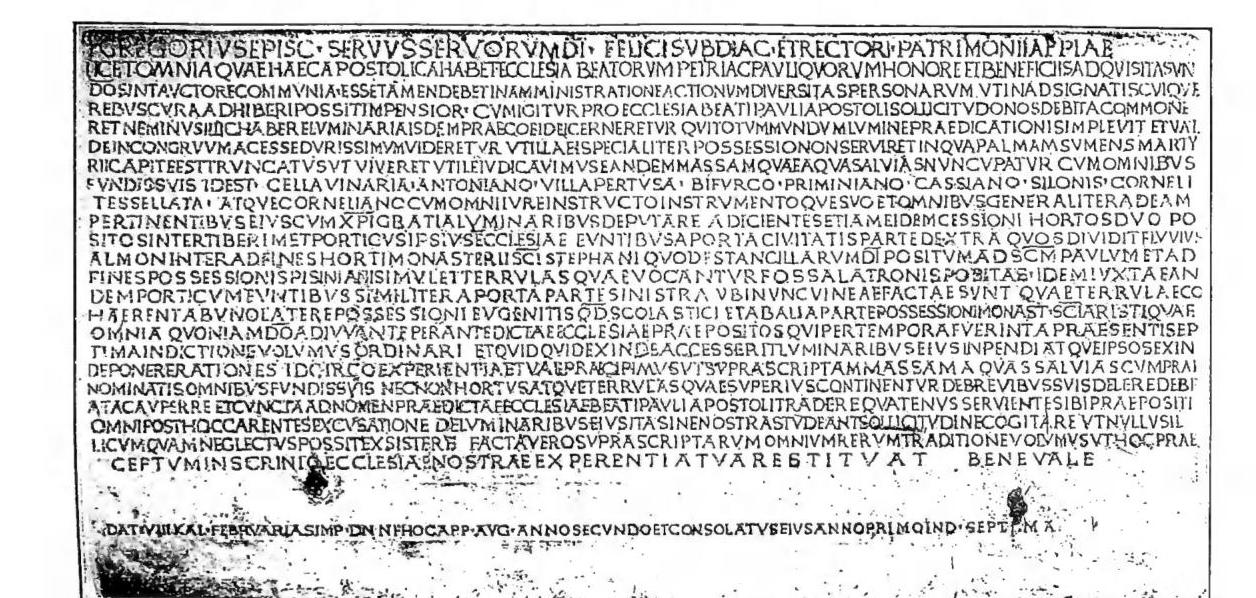
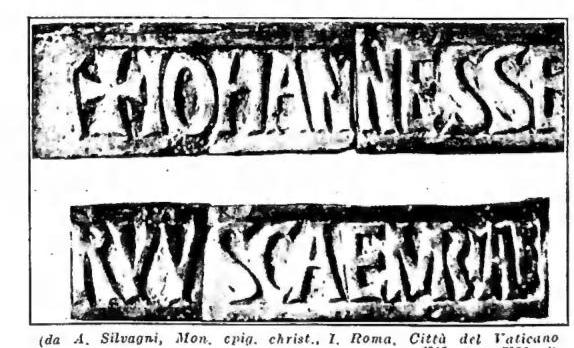
The use of the devotional or humbling formula Servus Dei or Jesu, Jesu Christi, δουλος Θεοῦ ο Χριστοῦ, Ιεσου Χριστοῦ in the “intitulatio” of letters dates back to the Apostles: Paul (Rom. 1, 1; Tit. 1, 1), Peter (II Pt. 1, 1), James (1, 1) and Jude (1, 1) employed it, and their example was later followed by others, such as, to mention only a few, the Christians of Vienne and Lyon, who signed themselves δουλο Χριστοῦ in their letter to the brethren in Asia and Phrygia (Eusebius, Hist. eccl., V, 1, 3); by St. Augustine, who called himself “servus Christi servorumque Christi” (De peccatorum meritis et remissione, III, 1; Ep. 130: PL 44, 185; ibid., 33, 494); by St. Caesarius of Arles, who styled himself “episcopus minimus servorum Dei famulus” (Ep. II to Abbess Caesaria: PL 67, 1128; ed. G. Morin, II, Maredsous 1942, p. 134); by Laurentius of Canterbury and his colleagues Mellitus and Justus, who signed themselves “servi s. D.” (Bede, Hist. eccl., II, 4); by John the Almoner (d. 619), who described himself as δουλος τῶν δουλων τοῦ κυρίου ἡμῶν Ιεσου Χριστοῦ (Vita, 3: ed. H. Gelzer, Freiburg im Br.-Leipzig 1893, p. 9; PG 93, 1619); by Maurus of Cesena in 649, who signed himself “Maurus s. s. D. episcopus” (Mansi, X, 883), etc. Moreover, Damasus, in the inscription in honor of St. Saturninus, subscribed himself “Damasus episcopus servus Dei” (A. Ferrua, Epigrammata Damasiana, Città del Vaticano 1942, p. 189), and Pope Hilarius described himself as “Famulus Christi” in the dedicatory inscription of the oratory of St. John the Evangelist in the Lateran Baptistery (v. ILARIONE). It is not necessary here to list the epigraphic monuments concerning bishops with the title “Servus Dei” or “Christi” (cf. E. Diehl, *Inscriptiones latinae christianae veteres*, I, Berlin 1924, nos. 995, 1797, 1851, 1855) or simple faithful, “famulus” or “servus Dei” or “Christi” (cf. *ibid.*, nos. 1419-58; F. Grossi-Gondi, *Trattato di epigrafia cristiana latina e greca*, Rome 1920, pp. 159-61), “servus sanctorum” (H. Delehaye, *op. cit.* in bibliography, p. 378), as they are too numerous. Pope John VII called himself “Servus Sanctae Mariae” (v. illustration); Gregory II styled himself “Apostolorum principum servus” (cf. illustration in *Enc. Catt.*, VI, cols. 1125 ff.). The expression “ill. ecclesiae servus” had a long duration (cf., for example, the letter of Hugh, archbishop of Lyon, of 1099, in *Monasticon Cisterciense*, ed. H. Séjalon, Solenses 1892, p. 56; letters 340 and 466 of St. Anselm of Aosta: in letter 472 he himself uses “minister”: ed. F. Schmitt, *S. Anselmi Cantuariensis Opera Omnia*, V, Edinburgh 1951, pp. 278, 415, 420).
St. Gregory the Great, who had already called himself s. *D.* while still a deacon in the donation to the monastery of St. Andrew on 28 Dec. 587 (appendix to the *Registrum*, ed. cited below, III, p. 437), was the first Pope to make extensive use of the s. *D.* in the “superscriptions” of his letters and his “praecepta” (cf. Paul the Deacon, *Vita S. Gregori*, II, 1: PL 75, 87: some letters that have preserved the protocol formula in the *Registrum*, I, 14a, 39a; IV, 17a; V, 53a; VI, 56a; XII, 16a: ed. P. Hewald-L. M. Hartmann, in MGH, *Epistolae*, I, pp. 14, 53, 251, 353, 425; II, p. 363; and the “praeceptum” of 25 Jan. 604 for the basilica of St. Paul inscribed on a marble slab). Gregory was then increasingly imitated by his successors in the 7th and 8th centuries, as is evident from the surviving documents (cf. C. Silva Tarouca, *Nuovi studi sulle antiche lettere dei papi*, Rome 1932) and from the list of “superscriptions” placed at the beginning of the *Liber diurnus* and in formula 86 (ed. Th. E. V. Sickel, Vienna 1899, pp. 1-3, 111). As the s. *D.* gradually became the exclusive title of the Pope, it ceased to be used by other ecclesiastical dignitaries; however, the archbishops of Ravenna continued to use it until the early 13th century (cf., for example, the document issued by Archbishop Ubaldo on 12 Oct. 1213, parchment no. 4694 of the Archiepiscopal Archive) together with the pompous title: “Dominus sanctus ac meritis beatissimus atque Apostolicus Pater Patrum” (same Archive, parchments from the 10th-12th centuries).
It is not unlikely that the controversy over the title “ecumenical bishop or patriarch,” which became very heated during the pontificates of Pelagius II and St. Gregory the Great against the patriarchs of Constantinople, who had borne this title at least since the time of Acacius (485-519), influenced St. Gregory’s choice of the s. *D.* In the controversy with John the Faster, St. Gregory, though conscious of his authority, carried his humility so far as to refuse for himself the title of “universal pope” (*Registrum*, VIII, 28, ed. cit., II, p. 30).
SESAC (Hebr. *Sisag*, LXX *Sovazzij*). “Prince of Egypt (Shoshenq I), founder of the 22nd Dynasty (934-913 B.C.), who transferred its capital to Bubastis in the Delta instead of Tanis.
He appointed a nephew as high priest at Thebes and there built, in front of the hypostyle hall of the temple of Amun at Karnak, a great colonnaded court with a broad frieze adorned with bas-reliefs and an inscription in which he records his military exploits and enumerates, among other things, 100 cities of the Kingdom of Judah and 50 of the Kingdom of Israel that he had conquered. There is here a reference to his campaign against Rehoboam, king of Judah, in the fifth year of that monarch’s reign, recorded in *1 Kings* 14:25-26 and *2 Chron.* 12:2-9.
Having Solomon persecuted Jeroboam, the latter took refuge with Shishak and remained there until Solomon’s death (*1 Kings 11:40*), so that it was conjectured that Jeroboam himself had incited Shishak to invade Palestine. But the Pharaoh, after invading the Kingdom of Judah, also plundered a considerable part of the Kingdom of Israel, over which Jeroboam himself had meanwhile ascended as the first dissident king. Nothing prevents us from believing that Shishak, intending to exact reprisals against those who had been friends of the preceding XXI Dynasty (Solomon was related to the king of the XXI Dynasty overthrown by Shishak), had encouraged the disturbances that arose at Solomon’s death, which led to the division of Palestine into two hostile kingdoms, and then sought, in order to enhance his prestige and secure rich booty, to attack Rehoboam, Solomon’s successor. Shishak’s raid into Palestine, accompanied—as *2 Chron. 12:3* states—by 1,200 chariots and 60,000 horsemen, besides a multitude of Libyans, *Sukkijjim* (Vulg. “Troglodytae”), and Ethiopians, led him to the sack of Jerusalem, from which he carried off the treasures of the Temple and the royal palace, and in particular the golden shields made by Solomon for the House of the Forest of Lebanon.