
SECTS AND ECCLESIASTICAL LEGISLATION. — The name derives directly from classical Latin secta, etymologically from sequor, and originally had the sense of a separation, of a segregation in order to adhere to a set of particular principles and maxims, whether in the political sphere (party, faction) or in the philosophical sphere (school, sect). Classical authors never give the word a derogatory sense. The Vulgate uses it to indicate a religious tendency; only somewhat later do the Epistle to the Galatians (5:10) and the Second Epistle of s. Peter (4:1) attach to it a pejorative meaning, and it was precisely in this sense that it came to be used in ordinary ecclesiastical language. The fundamental characteristic of a sect is that it stands in opposition to the universality of the Catholic Church and constitutes a separate religious group, generally claiming moral superiority. The term has a broader and more general meaning than heresy and schism, since it may involve either, insofar as it denies some truth of the Church of Christ or asserts others opposed to it, and insofar as it opposes the unity of the Church.
For approximately two centuries, and definitively with the CIC, the term passed from the theological sphere into the juridical sphere, though in a derivative sense. Therefore today, in canonical language, the name sect refers to those s. that operate against the Church or the civil power. Thus, for a sect to exist for moral and juridical purposes, the following are required: 1) that there be a genuine sect, regardless of its designation, and regardless of whether or not there is secrecy or an oath to maintain it; 2) that, either by its constitution or in fact, in the application of its means (even when pursuing a philanthropic aim), there be a plot against the Church or the legitimate civil power. A plot exists when the activity is truly data opera rebellious or subversive against: a) the Church; that is, against the doctrine, authority, powers, constitution, rights, or privileges of the Church; or against ecclesiastical persons as such; b) the legitimate civil power (if the power were not legitimate, it would lack the right to command, and subjects would have no obligation to obey). Thus, when a s. has as its purpose, at least in fact, to undermine the principle of social authority in itself, even solely through cultural activity, it is directed against the civil power. When the attempt to alter the institutional form is made legitimately, with the exclusion of violence and conspiracy against the established power, there is no genuine plot.
Freemasonry (v.) and similar sects, Carboneria (v.), the sects of the Fenians, an American and Irish sect (decree of the S. Ufficio of 12 Jan. 1870); the three American workers’ sects: 1) Odd fellows; 2) Sons of temperance; 3) Knights of Pyrrhis (decree of the S. Ufficio of 20 Aug. 1894); the society Independent order of good templars or Guttempler-Orden (decree of the S. Ufficio of 19 Aug. 1893); associations whose purpose is to cremate corpses (decree of the S. Ufficio of 19 May 1886); the Theosophical societies; the sects Y.M.C.A. = Young men Christian Association for men and Y.W.C.A. = Young women Christian Association for women (decree of the S. Ufficio of 5 Nov. 1920: AAS, 12 [1920], p. 595); atheistic sects (encyclical Divini Redemptoris, AAS, 29 [1937], pp. 76 ff.). Nihilistic, anarchist, and pan-Christian societies are condemned by their very nature. A sect that has given rise to much discussion is the one that developed from 1865 onward in the Northern United States and still exists, Ku-Klux-Klan (v.). The Church has now expressly condemned communism ([v.], 28–30 July 1949) and those factions of socialism that promote communism itself.
For the Rotary Club, V. the relevant entry. For heretics and schismatics, V. BRESIA; SCISMA.
SOCIETÀ PROIBITE - SOCIETÀ SALESIANA DI SAN GIOV. BOSCO
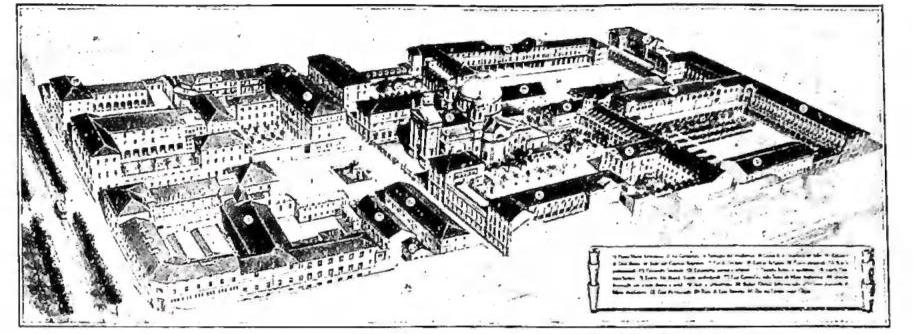
SOCIETÀ SALESIANA DI SAN GIOVANNI BOSCO - Aerial view of the building complex of the Casa Generalisia before 1938. The surrounding buildings have been lowered in height - Turin.
Against sects, can. 2335 decrees: whoever joins Freemasonry or another sect that plots against the Church or against the civil authority incurs ipso facto excommunication reserved simpliciter to the Apostolic See.
Ancient law also imposed the censure on those who aided them and on those who failed to denounce the leaders. The CIC no longer mentions these cases, which therefore must not be considered subject to censures. Whoever in good faith has joined a sect subject to censure does not incur excommunication until he becomes aware of it and does not intend to withdraw; if, however, he could not do so without serious inconvenience, he is excused from excommunication, provided that he intends to do so as soon as he can.
Membership in an acatholic sect (by this name are understood all heretical or schismatic churches or little churches, as well as atheistic sects and militant atheist communists) constitutes, with regard to Marriage, an impediment mixtae religionis (cf. can. 1060 ff., CIC, Comm. Interpr. Codic., 30 June 1934: AAS, 26 [1934], pp. 494 ff. and V. MISTA RELIGIONE).
Members of heretical, schismatic, Masonic sects or of prohibited societies of the same kind are excluded from ecclesiastical burial (can. 1240 § 1, n. 1); they may not be admitted to the novitiate (can. 542, n. 1) or to pious associations (can. 693 § 1); they lose the right to the transmission in their own favor of the right of personal patronage (can. 1453 § 1), and in the case of real patronage this remains suspended (can. 1453 § 3); they are ipso facto infamous (can. 2314 § 1, n. 3) and excommunicated with excommunication specially reserved, if it is an acatholic sect (can. 2314 §§ 1 and 2), and simpliciter reserved, if it is a Masonic or similar sect (can. 2335). Clerics, moreover, by joining an acatholic sect, lose their office ipso facto (cann. 188, n. 4 and 2314 § 1 n. 3) and, after admonition, must be degraded; if they join Masonic or similar sects, they must be denounced to the S. Office and must also be suspended and deprived of benefices, offices, dignities, pensions, or positions held by them in the Church; if they are religious, they must be deprived of active and passive voice and subjected to other constitutional penalties (can. 2336).