
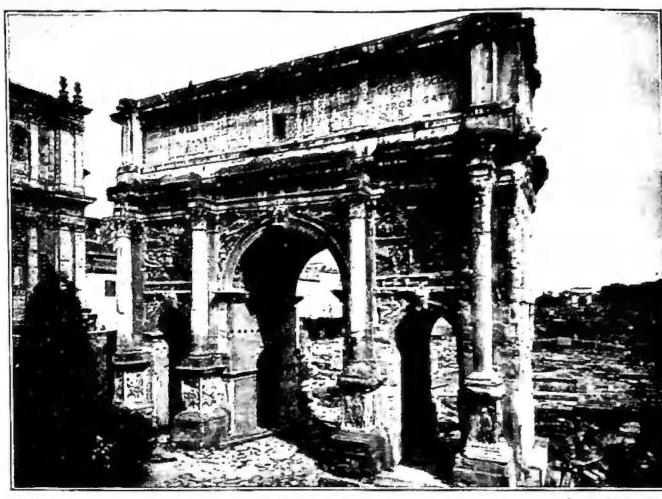
Descended from an equestrian family, he went to Rome and, under the protection of Marcus Aurelius, began his political career; he was quaestor (170), tribune of the plebs (176), and praetor in Spain (178). Under Commodus he fell into temporary disfavour but later regained credit and served as governor in Gaul (187), Sicily (189), and Upper Pannonia (192). There, upon the death of Pertinax (March 193), he was acclaimed emperor by his soldiers, while those in Gaul acclaimed their commander Clodius Albinus, those in the East Pescennius Niger, and the Praetorians in Rome elected Didius Julianus. Severus promptly came to Italy; he allied himself with Albinus while Julianus was killed, and the Senate recognized him as emperor. He then marched against Pescennius and defeated him near Issus (194). Returning to Italy, he fought against his colleague Albinus and defeated him at Lugdunum (197), remaining sole emperor. He then instituted an anti-senatorial policy, aligning himself with that of Commodus, to whom he decreed apotheosis. After a new campaign in the East that ended badly, he returned to Italy and set about organizing and pacifying the Empire, which was beset by deep social, moral, and military crises. He quelled the revolt of Bullo Felix, replenished the state treasury by increasing tax collections, and in every way favoured the military to remove any pretext for revolt. He attended to the organization of the provinces, especially Africa, and devoted himself to the codification of law; he gave new impetus to the imperial cult.
With regard to Christianity, Severus initially showed himself tolerant, even favourable. Tertullian reports that he had a Christian physician in his palace, entrusted his son Bassianus to a Christian nurse, and energetically opposed popular fury that raged against Christians (*Ad Scapulam*, 4). Yet even in the early years of his reign there were victims, due to popular uprisings or the hostile disposition of some provincial magistrate, as in Africa (*Tertull.*, *Apolog.*, 12, 30, 37), Alexandria (*Clement*, *Stromata*, II, 125), and Cappadocia (*Ad Scapulam*, 3). But Severus’s good disposition toward Christians did not last long. After the Parthian War, in 202, while travelling in the East and moving from Palestine toward Alexandria, he suddenly issued a decree by which he forbade circumcision under severe penalty and likewise legislated against Christians (*Script. Hist. Aug.*, *Vita S.*, 17). The motive for this decree is not entirely clear. It seems that Severus was alarmed and concerned by the great spread of Christianity, seeing in it a danger to the stability of the Empire, and therefore forbade conversions, punishing both those who converted and those who made proselytes. Under this Edict the famous school of Alexandria was dispersed and many students suffered martyrdom (*Eusebius*, *Hist. Eccl.*, VI, 4); the father of Origen was one of the victims (*ibid.*, VI, 1). At Carthage the group of Perpetua, Felicity, and companions was condemned (v.). For other provinces of the Empire there are no certain reports, but it is not to be doubted that there were other victims.