
Holy Week
Adoration of the Cross during the liturgical action of Good Friday. The celebrant and ministers here wear the canonical vestments of the basilica of St. Peter.
The Preface is recited, the oil of the catechumens is consecrated with a simple prayer, following an exorcism. On this Mass of Holy Thursday another Host is consecrated (in some regions of Germany even a third for the “holy sepulchre”) for the “Mass of the Presanctified” on Good Friday. This consecrated Host is carried after Mass with a more elaborate ceremonial, beginning in the 11th century, to a small chapel prepared for the purpose; this chapel becomes the representation of Christ’s sepulchre, especially from Good Friday until the dawn of Easter.
After the recitation of Vespers (composed in the 11th century), the recitation of Psalm 21 follows, then the stripping of the altars, a very ancient ceremony, since it is a remnant of the primitive custom of removing the altar cloth every day. In the Middle Ages, the washing of the altar was added, which is mentioned in the Ordines Romani and in monastic usage. The last function of Holy Thursday is the Washing of the Feet of the Lord, performed during the first nocturn (Jn 13:34): an act of charity in imitation of Christ (Jn 13:1–15), common in the Church (St. Augustine, Ep. 55, 18–33); made obligatory for all bishops and priests toward their dependents by the Council of Toledo in 694. The washing is mentioned in the Ordines Romani X, 12, and XII, 25, 27. Today, after the reading of the Gospel (Jn 13:1–15), the feet of twelve poor men are washed, while certain antiphons relating to the Gospel event are sung, especially the hymn *Ubi caritas*... (of Veronese origin from the 9th century, with a very simple but ancient and precious melody).
A peculiarity of these three days is the silence of the bells after the *Gloria* of Holy Thursday until the *Gloria* of the Easter Vigil, already noted by Amalarius. In place of bells and handbells, signals for the sacred functions are given with a *tabula*, *crepita cumulum* or *crotalum*, of wooden construction, derived from monastic usage since the time of Cassian (De instit. caenob., I, 2, 17; IV, 12), and in the Middle Ages by the Cluniacs (cf. *crepita colo*; *crotalol*).
Good Friday
(According to St. Augustine and St. Leo) Good Friday was still the first day of the sacred Paschal Triduum (St. Augustine, Ep. 55, 14: “sacratissimum triduum crucifixi, sepulti, suscitati”); it is called “Parasceve,” that is, “preparation,” from the Greek (παρασκευή). It was a day of fasting in the West and East; in Spain, in the 7th century, churches were kept closed. Another custom of this day was the recitation of the entire Psalter, as was done by Honorius III (1216–27) “at first light together with his chaplains, the whole Psalter from beginning to end”; in the same century, the monks of Monte Cassino did so barefoot. At Rome, the functions are held in the basilica of Santa Croce in Gerusalemme; formerly (as in the “Gelasian”), at the 9th hour of the day or toward evening.
### Ecological Service
This first part of the present rites is a fine example of the ancient “alturgy.” As in the time when the Introit was not yet sung, the ministers prostrate themselves on the floor in silent prayer; meanwhile the altar is prepared. Then the readings begin immediately: the first from Hosea (Hos 1–6, of Gallican origin), with a responsorial psalm from Habakkuk (Hab 3:1–3); the verse “in medio duorum animalium” is referred to Christ crucified between two thieves; the second from Exodus (Ex 12:1–11) alludes to the symbol and figure of Christ’s sacrifice in the Paschal lamb of the Jews. The third reading follows: in the church of St. Augustine, the Passion according to Matthew was read; that according to St. John is attested from the time of St. Gregory the Great. As usual, the alturgy concludes with the Solemn Prayers for all the people and for each class of them; a common usage in the Holy Mass until the 6th century (in the 8th century still on Holy Wednesday, cf. above). In the Prayer for the Jews, the usual genuflection after the invitation “Oremus” is omitted after the 9th century for symbolic reasons (cf. Ord. Rom. XII, 29). This was followed by the sermon of the officiating bishop (four homilies delivered on Good Friday by St. Augustine are preserved).
### Adoration of the Holy Cross
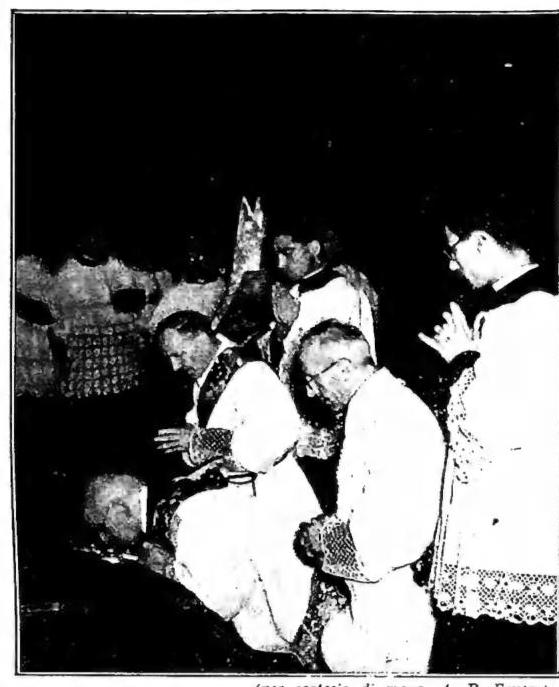
This rite comes from Jerusalem, where, according to Etheria, it was performed before the relic of the True Cross, and was a simple rite without precise liturgical character: the bishop held the relic, kissing the *cappiandola* on the forehead and eyes; there was no singing, no prayer; everything took place in silence. This rite was introduced into Rome (the Ordines Romani XVI, 33–34 do not have it) perhaps in the first half of the 7th century. According to the description in the Ordo of Einsiedeln (Ord. Rom. XXIII, 9–22), the pope went from the Lateran to Santa Croce in Gerusalemme; behind him the Holy Cross was carried (A. Baumstark, *Liturgie comparée*, cited in bibliography, p. 153) by a deacon in a casket and placed on the altar; the pope uncovered the Holy Cross, prostrated himself to adore it, followed by the faithful; but to prevent women from approaching the altar, the sacred relic was carried to them. After the veneration, the readings of the ecological service continued, and the functions of the Presanctified were added; the pope himself and his deacons did not receive Communion.
In other churches there was a double rite: in the morning the ecological service, in the evening the veneration of the Holy Cross together with the rite of the Presanctified (Ord. Rom. XXIII, 29–38 [Andrieu]): the Cross was placed before the altar, carried by two acolytes; then it was venerated by the pope and the people; meanwhile the antiphon *Ecce lignum* was sung, with Psalm 118; this was followed by the Mass of the Presanctified (cf. Ord. Rom. XXVII, 41–50). The present rite of the Adoration of the Cross took shape between the 9th and 11th centuries in Spain and Gaul: the uncovering and display of the Cross, the triple prostration, the Improperia, the Byzantine Trisagion (in Greek and Latin), the antiphon (of Greek origin) of triumph *Crucem tuam*, the two hymns of Venantius Fortunatus, *Pange lingua* and *Vexilla Regis*; all are found in the Roman Pontifical of the 12th century (M. Andrieu, *Le Pontifical romain au moyen âge*, I, Vatican City 1934, p. 236, nn. 8, 9).
### The Mass of the Presanctified
This is a simple rite of Communion, using the Sacred Species “presanctified,” i.e., previously consecrated, used on fast days, as the Greeks did in Lent, on Saturday and Sunday; at Rome only on Good Friday. It seems that at first the Roman Church (like the Ambrosian rite still today) did not officially have the use of the Presanctified, which entered the papal liturgy between the 7th and 8th centuries (Duchesne). The primitive rite contained only the Lord’s Prayer with the embolism, followed by the fraction and the commingling recited aloud; then offertory prayers, the incensation of the offerings and the altar, the washing of hands (Ord. Rom. XIV, 83), the elevation of the Host (Ord. Rom. XV, 77) at the words “as it is in heaven and on earth” (today after the embolism); a French usage of the 14th century, perhaps introduced at Avignon.
4. Deposition (Burial) of the Cross and the Host
A rite intended to commemorate in a more expressive manner the burial of the Lord, dating from the 10th century (cf. the biography of St. Ulrich of Augsburg [d. 973]), in use in almost all Churches except that of Rome; it continues in Germany and Austria.
The Cross or a consecrated Host or both together are carried to a kind of sepulchre, there incensed and sprinkled with holy water, and finally the sepulchre is closed and sealed, to be venerated by the piety of the faithful. At the dawn of Easter Sunday they are solemnly brought forth to represent the Resurrection.
BIBL.:
A. Baumstark, *Liturgie comparée*, Paris 1939.
M. Andrieu, *Le Pontifical romain au moyen âge*, I, Città del Vaticano 1934.
L. Duchesne, *Origines du culte chrétien*, Paris 1920.
**Holy Saturday.** — In the first six centuries, both in the East and in the West, Holy Saturday was a day entirely without liturgy. The functions that took place, for more than a millennium, on Holy Saturday were originally celebrated on the following night. At the time of St. Ambrose (397) in Milan and St. Augustine (430) in Hippo, the Easter Vigil was celebrated throughout the entire night; St. Jerome, however (419–20), refers to a function that occupied only the first part of the Holy Night (*ante noctis dimidium dimittere non liceat*). The vigil of the first part of the Holy Night became the norm under Leo I (d. 461) in Rome, under Lupus of Troyes (d. 479) in Gaul, and at the same time in the *Testamentum Domini* for Syria. By John the Deacon in 523–26, the end of the solemnity seems already to have been celebrated on the evening of Holy Saturday; the same is evident from a less edifying account by St. Gregory (d. 604) in Spain (*sacratissimo paschali Sabato post ieiunium*), and moreover a second Mass on Holy Night was said at first light on Easter Day. The most ancient Gelasian (Bibl. Vat., Reg. 316) in a rubric after the *Orationes per singulas lectiones in Sabato Sancto* determines the hour of the Mass *in nocte*: *et ingrediuntur ad missas in vigilia ut stella in caelo apparuerit* and contains a second Mass on *Dominicum Paschae*. Even the Sacramentaries of the Gregorian type have a Mass on *Sabato Sancto in nocte* and another on *Dominico sancto*; the following Sunday is considered outside the octave *diei dominicae post albas* (scil. *depositas*; V. Pasqua, 11, 3).
**
FOLKLORE. — The folkloric cycle of Holy Saturday extends from Palm Sunday (v.) to the Monday in Albis. Rather than describing the rites of Holy Saturday day by day, it is more useful to classify the various folkloric elements, especially since these are concentrated particularly on Holy Thursday, Good Friday, Holy Saturday, and Easter Sunday. The cycle thus presents liturgical ceremonies to which the people have given their own colors and forms without altering the character; ritual propitiatory ceremonies that recur at every annual or seasonal beginning, and in particular for Easter mark the beginning of spring, so much so that the period is also called “the beginning of spring or of Easter”; and finally various beliefs and superstitious practices, the individual meaning of which escapes us, but which in their entirety refer back to the sacred and exceptional value of those days.
The first group includes dramatic processions, sacred representations, and other living relics of medieval and Renaissance religious drama, as well as certain ecclesiastical prescriptions in which the folkloric element has been added to the liturgical one. A place of primary importance has been recognized for the procession in all survivals of sacred drama, it being observed that “the rhythmic procession of masses of men, especially when the rhythm is enhanced and marked by divisions into companies or groups dressed in special uniforms, as well as by songs and sounds, creates an atmosphere of connection, cohesion, and understanding among the masses and prepares their spirits to fully grasp what will constitute the climax of the event or rite” (Toschi). The Easter processions are characterized by scenes of the Passion, called “mysteries,” reconstructed by means of wooden statues or papier-mâché and sometimes by groups of living people: preeminent for their splendor are the procession of Seville in Spain, with groups (*pasos*) formed partly by statues and partly by living people, and with the colors of the garments always the same—blue and white for the Virgin, green for St. John, and yellow for Judas; in Italy, that of Trapani, where the 18 mysteries carved in wood, life-sized, are carried on the shoulders by representatives of different guilds (cooks, waiters, carpenters, etc.) and visit all the churches, entering through the central door and exiting through the side door; that of Caltanissetta, where the mysteries are 15 groups modeled in papier-mâché that the people call *le vare* and designate according to the class to which they belong—“vara delle li sulfatara,” sulfur miners; “dilivuceri,” butchers; “dili vinarioli,” wine merchants, etc.; and also those of Sezze in Lazio, Grassina in Tuscany, Romagnano in Piedmont, and Verona in Val Seriana. In Bari, the Easter procession takes on a penitential character: the confrères are called *perdune* and proceed two by two, barefoot, dressed in a wide white tunic, their faces covered, a crown of thorns on their heads and a long staff in hand; the *tròcola* (elsewhere called a rattle, clapper, etc.), a wooden instrument with small metal plates that makes a noise and replaces the sound of bells, is put up for auction the day before, and to obtain it (one may end up paying several thousand lire) is considered a penance performed by those who have sinned; the *troccolaro* leads the procession, regulating its route, stops, and pace, which is more or less slow according to the sin to be expiated. In some towns of the Mezzogiorno, especially in Sicily, the singing of the lament, in Italian dialect mixed sometimes with Latin, accompanies the rhythmic procession of the crowd. Among the sacred representations of the Passion of Christ, the most famous is that which is repeated every year Oberammergau (v.). The preparation of the *sepolcri* (Easter tombs), customary in parishes of the Roman rite, shows the folkloric element in the variety of decoration, which is related to the local tradition: laden with statues, paintings, and scenes evoking the Passion are, for example, those in Spain; in some regions of France, such as Roussillon and Cerdagne, due to the richness of their ornaments, they are called *monuments*; in Italy, those in Sicily are notable, for example, in the church of S. Anna dei Lombardi at Monteoliveto; in Naples in the church of the Girolamini with very ancient gold-embroidered fabrics, and in the church of S. Francesco di Paola with a 14th-century gilt bronze urn. A complete folklorization has been achieved in Nantes, where the *sepolcri* are set up along the streets.
Among the propitiatory rites classified in the second group, particular attention should be given to the custom of songs and that of eggs. The egg has a symbolic value of fertilization, also in relation to the spring season; however, historically the practice of giving eggs does not date back in Europe earlier than the 16th century (the oldest document is Alessian); in the 18th century it was customary in the Kingdom of France that the largest egg laid during Holy Week belonged to the king. In Paris, students and altar boys used to go begging for eggs to the sound of bells and drums. The shepherds of the Jura go around at Easter from house to house leading a young girl adorned with flowers and ribbons, called the queen of May: with the same ceremonial the Calendimaggio is celebrated in Provence and elsewhere. On Holy Saturday, the mountain-dwellers of upper Val Brembana offer eggs, wrapped in embroidered handkerchiefs, to their sweethearts, who bring in return an olive branch tied to some object; the arboreal spirit present in these rites is a symbol of spring. And the very outings on Easter Monday, so traditional over a vast area, have always had the appearance and significance of spring rites. The coloring of eggs is folkloric, both in technique (in Anjou, for example, cardinal red is obtained with onion skins cooked with vinegar) and in interpretation (red is considered almost everywhere effective against any evil influence). With eggs, various games are also played, the most specifically Easter-related and widespread in Europe being two: one consists in making two eggs butt against each other; the player whose egg does not break is the winner and takes possession of the opponent’s egg (called coccotta in the Marches, scozza in Romagna, toquette in France, Eierspecken and Eierpicken in Germany, croquer in French-speaking Switzerland, Tupfen and Tütschen in Swiss German); the other consists in rolling the egg down the slope of a meadow, the winner being the one who manages to send it the farthest; this game, called cutdello in the Marches, which is widespread in France (roulée), Scotland, Germany (Eierrollen and Eierschieben), and throughout Eastern Europe, some scholars have sought to give a ritualistic explanation. It is certain that both games have a propitiatory character for the opening of a new cycle: the roulée, for example, was played at Nansous-Thil at Christmas with nuts, in Burgundy on Shrove days, and the winner was proclaimed queen of Jaudiau. Other transfers to Easter of carnival rites are documented by Fehle in Germany, where the winner of certain horse races was called king; similarly, a final trace of the “king of carnival” can be recognized in the Romagnol custom described by Placucci: on Holy Saturday “a man is found, the clumsiest and least clever in the village; a box full of stones is placed on him, and he is ordered to carry it to the parish, being told that they are the keys to the alleluia”; from the church he is paraded about until he realizes it is a joke. Also propitiatory is the Romagnol custom, recorded on Holy Saturday, of observing, an hour before the Angelus, “to see the champions, who are twenty dominators for the coming year, so as to predict good and evil that may happen in that year to the products of the countryside”: it is a rite typical of every annual or seasonal beginning.
Finally, there are countless beliefs and superstitious practices not strictly tied to the Easter cycle as such but referring to it only insofar as it is an exceptional period. Common to the feast of St. John is the custom of bathing at dawn in the dew, considered blessed. In general, the water of Easter night preserves from evils and makes women beautiful: in Sicily, people and sick animals immerse themselves in the sea; in Romagna, at the moment when the bells are untied, farmers customarily wet their eyes to preserve their sight; in Saxony and Silesia, young men hidden near riverbanks and fountains sprinkle water on girls who come to draw II. Comparative forms are the so-called rites of fraternization performed in Ukraine with embraces and among the South Slavs with the mixing of blood, on the day after Easter or on another solemn or fair day, called druzicola, the day of friendship. In connection with the silence of the bells, many other customs exist: the Romagnols, for example, at the tying of the bells on Holy Thursday, tie up trees to make them fruitful, others tie them on Holy Saturday so that fog will not damage them; in many towns of Abruzzo and Romagna, from the tying of the bells to their untying, fasting is observed (trapassata). Among the various taboos of Holy Week, the most universally widespread is the suspension of all work as in the course of any feast: in some regions of Italy and France, in particular, women must not do laundry, especially on Good Friday, which is a day of mourning.
to carry out the task of propaganda and cultural work.
Unlike the French Semaines, however, the Italian ones (first called Congressi di studi sociali) had the character of reports on various topics, oriented toward a central idea: they were followed by free discussions, often very lively, after which the speaker would summarize, reply, and conclude. The final result was solemn declarations (orders of the day, votes, motions, etc.), in which the prevailing opinions among the weekly meetings on the various topics discussed were condensed and ordered. Subsequently, the s. s. came to resemble the French model after the reform of Catholic Action, desired by Pius XI.
Begun in Italy in 1907, eighteen were held up to 1935: the first ten were organized by the Unione Popolare, and the others by the Giunta centrale of Catholic Action. It was the golden age of social Catholicism, in which the minds and hearts of masters such as Giuseppe Toniolo, Vico Necchi, Filippo Crispolti, Angelo Mauri, Nicolò Rezzara, Giuseppe Dalla Torre, Mario Chiri, Mons. Pottier, Mons. F. Olgiati, Fr. Gemelli, Fr. Cordovani, Fr. Brucculeri, Fr. Oddone, and many others shone brightly. The 1st s. s. in Italy, held in Pistoia (1907), was presided over by Cardinal Maffi and dealt with various topics: cooperation, labor leagues, professional organization, emigration, social legislation, etc.; the 2nd followed in Brescia (1908) and, presided over by Giorgio Montini and Rezzara, addressed the historical origins of agricultural contracts, workers’ housing, the social action of the clergy, freedom of teaching and technical problems of schooling, the Catholic woman and her duties; the 3rd took place in Palermo (1909), presided over by Antonio Boggiano, on Sicilian problems, occupational diseases, religion among the people, State and Church, Society and State; the 4th (1910) in Florence, presided over by Gennaro De Simone, also with various topics, from sharecropping contracts to homework for women, and from the problem of morality in Italy to school mutual aid and popular press.
A greater thematic unity then began to emerge starting with the 5th, presided over by Luigi Caisotti di Chiusano (Naples 1911): The Family and the Labor Question; followed by the 6th in Assisi, presided over by Boggiano, on Professional Organization; the 7th in Venice, presided over by Filippo Sassoli, on The School Problem; the 8th in Milan, presided over by Paolo Pericoli, in 1913, on The Civil Liberties of Catholics, in celebration of the XIVth centenary of Constantine. The 9th and 10th passed almost unnoticed because of the First World War.
After a period of suspension, the *Settimane Sociali* were resumed, under the presidency of Minoretti, at the 11th Turin in 1924, on the theme *Social Authority*. These were followed by: the 12th in Naples (1925) on *Social, Economic, and Educational Problems*; the 13th in Genoa (1926), pres. Minoretti, on *The Christian Family*; the 14th in Florence (1927), pres. G. Dalla Torre, on *Education*; the 15th in Milan, pres. G. Dalla Torre (1928) on *The Unity of the Church*; the 16th in Rome (1929), pres. G. Dalla Torre, to illustrate *The Work of Pius X*; the 17th *Settimana Sociale*, resumed in Rome, pres. Adriano Bernareggi, in 1933, on the topic *Charity*; then the 18th in Padua (1934) with the theme: *The Profession*; but the one called for 1935 on *The Ethical Value of Work* had to be suspended once again due to the Ethiopian War. After a decade-long interruption, caused by political factors and then by the Second World War, the *Settimane* resumed with the 19th in Florence, in 1945, pres. A. Bernareggi, on the theme *Constitution and the Constituent Assembly* (1945); the 20th in Venice, under the presidency of the same A. Bernareggi, on the theme *Work* (1946); the 21st in Naples, pres. Antonio Lanza, on the theme *Problems of Rural Life* (1947); the 22nd in Milan, pres. A. Bernareggi, on the theme: *The International Community* (1948); the 23rd in Bologna, pres. A. Bernareggi, on the theme *Social Security* (1949); the 24th in Genoa, on the theme *Professional Organization* (1951).
pres. A. Siri; the 25th in Turin, pres. mons. Giuseppe Siri, on the theme: *The Enterprise in Contemporary Economy* (1952).
There have been countless abridged editions of the *Settimane Sociali*: provincial, regional, or even diocesan (the prevailing type being the so-called “three-day” event), which bring together with notable success scholars, leaders, and activists of Catholic Action, very young people, and even those indifferent. From this long experience there has emerged a fairly unified and continuously updated Catholic social culture, which, although still affected by a certain doctrinalism—albeit conscious and accepted—is deeply permeating the active strata and the inert base of Christian society. The results can only improve when the *Settimane Sociali* succeed in setting themselves goals and adopting attitudes of more evident concreteness, forging original paths, and inviting to teach—not only the leading figures in the organized, academic, political, and union life of Catholics—but also experts in economic, entrepreneurial, and labor realities. Full and fruitful success can only follow, as always, from the happy integration of academic culture with applied science and practical experience.
The declared current aim of the *Settimane Sociali* is not to exert direct influence on institutions, but on the interiority of minds, to outline objectives, arouse or consolidate convictions, and give rise to intentions regarding the most pressing and far-reaching social problems. At present, the *Settimane Sociali* in Italy are organized by a special standing committee in Rome, presided over by Cardinal Giuseppe Siri, Archbishop of Genoa, with Monsignor Pietro Pavan as secretary.
### III. THE *SETTIMANE SOCIALI* ABROAD
Abroad, the initiative has developed and continues to thrive with great success and resonance in the cultural world, especially in Belgium and Canada, where, however, the *Settimane Sociali* do not follow initiatives, rules, or precise schedules as in France and Italy.