
SIGISMUND of Luxembourg, Emperor. Second son of Charles IV of Luxembourg, King of Bohemia and Emperor, and of Mary of Valois, daughter of Philip VI, King of France, was born in Prague on 15 February 1361. His father secured for him the crown of Hungary, but Sigismund encountered strong opposition from Charles of Durazzo and was not crowned until 1387, after Charles’ assassination. During his reign, Hungary was repeatedly threatened by the Turks: in 1396, Sigismund was defeated by Sultan Murad at Nicopolis. He also fought repeatedly and unsuccessfully with Venice over the possession of Dalmatia and the patriarchate of Aquileia.
Elected King of the Romans on 20 September 1410, he was universally recognized on 21 July 1411. His only financial base was the Kingdom of Hungary, and to rely on it he was forced to turn to the great Hungarian aristocracy and to favor the weak bourgeoisie of Hungarian towns in order to extract money; thus he did not hesitate to assert rights over bishoprics. The heavy taxation weighed heavily on the rural classes, causing discontent and rebellions. As for imperial affairs, in 1411 he already ceded the Margraviate of Brandenburg to a loyal partisan, Frederick of Hohenzollern, Burgrave of Nuremberg, laying the foundations for the power of that dynasty. Concerned by the fate of the Teutonic Order, which was in crisis after the defeat at Tannenberg, he induced the victor, Ladislaus of Poland, to accept a mild peace at Thorn. Considering himself entitled, as King of the Romans, to act in favor of the Church to end the schism, he reached an agreement with John XXIII at the conference of Como (1413) for an ecumenical council to be held at Constance on 19 November 1414; it was indeed opened by John XXIII on 5 November 1414. After the conciliar decision that the three rival popes should resign to restore unity, he acted energetically against John XXIII, who refused, and against Frederick of Austria, his protector. To persuade the Avignonese pope, Benedict XIII, to yield, the Emperor even traveled as far as Perpignan (July–November 1415). Though he failed in this attempt, he succeeded in inducing the Spanish monarchs to submit to the Council. Worried by the spread of the heresy that had emerged in Bohemia,
he wished John Hus to appear before the Council and granted him a safe-conduct. He nevertheless encouraged the Council to combat heresy, attended Hus’s trial, and approved his condemnation to the stake.
When the King of Bohemia, Wenceslaus (18 August 1419), his brother, died, Sigismund was the rightful successor; but in Bohemia the nobles and burghers now demanded that he recognize the Four Articles proclaimed by the University of Prague, the cornerstones of their faith. The religious conflict was compounded by a national antagonism of the Bohemians against Germany, which looked to Sigismund. He ordered the rebels to return to the Catholic Church; the consequence was open rebellion, centered in the town of Hradista, which its inhabitants called Tábor. The military leader of the rebels was Jan Žižka. Sigismund had Martin V preach a crusade against the heretics and, with the German princes who recognized him as King of Bohemia, organized a military expedition. He managed to enter Prague Castle and have himself crowned (28 July 1420), but soon afterward had to withdraw. Subsequent expeditions by the German crusaders failed. The Bohemian Diet declared that it no longer recognized Sigismund as king and sought another: Vitold of Lithuania, invited, sent his nephew Korybut, who was made regent and then recognized as king by some of the Czechs; but soon a rebellion also broke out against him, and in 1427 he was driven out. For years the country remained without a real government: among the rebels various tendencies formed, and against the Taborites there were the Utraquists, who in turn persecuted more radical religious currents. After Žižka, the priest Procopius took command and in 1427 repulsed a new German expedition led by Albert of Austria, Sigismund’s son-in-law. Then Procopius went on the offensive, and his fanatical bands invaded various parts of Germany. Negotiations for an agreement took place only after 1432, through the efforts of the Council of Basel and Sigismund, with the more moderate rebel groups. After Procopius died in an internal conflict in 1434, the moderates prevailed, and Sigismund mediated between the Council and his subjects. On 5 July 1436, the Compactata were signed at Iglau, ambiguously restoring religious peace in Bohemia. In August, Sigismund was finally able to return to his kingdom. Even in Germany, after the close of the Council of Constance, he made very few stays, arousing great discontent among the princes, who in 1421 threatened him with deposition. Crowned King of Italy in Milan and then Emperor in Rome (31 May 1433), Sigismund hoped to assert his authority in Germany with renewed vigor. After his death, there was talk of a *reformata Sigismundi* that would have reduced feudalism, secularized ecclesiastical principalities, abolished serfdom, and imposed strict ecclesiastical discipline. In his government, Sigismund significantly enhanced imperial prestige. He died at Znaim on 9 December 1437, just as the breach between Eugenius IV and the Council of Basel—which he had tried to prevent—was occurring. — See pl. XXXVII.
SIGISMUND I Jagiellon, called the Old, King of POLAND and Grand Duke of LITHUANIA. — Son of Casimir and Elizabeth of Habsburg, born in Cracow on 19 January 1467, died there on 19 April 1548, was elected to the throne of Lithuania on 20 October and to that of Poland on 9 December 1506, thanks to the reputation he had earned as an able administrator in the Silesian Duchy.
Wise and far-sighted, just and loyal, of notable intelligence, he nevertheless lacked sufficient energy and initiative and a broad vision of the country’s needs. He ascended the throne at a particularly grave and delicate moment: Poland was threatened by a coalition of Russia, Austria, the Teutonic Order, the Tatars, and the Turks—determined, as nearly three centuries later, to
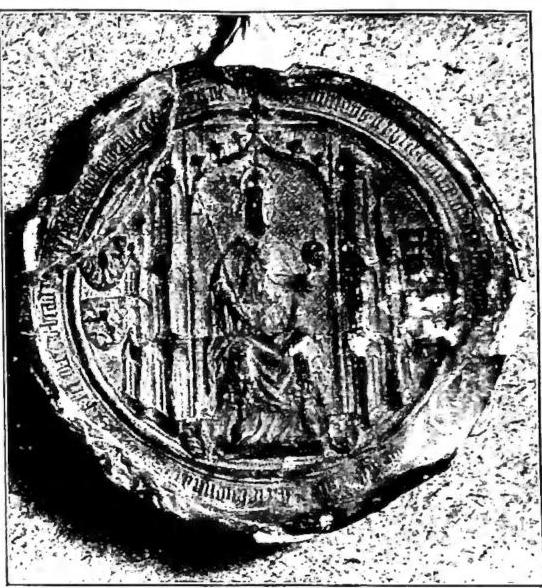
(from J. Boson, *Paléographie callixtine*, II, Aosta 1951, p. 16) Sigismund of Lisbon, Emperor — Large seal of S. attached to a privilege of the Emperor for the Canons of S. Orso (16 July 1418) — Aosta, archive of the collegiate church of SS. Peter and Orso.
(from J. Boson, *Paléographie callixtine*, II, Acta 1951, p. 10)